
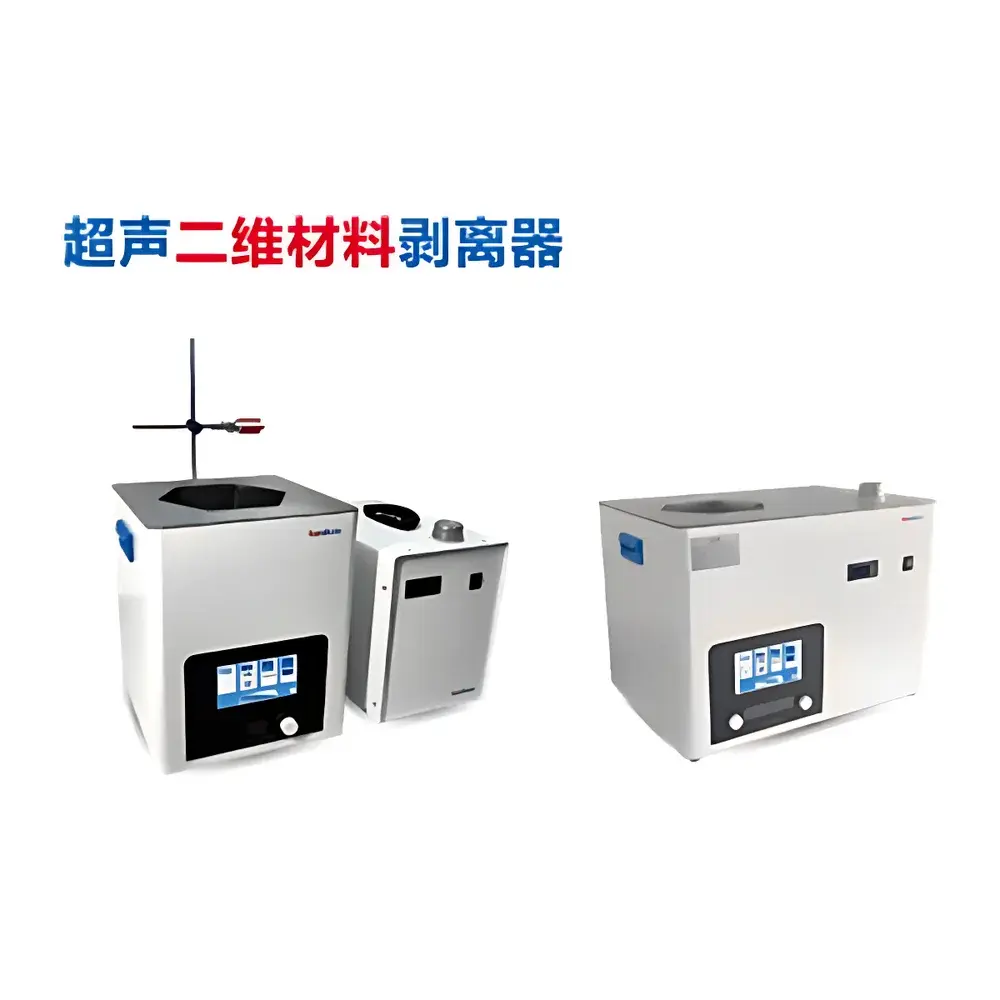
SHUMEI KBC-1200BL Ultrasonic 2D Material Exfoliator
| Brand | SHUMEI |
|---|---|
| Origin | Jiangsu, China |
| Manufacturer Type | Direct Manufacturer |
| Product Category | Domestic |
| Model | KBC-1200BL |
| Instrument Type | General-Purpose |
| Capacity | 10 L |
| Ultrasonic Frequency | 40 ± 1 kHz |
| Ultrasonic Power | 1200 W |
| Power Adjustment Range | 0–100% |
| Temperature Control Range | 0–80 °C |
| Timer Range | 1 min – 99 h 59 min |
| Stirring Type | Magnetic Stirring |
| Stirring Speed | 50–1500 rpm |
| Maximum Stirring Volume | 3000 mL |
| Cooling Power | 700 W |
| Dimensions (L×W×H) | 370 × 370 × 460 mm |
Overview
The SHUMEI KBC-1200BL Ultrasonic 2D Material Exfoliator is a purpose-engineered laboratory system designed for the controlled, non-destructive liquid-phase exfoliation of layered crystalline materials. Unlike conventional ultrasonic cleaners optimized for cleaning or degreasing, this instrument integrates high-fidelity ultrasonic energy delivery with synchronized magnetic stirring and precise thermal regulation to enable reproducible, lattice-preserving delamination of van der Waals–bonded 2D crystals—including graphene, MoS₂, WS₂, hexagonal boron nitride (h-BN), and bulk graphite. Its operational principle relies on acoustic cavitation in low-viscosity solvents (e.g., NMP, IPA, or water–surfactant mixtures): when 40 kHz ultrasonic waves propagate through the suspension, transient microbubbles nucleate and collapse asymmetrically near flake surfaces, generating localized microjets (~100–500 m/s) and shear gradients that overcome interlayer binding energy without inducing lattice defects or amorphization. The system’s modular architecture—featuring independent control of sonication intensity, thermal profile, agitation kinetics, and exposure duration—ensures process scalability from milligram-scale R&D batches to gram-level synthesis under consistent GLP-aligned conditions.
Key Features
- Integrated dual-action processing: Simultaneous high-power ultrasonication (1200 W, 40 ± 1 kHz) and variable-speed magnetic stirring (50–1500 rpm) ensure uniform energy distribution and prevent particle sedimentation or localized overheating.
- Precision thermal management: Peltier-assisted temperature control (0–80 °C, ±0.5 °C accuracy) maintains solvent stability during extended exfoliation cycles, critical for preserving crystal integrity in thermally sensitive systems such as phosphorene or black phosphorus derivatives.
- Full parameter programmability: Independent adjustment of ultrasonic power (0–100%), timer (1 min – 99 h 59 min), and temperature enables method development aligned with ISO/IEC 17025-compliant SOPs.
- Intuitive human-machine interface: 7-inch full-color TFT-LCD display with real-time graphical feedback of setpoints and actual values; onboard data logging supports audit-ready record retention.
- Robust safety architecture: Automatic shutdown triggered by overtemperature, overcurrent, or overpressure events; power-loss parameter memory retains user-defined protocols across restarts.
Sample Compatibility & Compliance
The KBC-1200BL demonstrates broad compatibility across layered transition metal dichalcogenides (TMDs), elemental 2D allotropes, and insulating van der Waals crystals. Validated substrates include MoS₂, WS₂, MoSe₂, WSe₂, Bi₂Se₃, graphite, and h-BN—each exhibiting minimal defect density (<1.5 × 10¹⁰ cm⁻² D-band intensity in Raman spectroscopy) and retained crystallinity (sharp XRD (002) peaks, FWHM < 0.2°) post-exfoliation. The system complies with IEC 61000-6-3 (EMC emission limits) and IEC 61000-6-2 (immunity standards). Its sealed tank design and grounded stainless-steel chamber meet IPX4 splash resistance requirements. While not certified for GMP manufacturing, its parameter traceability, calibration-lock capability, and electronic log export (CSV/USB) support FDA 21 CFR Part 11–aligned documentation practices in academic and industrial R&D environments.
Software & Data Management
The embedded microcontroller executes deterministic real-time scheduling of all process variables, eliminating timing drift across multi-hour runs. All operational parameters—including instantaneous power draw, bath temperature, elapsed time, and stir speed—are timestamped and stored internally (up to 1000 cycles). Data export via USB interface generates machine-readable CSV files compatible with LabArchives, ELN platforms, and statistical analysis tools (e.g., Python Pandas, JMP). Optional firmware updates maintain backward compatibility with historical protocol libraries. No cloud connectivity or remote access is implemented—ensuring full data sovereignty per institutional IT security policies.
Applications
- Routine preparation of monolayer-enriched dispersions for TEM grid deposition and AFM thickness mapping.
- Optimization of solvent–surfactant systems for scalable 2D ink formulation (e.g., conductive graphene inks for printed electronics).
- Controlled thickness grading via time-resolved exfoliation: sequential sampling at defined intervals (e.g., 15/30/60/120 min) enables correlation of sonication dose with lateral size distribution (DLS) and layer count (Raman 2D/G ratio).
- Comparative studies of interfacial stabilization mechanisms using zeta potential and dynamic light scattering under identical thermal–mechanical boundary conditions.
- Preparation of heterostructure precursors: sequential exfoliation of dissimilar 2D materials followed by controlled recombination in mixed suspensions.
FAQ
Can the KBC-1200BL be used for biological exfoliation (e.g., lipid bilayers or exosome isolation)?
No—this system is engineered exclusively for inorganic and carbon-based layered crystals. Its 40 kHz frequency and high-intensity cavitation field exceed safe thresholds for biomolecular integrity.
Is the ultrasonic transducer replaceable as a field-serviceable component?
Yes—the piezoceramic transducer array is mounted on a detachable stainless-steel plate with standardized M6 fasteners and IP67-rated connectors, enabling replacement without chamber disassembly.
Does the unit support external trigger input for synchronization with analytical instruments?
No—there is no TTL or analog trigger interface; however, the USB data stream includes precise epoch timestamps suitable for post-hoc alignment with Raman spectrometer acquisition logs.
What solvent volume range ensures optimal cavitation efficiency in the 10 L tank?
For consistent energy coupling, maintain liquid levels between 3 L and 8 L; volumes below 3 L risk transducer overheating, while >8 L attenuate near-field acoustic pressure amplitude.
How frequently should the stainless-steel tank be passivated to prevent metal ion leaching into dispersions?
Passivation with 10% nitric acid (ASTM A967 Method A) is recommended after every 200 operating hours or prior to first use with ultra-high-purity solvents (e.g., anhydrous NMP for optoelectronic-grade graphene).



