
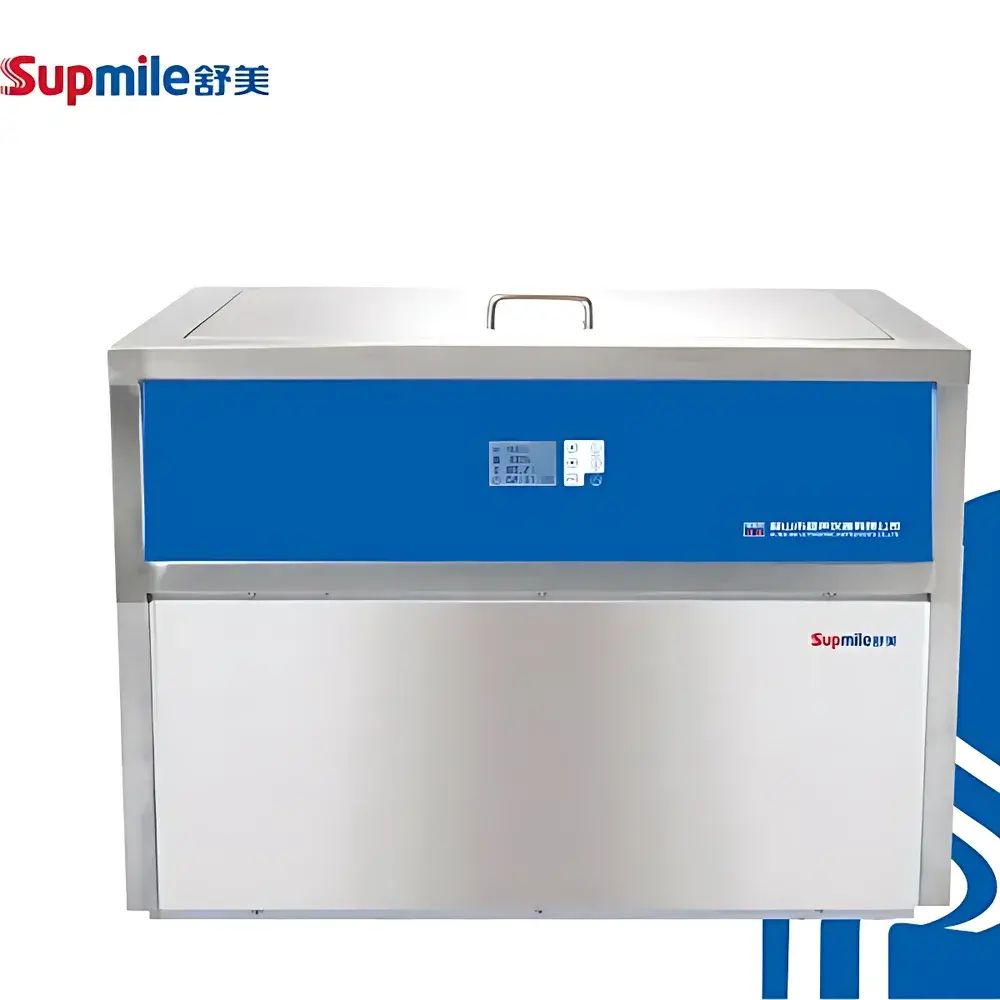
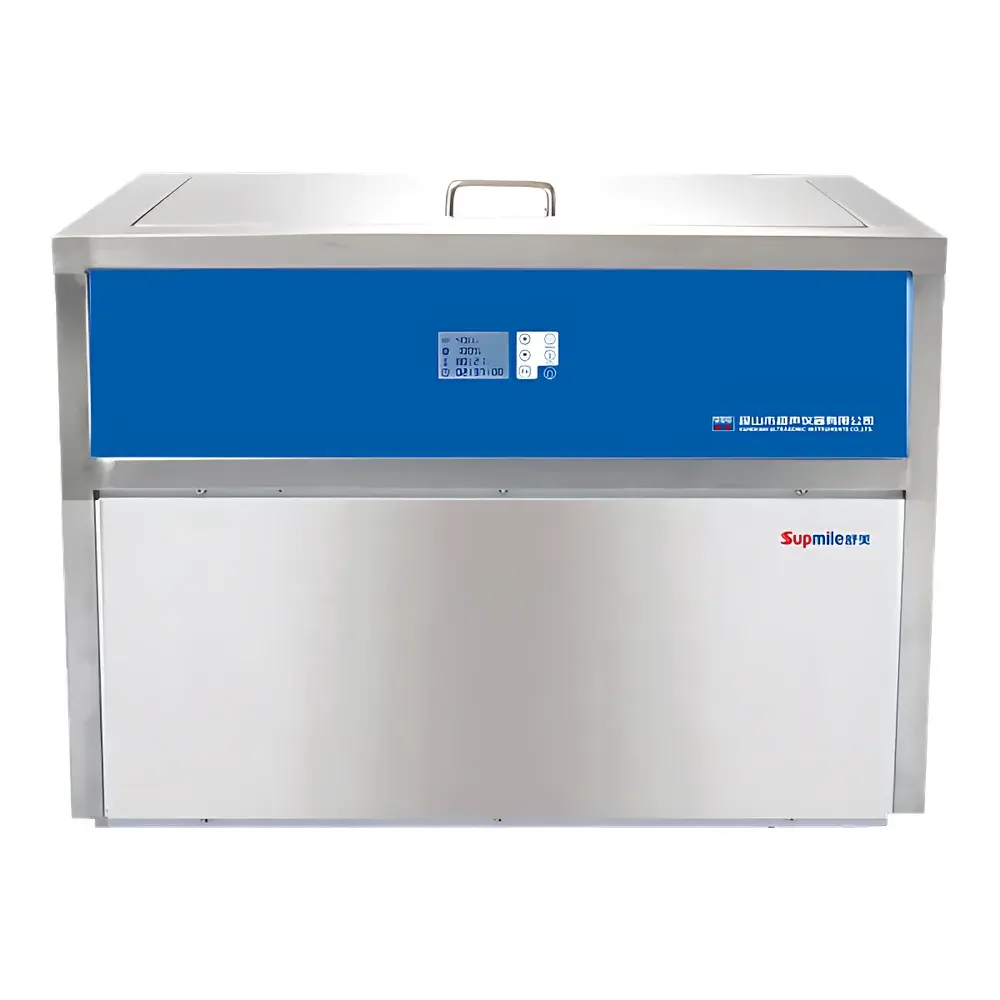
Shumei KQ-1000DM-T Quiet-Operation Ultrasonic Cleaner
| Brand | Shumei |
|---|---|
| Origin | Jiangsu, China |
| Manufacturer Type | Direct Manufacturer |
| Product Category | Domestic |
| Model | KQ-1000DM-T |
| Instrument Type | General-Purpose |
| Tank Capacity | 54 L |
| Ultrasonic Frequency | 40 kHz |
| Ultrasonic Power Output | 1000 W |
| Power Adjustment Range | 0–100% |
| Temperature Control Range | Ambient to 80 °C |
| Timer Range | 0–24 h |
| Sound-Dampening Lid | Yes |
| Drain/Inlet | Manual Control |
| Heating Power | 3000 W |
| Tank Dimensions (L×W×H) | 600 × 300 × 300 mm |
| External Dimensions (L×W×H) | 800 × 550 × 550 mm |
| Operating Noise Level | <60 dB(A) |
| Construction Material | 304 Stainless Steel (Tank & Housing) |
| Protection Features | Liquid-Level Sensor, Over-Temperature & Over-Current Protection |
| Power Supply | AC 220 V / 50 Hz |
Overview
The Shumei KQ-1000DM-T Quiet-Operation Ultrasonic Cleaner is a general-purpose laboratory cleaning system engineered for precision, reliability, and low-noise operation in demanding analytical, quality control, and research environments. It operates on the principle of ultrasonic cavitation—where high-frequency sound waves (40 kHz) generate microscopic vacuum bubbles in the cleaning solution that collapse with localized energy release, effectively dislodging particulate contaminants, organic residues, and biofilms from immersed surfaces. Designed for consistent performance across diverse sample geometries and material types, the unit features a robust 54 L stainless steel tank fabricated from seamless 304-grade stainless steel, ensuring corrosion resistance, structural integrity, and compliance with long-term GLP laboratory infrastructure requirements.
Key Features
- Ultra-low acoustic emission: Integrated sound-dampening lid and optimized transducer mounting reduce operational noise to <60 dB(A), enabling deployment in shared lab spaces without acoustic interference.
- Full-range ultrasonic power modulation: Continuous 0–100% digital power adjustment allows precise optimization of cavitation intensity for delicate components (e.g., optical lenses, microfluidic devices) or heavily soiled instrumentation (e.g., HPLC injector valves, filtration housings).
- Programmable thermal control: Independent heating system (3000 W) supports temperature regulation from ambient up to 80 °C, enhancing solubilization of waxy, lipidic, or polymer-based residues while maintaining thermal stability within ±1 °C accuracy.
- Extended timer functionality: 0–24 h programmable cycle duration accommodates both rapid pre-rinse protocols and extended soak-and-clean procedures for stubborn contamination layers.
- Comprehensive safety architecture: Built-in liquid-level sensor prevents dry-run damage; dual over-temperature and over-current protection circuits ensure stable operation under variable load conditions.
- Human-centric interface: Backlit LCD touchscreen panel enables intuitive parameter entry, real-time status monitoring, and repeatable method recall—critical for SOP-driven workflows.
Sample Compatibility & Compliance
The KQ-1000DM-T accommodates a broad range of laboratory hardware including glassware (volumetric flasks, burettes, cuvettes), metal components (syringe needles, surgical instruments), ceramic substrates, and polymeric parts (PTFE tubing, silicone gaskets). Its 600 × 300 × 300 mm internal tank volume supports batch cleaning of multiple items simultaneously without compromising ultrasonic field uniformity. The unit meets mechanical and electrical safety standards aligned with IEC 61010-1 for laboratory equipment. While not certified for medical device reprocessing per ISO 15883 or EN 285, its design adheres to foundational principles referenced in ASTM D2603 (ultrasonic cleaning validation) and supports documentation practices required for FDA 21 CFR Part 11–compliant environments when integrated with external audit-trail software.
Software & Data Management
This model operates via embedded firmware with no proprietary PC software dependency. All operating parameters—including time, temperature, and power level—are stored in non-volatile memory and retained after power cycling. For laboratories requiring traceability, the unit supports manual logbook recording or integration with third-party LIMS platforms via RS-232 serial output (optional adapter). Parameter changes are timestamped internally, and the system logs fault events (e.g., low fluid level, thermal cutoff) with descriptive error codes—facilitating root-cause analysis during QA audits.
Applications
- Pre-analytical sample preparation: Cleaning chromatography vials, autosampler trays, and electrode surfaces prior to electrochemical or spectroscopic analysis.
- Instrument maintenance: Decontamination of pipette tips, centrifuge rotors, and spectrophotometer cuvette holders to prevent cross-contamination.
- Materials science: Removal of sintering aids or binder residues from ceramic green bodies and powder metallurgy compacts.
- Electronics manufacturing support: Degreasing of PCB stencils, solder paste dispensing nozzles, and MEMS component carriers.
- Pharmaceutical QC labs: Routine cleaning of dissolution apparatus baskets, sinkers, and filter assemblies in accordance with USP and guidelines.
FAQ
Is the KQ-1000DM-T suitable for cleaning delicate optical components?
Yes—the 0–100% ultrasonic power control and low-noise transducer configuration allow safe operation at reduced intensities for lenses, prisms, and coated mirrors when used with low-surface-tension, non-etching aqueous solutions.
Does it support automatic fill/drain functions?
No—fluid inlet and outlet are manually controlled via standard threaded fittings; automated plumbing requires external pump and valve integration.
Can the unit be validated for GMP environments?
While the hardware provides stable, repeatable performance, formal IQ/OQ/PQ validation must be conducted by the end user using documented protocols aligned with ISO/IEC 17025 or Annex 15 requirements.
What cleaning solutions are recommended?
Neutral pH aqueous detergents compliant with ASTM D4169 are preferred; avoid halogenated solvents or strong acids unless verified compatible with 304 stainless steel and the transducer bonding layer.
Is remote monitoring or Ethernet connectivity available?
Not natively—communication is limited to local LCD interface and optional RS-232 output; networked control requires external industrial gateway integration.



