
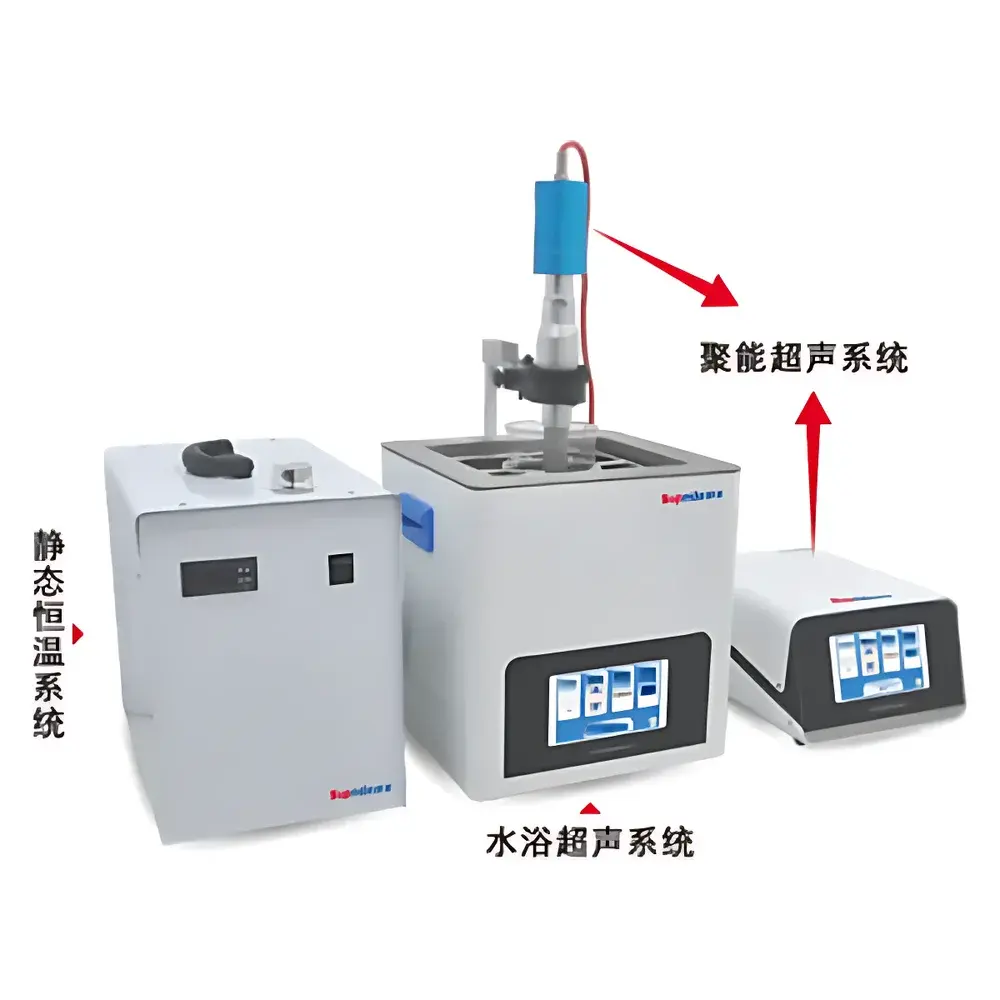
SHUMEI KBC-300G Tri-Mode Ultrasonic Processing System (Static Temperature Control + Water-Bath Ultrasonication + Probe-Type Sonication)
| Brand | SHUMEI |
|---|---|
| Origin | Jiangsu, China |
| Manufacturer Type | Direct Manufacturer |
| Product Category | Domestic |
| Model | KBC-300G |
| Instrument Type | General-Purpose |
| Tank Capacity | 10 L |
| Ultrasonic Frequency | 20 ± 1 kHz |
| Ultrasonic Power Output | 300 W |
| Power Adjustment Range | 0–100% |
| Timer Range | 1 min – 99 h 59 min |
Overview
The SHUMEI KBC-300G Tri-Mode Ultrasonic Processing System is an integrated laboratory platform engineered for precision-controlled sample processing under thermally stable conditions. It combines three complementary ultrasonic modalities—static temperature-regulated water-bath sonication, immersion probe-based high-intensity sonication, and independent thermal management—within a single robust architecture. Unlike conventional ultrasonic cleaners that rely solely on tank-based cavitation, this system employs a dual-path transduction strategy: low-frequency (20 ± 1 kHz) water-bath energy delivery ensures uniform macro-scale dispersion and gentle cleaning, while the optional detachable probe sonicator (KBC-800F, supplied with KBC-300ZH configuration) delivers focused, high-energy acoustic output directly into viscous or heterogeneous samples. The static temperature control module utilizes a closed-loop circulating chiller-heater (600 W cooling / 3000 W heating capacity) to maintain bath temperatures from −60 °C to +100 °C with ±0.3 °C stability—critical for temperature-sensitive applications such as chromatin immunoprecipitation (ChIP), enzymatic reactions, or nanoparticle synthesis where thermal drift induces aggregation or denaturation.
Key Features
- 7-inch TFT capacitive touchscreen interface with real-time display of temperature, power level, elapsed time, and fault diagnostics (over-temperature, over-voltage, over-current)
- Stainless steel powder-coated housing with corrosion-resistant interior tank; IP54-rated electrical enclosure for lab-grade durability
- Independent operational modes: water-bath sonication only, probe sonication only, or synchronized dual-mode operation
- Adjustable ultrasonic power (0–100%) and programmable timer (1 min – 99 h 59 min) with memory retention across power cycles
- Modular design supports field-upgradable configurations—including optional multi-frequency water-bath modules (dual/triple frequency) and interchangeable titanium alloy probes (Φ10 mm standard)
- High electroacoustic conversion efficiency (>82%) achieved via upgraded piezoelectric transducer matching and low-loss impedance circuitry
Sample Compatibility & Compliance
The KBC-300G accommodates diverse sample formats including glass vials (1.5–50 mL), centrifuge tubes, Petri dishes, and custom reaction vessels up to 10 L volume. Its static temperature control eliminates convective currents that disrupt cavitation uniformity—enabling reproducible particle deagglomeration in nanomaterial dispersions (e.g., graphene oxide, metal-organic frameworks) and consistent cell lysis yields in mammalian tissue homogenization. The system complies with IEC 61000-6-3 (EMC emission standards) and meets mechanical safety requirements per ISO 13857. For regulated environments, audit-ready operation logs (timestamped temperature/power/time records) support GLP/GMP documentation workflows. While not FDA 21 CFR Part 11–certified out-of-the-box, the system’s deterministic control architecture permits integration with validated LIMS or ELN platforms via RS-232/USB interfaces.
Software & Data Management
Operation is managed through embedded firmware with no external PC dependency. All parameters—including setpoint temperature, ultrasonic duty cycle, ramp profiles, and alarm thresholds—are stored in non-volatile memory. The system generates timestamped event logs (power-on, mode switch, fault trigger, timer completion) accessible via USB export in CSV format. Optional LabVIEW-compatible drivers enable remote scripting for automated batch processing sequences. Data integrity safeguards include write-protected configuration storage and automatic calibration offset logging for transducer aging compensation.
Applications
- Cleaning & Decontamination: Residue removal from microfluidic chips, HPLC columns, and surgical instruments per ASTM F2571
- Extraction & Homogenization: Accelerated solvent extraction of soil-bound organic pollutants (EPA Method 3545A), herbal active compound isolation (USP <2021>), and nuclear extract preparation for ChIP-seq
- Nanomaterial Processing: Exfoliation of 2D materials, stabilization of colloidal suspensions, and sonochemical synthesis of metal nanoparticles
- Life Science Sample Prep: Controlled cytoplasmic membrane disruption without nuclear damage; optimized for RNA integrity preservation (RIN > 8.5)
- Chemical Synthesis: Enhancement of heterogeneous catalysis, emulsification of immiscible phases, and acceleration of Suzuki coupling reactions
FAQ
Can the water-bath and probe sonication modules operate simultaneously?
Yes—the system supports concurrent operation with independent parameter control for each module, enabling hybrid processing strategies such as pre-dispersion in the bath followed by targeted fragmentation via probe.
What is the maximum continuous operating time for the probe sonicator?
The KBC-800F probe generator supports uninterrupted operation up to 99 hours 59 minutes, with pulse-mode capability (1 s–59 min 59 s on/off intervals) to manage thermal load in heat-sensitive samples.
Is the temperature control module compatible with external cooling fluids?
Yes—the static circulation system accepts standard laboratory coolants (e.g., ethylene glycol/water mixtures) or municipal chilled water, with inlet/outlet NPT 1/4″ ports.
Does the system meet CE or UL safety certification requirements?
The KBC-300G carries CE marking per Directive 2014/30/EU (EMC) and 2014/35/EU (LVD); UL listing is available upon request for North American deployment.
How is calibration traceability maintained for temperature and power outputs?
Factory calibration uses NIST-traceable RTD sensors and calibrated power analyzers; users may perform field verification using external Class A PT100 probes and ISO/IEC 17025-accredited reference meters.



