
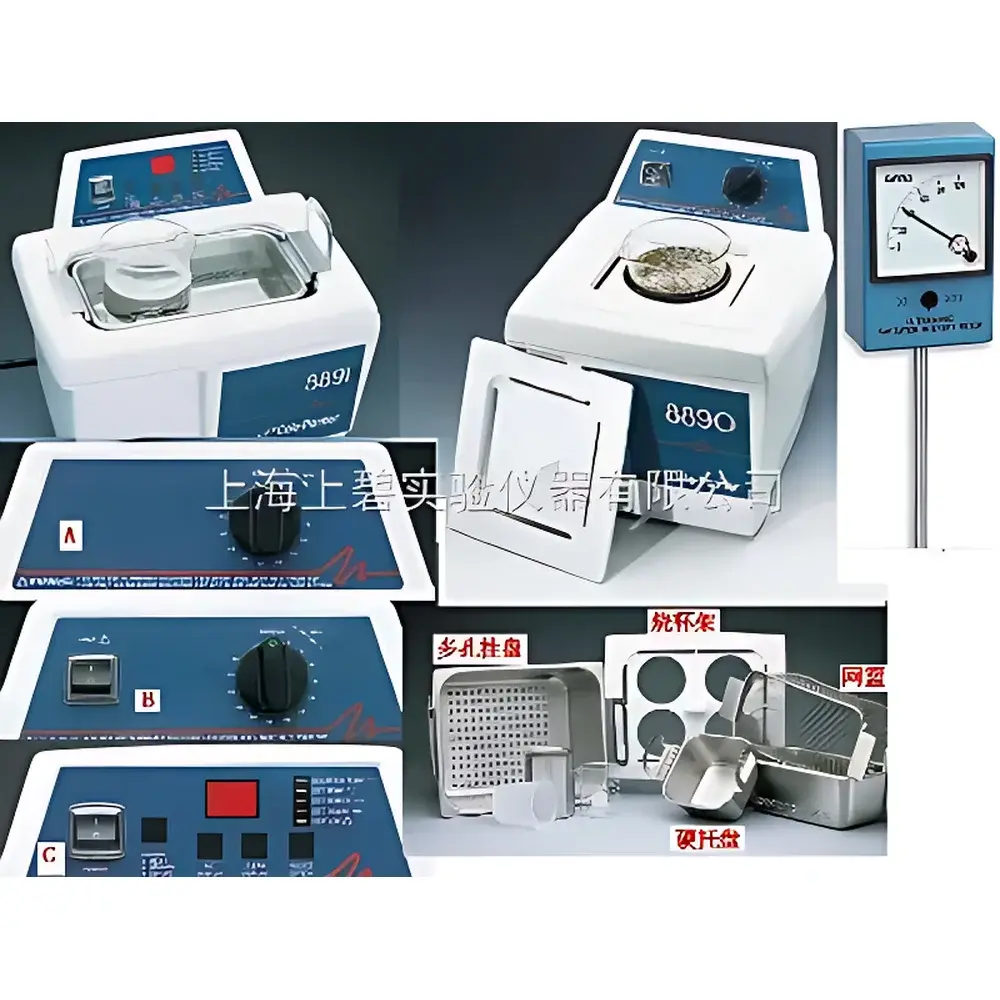
Cole-Parmer Ultrasonic Cleaner Series 8890–8894 (Model 08894-60 with Cavitation Intensity Meter)
| Origin | USA |
|---|---|
| Manufacturer Type | Authorized Distributor |
| Origin Category | Imported |
| Model | 08894-60 |
| Pricing | Upon Request |
| Frequency | 42 kHz |
| Power Supply | 230 V, 50/60 Hz |
| Current Draw | 0.4 A to 4 A (model-dependent) |
| Tank Capacities | 2 L to 21 L |
| Timer Options | Mechanical (60 min), Digital (up to 99 min) |
| Temperature Control | Up to 69 °C (B/C models) |
| Deaeration Function | Available (C models) |
| Certifications | UL, CSA, CE |
| Cavity Material | Stainless Steel (304) |
| Lid Material | Stainless Steel (8894 series) |
| Cavitation Intensity Range | 0–1000 Cavins (water), 0–100 Cavins (solvents) |
| Probe Temp. Range | −240 to 537 °C |
| Meter Operating Temp. | −40 to 65 °C |
| Included Accessories | Stainless steel basket, perforated rack, beaker holder, polypropylene lid (except 8894), non-slip feet, integrated handle |
Overview
The Cole-Parmer Ultrasonic Cleaner Series 8890–8894 is a family of benchtop and floor-standing ultrasonic cleaning systems engineered for precision laboratory, quality control, and manufacturing environments where consistent, non-abrasive removal of particulate, organic, and ionic contaminants from delicate instruments and components is required. These units operate on the principle of acoustic cavitation: piezoelectric transducers convert high-frequency electrical energy (42 kHz) into mechanical vibrations transmitted through the cleaning solution. This generates transient microbubbles that grow and collapse violently—releasing localized energy in the form of shockwaves and microjets. This physical phenomenon enables thorough cleaning at microscopic interfaces without mechanical scrubbing or thermal degradation, making it ideal for glassware, surgical tools, optical components, electronic assemblies, and analytical sample preparation vessels.
Key Features
- Stainless steel (304) tank construction ensures long-term corrosion resistance and compatibility with aqueous and mild solvent-based cleaning chemistries—including Micro-90® (dilutable up to 1:100).
- Three operational configurations: Type A (mechanical timer only), Type B (mechanical timer + thermostatically controlled heating up to 69 °C with overtemperature cutoff at 70 °C), and Type C (digital timer up to 99 minutes + temperature control + deaeration mode to remove dissolved gases prior to cleaning, enhancing cavitation efficiency).
- Scanning frequency technology minimizes standing wave formation, ensuring uniform energy distribution across the entire tank volume—critical for reproducible cleaning performance regardless of load geometry or position.
- Dual O-ring sealing system with vented groove design and sealed membrane keypad provides IPX4-level protection against splashes and condensation ingress, supporting safe operation in humid or wet-lab environments.
- Modular accessory ecosystem includes stainless steel baskets, multi-hole beaker racks (1–6 positions), perforated hanging trays, and chemical-resistant polypropylene lids (stainless steel lids standard on 8894-series units).
- Compliance-ready architecture: All models meet UL 61010-1, CSA C22.2 No. 61010-1, and CE marking requirements under the EU Machinery Directive and Electromagnetic Compatibility (EMC) Directive.
Sample Compatibility & Compliance
The 8890–8894 series accommodates a broad range of sample geometries—from single vials and pipette tips to large-volume flasks and multi-well plates—via configurable accessories and scalable tank volumes (2 L to 21 L). The stainless steel cavity supports autoclave-compatible cleaning protocols and repeated exposure to alkaline detergents, enzymatic solutions, and low-volatility solvents. For regulated environments (e.g., pharmaceutical QC labs, medical device reprocessing facilities), the system’s stable thermal control, repeatable timing, and absence of user-adjustable parameters during active cycles align with GLP/GMP documentation expectations. While the base unit does not include 21 CFR Part 11-compliant audit trails, its deterministic behavior—combined with optional validation kits and third-party calibration services—enables qualification per ASTM D2603 (Standard Test Method for Sonic Shear Stability of Lubricating Oils) and ISO 13485 Annex A.3.2 (cleaning process verification).
Software & Data Management
These are standalone analog/digital hardware systems with no embedded firmware or network connectivity. Timing and temperature setpoints are adjusted manually via front-panel dials or push-button interfaces. Type C models feature a digital display with real-time temperature readout and elapsed time countdown. For traceability, users are advised to document operating parameters (time, temperature, solution composition, load configuration) in lab notebooks or LIMS-integrated SOPs. Optional ancillary instrumentation—including the Cole-Parmer Cavitation Intensity Meter (Model 08894-60)—provides quantitative verification of acoustic output. Its calibrated stainless steel probe measures cavitation intensity in Cavins units across defined thermal ranges, enabling periodic performance verification and cross-unit harmonization—particularly valuable during equipment qualification or after maintenance interventions.
Applications
- Pre-analytical sample preparation: Removal of residual proteins, lipids, or salts from HPLC vials, autosampler needles, and ICP-MS nebulizers.
- Medical device reprocessing: Cleaning of endoscopes, biopsy forceps, and laparoscopic instruments prior to sterilization (validated per AAMI ST91).
- Electronics manufacturing: Degreasing of PCBs, solder paste residue removal, and flux cleaning before conformal coating.
- Materials science: Surface activation of polymers and metals prior to adhesion testing or coating deposition.
- Academic research: Cleaning of quartz cuvettes, NMR tubes, and TEM grids without surface etching or micro-scratching.
- Regulatory compliance support: Routine verification of cleaning efficacy using standardized test soils (e.g., bovine serum albumin films) per USP and ISO 15883-1.
FAQ
What is the difference between Type A, B, and C models?
Type A offers mechanical timing only; Type B adds thermostatic heating (max 69 °C) with safety cutoff; Type C upgrades to digital timing (0–99 min), precise temperature control, and programmable deaeration to optimize cavitation onset.
Is the 08894-60 Cavitation Intensity Meter compatible with all tank sizes in this series?
Yes—the 40.6 cm stainless steel probe is designed for immersion in tanks ranging from 2 L to 21 L, with depth-adjustable positioning to assess spatial uniformity across the cleaning field.
Can these units be used with flammable solvents?
No. These cleaners are rated for aqueous and low-flashpoint solutions only. Use with flammable solvents requires explosion-proof certified equipment meeting NEC Class I, Division 1 standards—not provided in this series.
What maintenance is required to sustain optimal cavitation performance?
Regular tank cleaning to prevent scale buildup, quarterly inspection of transducer mounting integrity, and annual verification of frequency stability and power delivery using a calibrated intensity meter are recommended per Cole-Parmer Technical Bulletin TB-ULS-002.
Are replacement parts and service support available globally?
Yes—Cole-Parmer maintains an international spare parts inventory and authorizes service centers in North America, EMEA, and APAC regions. Transducer modules, timers, heaters, and O-rings are stocked under part numbers beginning with 0885x and 0889x.



