
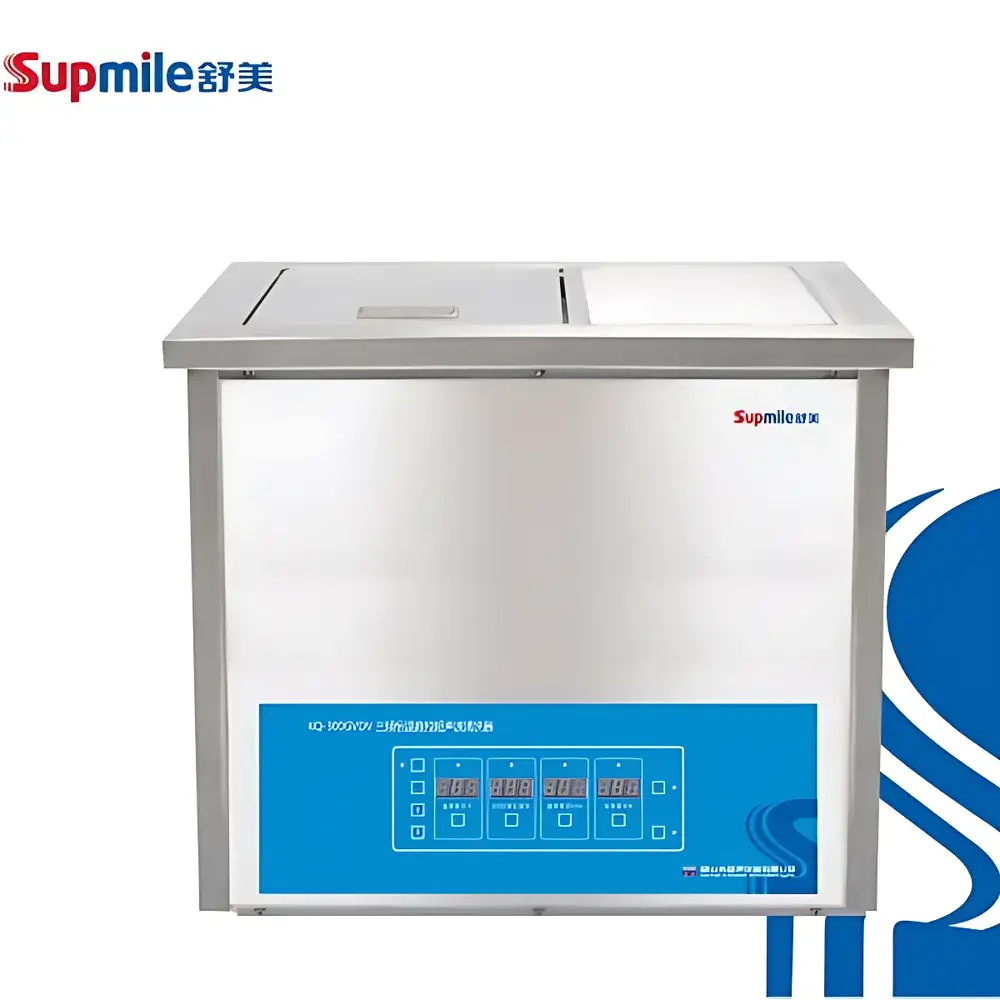
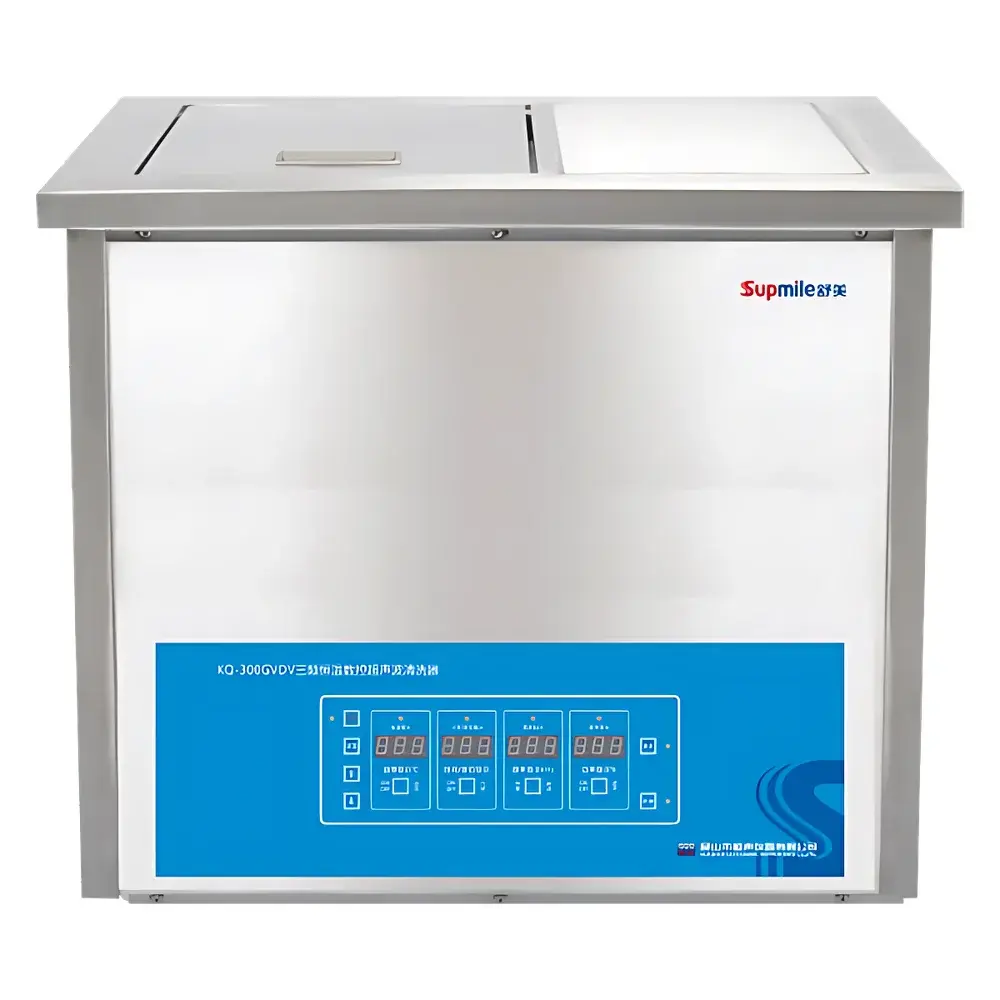
Shumei KQ-300GVDV Benchtop Tri-Frequency Programmable Temperature-Controlled Ultrasonic Cleaner
| Brand | Shumei |
|---|---|
| Origin | Jiangsu, China |
| Manufacturer Type | Direct Manufacturer |
| Instrument Type | General-Purpose Ultrasonic Cleaner |
| Capacity | 13 L |
| Ultrasonic Frequencies | 45 / 80 / 100 kHz |
| Ultrasonic Power Output | 300 W (Adjustable 40–100%) |
| Heating Power | 400 W |
| Cooling Power | 350 W |
| Temperature Range | 0–80 °C (±2 °C accuracy) |
| Timer Range | 1–480 min |
| Sound-Dampening Lid | Yes |
| Electronic Inlet/Drain Control | Yes |
| Dimensions (W×D×H) | 640 × 490 × 540 mm |
| Tank Internal Dimensions (W×D×H) | 300 × 240 × 180 mm |
| Power Supply | AC 220 V / 50 Hz |
Overview
The Shumei KQ-300GVDV is a benchtop tri-frequency programmable ultrasonic cleaner engineered for precision cleaning of delicate laboratory components, optical elements, microfluidic devices, and analytical instrumentation parts. It operates on the principle of cavitation—where high-frequency acoustic energy induces controlled formation and collapse of microscopic bubbles in liquid media—generating localized shear forces that dislodge particulate contaminants, organic residues, and loosely adhered biofilms without mechanical abrasion. Unlike single-frequency units, its three discrete operating frequencies (45 kHz, 80 kHz, and 100 kHz) enable optimization across diverse sample geometries and soil types: lower frequencies deliver higher cavitation intensity suited for robust metal parts and heavy particulates; mid-range frequencies balance penetration and gentleness for glassware and ceramic substrates; while the 100 kHz mode provides fine-resolution cleaning ideal for MEMS devices, semiconductor wafers, and coated optics where surface integrity is critical. Integrated temperature control (0–80 °C) enhances solvent efficacy—particularly with aqueous alkaline or enzymatic solutions—while maintaining thermal stability within ±2 °C. The unit complies with IEC 61000-6-3 (EMC emissions) and IEC 61000-6-2 (immunity), and its stainless-steel 304 tank construction meets ISO 8573-1 Class 4 requirements for cleanliness-critical environments.
Key Features
- Tri-frequency ultrasonic generation (45 / 80 / 100 kHz) with user-selectable frequency switching and dwell time per frequency (0–999 s)
- Digital microprocessor control with real-time display of bath temperature (setpoint & actual), ultrasonic power level (40–100%), elapsed time, and remaining cycle duration
- Precise thermostatic regulation via integrated heating (400 W) and active cooling (350 W) systems, enabling stable temperature maintenance during extended cycles
- Full electronic inlet and drain control with low-level protection and automatic shut-off to prevent dry-run operation
- Sound-dampening insulated lid with ergonomic latch mechanism, reducing ambient noise to ≤55 dB(A) at 1 m distance
- Comprehensive safety monitoring: over-temperature, over-voltage, over-current, low-water-level, and no-solution detection with visual alarm indicators
- Stainless steel 304 tank (300 × 240 × 180 mm internal), corrosion-resistant transducer mounting, and sealed electronics housing for long-term reliability in humid lab environments
Sample Compatibility & Compliance
The KQ-300GVDV accommodates a broad range of sample formats including beakers, crucibles, pipette tips, HPLC columns, filtration membranes, watch components, dental instruments, and PCB assemblies—provided they fit within the 13 L tank volume. Its frequency versatility ensures compatibility with both high-mass metallic samples and fragile microstructures. All wetted surfaces are electropolished 304 stainless steel, compliant with USP for extractables profiling and suitable for cleaning under GLP/GMP conditions when validated. The unit supports documentation of cleaning parameters (time, temp, frequency, power) required for audit trails per FDA 21 CFR Part 11 when paired with external data logging software. It meets CE marking requirements for laboratory equipment (2014/30/EU EMC Directive and 2014/35/EU LVD Directive).
Software & Data Management
While the KQ-300GVDV operates via embedded firmware without external PC connectivity, its digital interface supports full parameter recall and repeat-cycle programming. Up to 10 user-defined cleaning protocols can be stored—including frequency sequence, power ramping profile, temperature ramp/soak steps, and timer logic—with non-volatile memory retention. Real-time operational data (actual temperature, instantaneous power draw, elapsed time) is continuously displayed and logged internally for the last 50 cycles. For integration into quality management systems, optional RS-232 or USB-to-serial adapters (sold separately) allow export of timestamped cycle logs compatible with CSV-based LIMS or ELN platforms. Audit-trail functionality satisfies basic traceability needs under ISO/IEC 17025 Clause 7.7 and ASTM E2500-13 guidelines for equipment qualification.
Applications
- Pre-analytical sample preparation: removal of residual solvents, salts, or proteins from vials, autosampler needles, and LC-MS interfaces
- Microelectronics: particle-free cleaning of photomasks, wafer carriers, and probe station fixtures prior to metrology
- Pharmaceutical manufacturing: cleaning of tablet punches, capsule fillers, and stainless-steel contact parts per USP cleaning validation guidance
- Materials science: debubbling of nanoparticle suspensions and dispersion homogenization prior to DLS or TEM analysis
- Medical device reprocessing: adjunctive cleaning of endoscopic accessories and surgical instrument sets prior to sterilization (used off-label per local regulatory approval)
- Academic research: standardized cleaning of AFM cantilevers, quartz crystal microbalances, and microfluidic chips requiring sub-micron contamination control
FAQ
Can the KQ-300GVDV operate continuously for extended periods?
Yes—the unit supports uninterrupted operation up to 480 minutes per cycle and includes thermal overload protection for both transducers and heating elements.
Is the 100 kHz mode suitable for cleaning silicon wafers?
Yes, provided deionized water or low-surface-tension solvents are used; the high-frequency mode minimizes pitting risk while achieving effective removal of sub-100 nm particles.
Does the unit support calibration verification?
It features built-in temperature sensor calibration offset adjustment and ultrasonic power linearity verification via supplied test load protocol (per ASTM D2245-19 Annex A1).
What maintenance is required for long-term reliability?
Monthly inspection of tank seal integrity, quarterly descaling of heating elements using 5% citric acid solution, and annual transducer impedance check using a dedicated LCR meter.
Can multiple frequencies be run sequentially in one cycle?
Yes—users may define a multi-stage program where each frequency operates for a specified duration before automatically transitioning to the next, with independent power and temperature settings per stage.



