
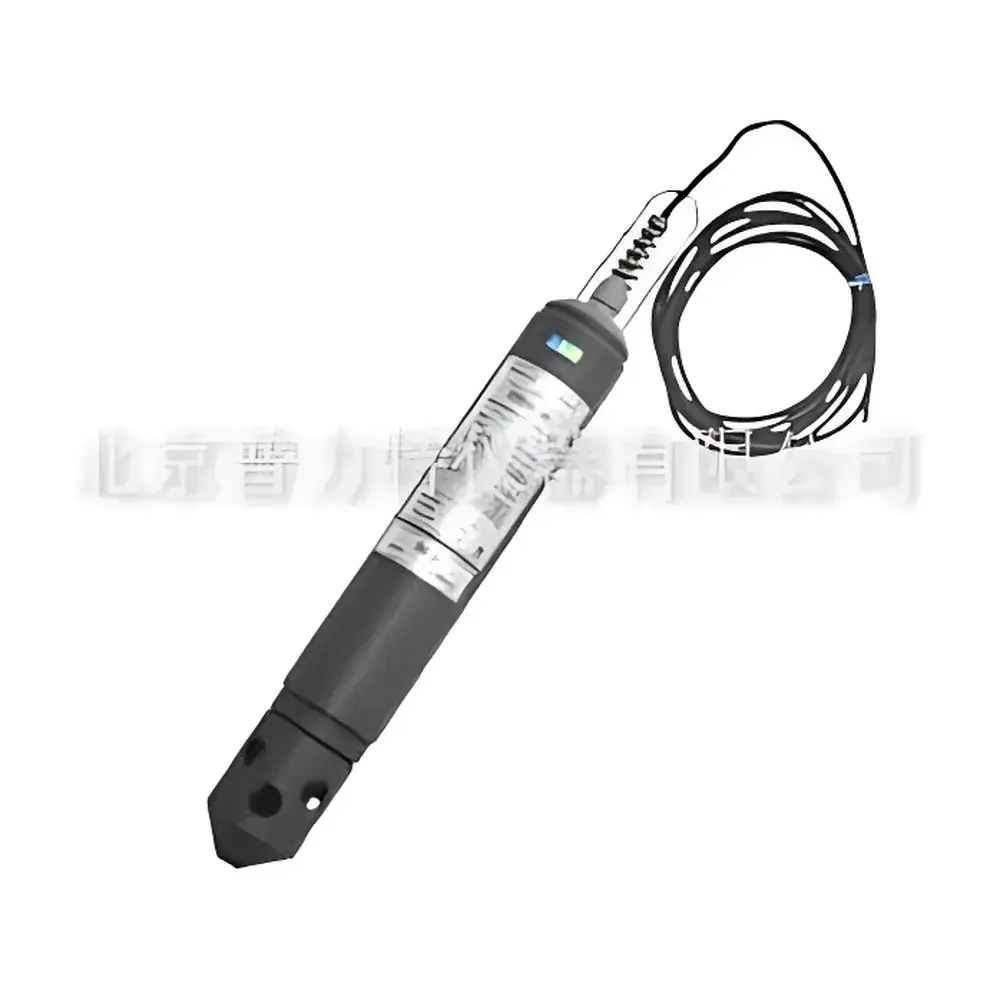
WMP6 Multi-Parameter Water Quality Sensor
| Origin | Italy |
|---|---|
| Manufacturer Type | Authorized Distributor |
| Origin Category | Imported |
| Model | WMP6 |
| Price Range | USD 7,000–14,000 (FOB) |
| Instrument Type | Online Water Quality Analyzer |
| Measured Parameters | pH, Water Depth (Level), Temperature, Conductivity, Oxidation-Reduction Potential (ORP), Dissolved Oxygen (DO), Turbidity or Selectable Ion (e.g., NH₄⁺, NO₃⁻, Cl⁻, F⁻, K⁺, Na⁺, Ca²⁺, etc.) |
Overview
The WMP6 Multi-Parameter Water Quality Sensor is an integrated, submersible online monitoring instrument engineered for continuous, real-time assessment of critical physicochemical parameters in diverse aquatic environments. Designed and manufactured in Italy, the sensor employs proven electrochemical, optical, and pressure-based transduction principles to deliver high reproducibility and long-term stability under field conditions. Its core measurement suite—pH, water depth (hydrostatic level), temperature, electrical conductivity, oxidation-reduction potential (ORP), and dissolved oxygen (DO)—is co-located within a single robust probe, minimizing spatial variability and enabling synchronized data acquisition. The modular architecture supports optional expansion with either a turbidity sensor (nephelometric detection at 860 nm) or a single-ion-selective electrode (ISE), selected from a validated library of over 20 ion-specific configurations. This design meets the operational requirements of environmental monitoring networks, drinking water utilities, aquaculture facilities, industrial effluent control systems, and research-grade limnological and marine observatories.
Key Features
- Integrated six-parameter baseline configuration: pH, water depth (0–20 m standard; up to 50 m optional), temperature (−5 to +60 °C), conductivity (0–6,000 µS/cm standard; up to 60,000 µS/cm optional), ORP (±1100 mV), and DO (0–20 mg/L or 0–200% saturation).
- Modular expansion capability: Select one additional parameter—either turbidity (0–4000 NTU, resolution 0.5 NTU) or a single ion-specific electrode (e.g., NH₄⁺, NO₃⁻, Cl⁻, F⁻, K⁺, Ca²⁺, Na⁺) calibrated per ISE Nernstian response standards.
- Dual digital interface: RS485 (Modbus RTU protocol) and USB 2.0, enabling direct integration with SCADA systems, PLCs, data loggers, or PC-based acquisition software without external signal conditioning.
- Industrial-grade mechanical construction: PVC housing (IP68 rated), 512 mm × 70 mm cylindrical form factor, 30 m submersible cable with barometric compensation and IP68 waterproof connector.
- Low-power operation: 10.8–16 V DC input, typical current draw ≤30 mA—compatible with solar-powered remote stations and battery-backed telemetry nodes.
- CE-marked and compliant with EN 61326-1 (EMC for laboratory and industrial use) and EN 61000-6-2/6-3 (immunity and emission requirements for environmental monitoring applications).
Sample Compatibility & Compliance
The WMP6 is validated for use in freshwater, brackish water, seawater (up to 45 ppt salinity), and treated industrial process streams. Its pH and ORP electrodes utilize double-junction reference systems with polymer gel electrolyte to resist sulfide poisoning and chloride interference; the DO sensor employs Clark-type polarographic technology with Teflon membrane diffusion control for stable performance in high-turbidity or biofouling-prone waters. Conductivity measurements are temperature-compensated using built-in Pt1000 thermistor input. All sensors meet ISO 5814:2012 (DO), ISO 7888:2012 (conductivity), ISO 10523:2012 (pH), and ASTM D1293 (pH and conductivity of water) method equivalency. Calibration traceability follows ISO/IEC 17025 guidelines when performed using NIST-traceable standard solutions. The device supports GLP-compliant audit trails when paired with TMF-series data loggers featuring 21 CFR Part 11–compliant firmware (electronic signatures, user access control, and immutable data logging).
Software & Data Management
Data acquisition and configuration are managed via Windows-compatible desktop software (WMP Control Suite v3.x), supporting automated calibration scheduling, multi-point linear/nonlinear calibration curves, sensor diagnostics (impedance check, membrane integrity alert), and export to CSV, Excel, or SQL database formats. When interfaced with the optional TMF-3000 series intelligent data logger, the WMP6 enables secure wireless transmission via GPRS/UMTS, satellite modem (Iridium), or Ethernet/Wi-Fi—supporting MQTT, HTTP POST, and FTP protocols. Firmware updates are delivered over-the-air (OTA), and all communication channels support TLS 1.2 encryption. Raw sensor outputs are timestamped with microsecond precision and include embedded metadata (sensor ID, firmware version, calibration date, ambient pressure compensation status).
Applications
- Real-time compliance monitoring for municipal wastewater discharge (EPA NPDES permit parameters)
- Early-warning systems in reservoirs and drinking water distribution networks (turbidity spikes, ORP anomalies, DO depletion)
- Marine ecological observatories tracking hypoxia events, acidification trends, and nutrient loading (NH₄⁺/NO₃⁻)
- Recirculating aquaculture systems (RAS) where simultaneous DO, pH, and NH₄⁺ monitoring is essential for biofilter health
- Industrial cooling tower management (conductivity for blowdown control, ORP for biocide dosing verification)
- Long-term groundwater quality assessment in contaminated sites (Cl⁻, NO₃⁻, F⁻, heavy metal ions)
FAQ
What is the recommended calibration frequency?
Calibration is typically required every 6–12 months depending on deployment environment; field validation against certified reference standards is advised quarterly.
Can the WMP6 operate continuously at 30 bar pressure?
Yes—the high-pressure variant (optional) is rated to 30 bar (≈300 m water column), suitable for deep-well or pressurized pipeline monitoring.
Is ion selection limited to one per unit, or can multiple ions be measured simultaneously?
Only one ion-selective electrode can be installed per WMP6 unit; concurrent multi-ion analysis requires parallel sensor arrays or sequential multiplexed configurations.
Does the turbidity module comply with ISO 7027?
Yes—the 860 nm LED light source and 90° scattered-light detection geometry conform to ISO 7027:2016 for formazin-equivalent NTU reporting.
How is barometric pressure compensation handled for water depth readings?
The included vented cable assembly provides real-time atmospheric pressure reference; absolute depth = differential pressure reading − compensated barometric pressure.







