
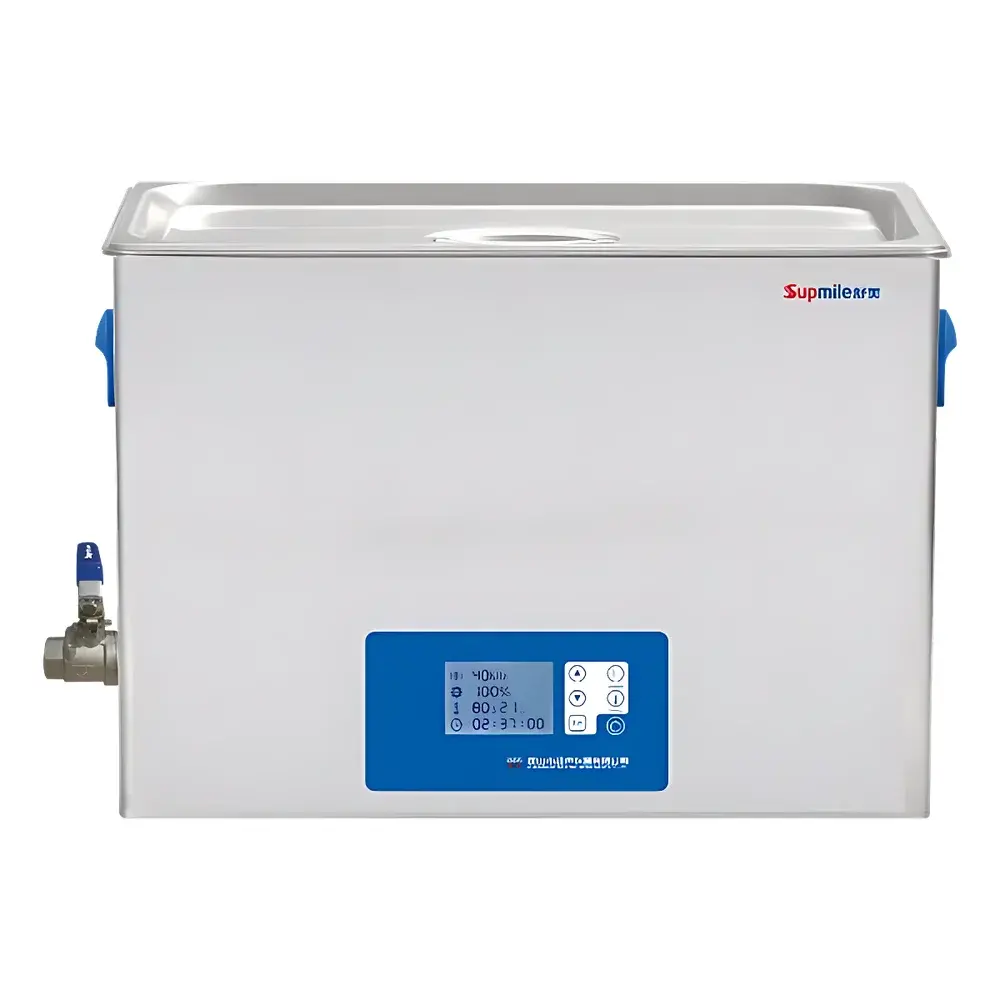
Shumei KQ-500VSM Dual-Frequency Low-Noise Ultrasonic Cleaner
| Brand | Shumei |
|---|---|
| Origin | Jiangsu, China |
| Manufacturer Type | Direct Manufacturer |
| Product Category | Domestic |
| Model | KQ-500VSM |
| Instrument Type | Specialized |
| Tank Capacity | 22.5 L |
| Ultrasonic Frequencies | 35 kHz / 50 kHz |
| Ultrasonic Power Output | 500 W |
| Power Adjustment Range | 0–100% in 1% increments |
| Heating Power | 800 W |
| Temperature Control Range | Ambient to 80 °C |
| Timer Range | 0–24 h |
| Sound-Dampening Lid | Yes |
| Drain/Inlet | Manual |
| Dimensions (W×D×H) | 531 × 326 × 375 mm |
| Inner Tank Dimensions (L×W×H) | 500 × 300 × 150 mm |
| Noise Level | <65 dB(A) |
| Construction Material | 304 Stainless Steel (tank and chassis) |
| Display | LCD Touchscreen Interface |
| Safety Protections | Overtemperature and overcurrent protection |
| Power Supply | AC 220 V / 50 Hz |
Overview
The Shumei KQ-500VSM Dual-Frequency Low-Noise Ultrasonic Cleaner is engineered for precision cleaning of delicate laboratory components—including glassware, pipette tips, filtration membranes, microfluidic devices, and optical components—where consistent cavitation energy delivery and thermal stability are critical. It operates on the principle of acoustic cavitation: high-frequency sound waves generate microscopic vacuum bubbles in the cleaning solvent, which collapse violently upon reaching resonance, producing localized shockwaves and microstreaming that dislodge particulate and organic contaminants without mechanical abrasion. The dual-frequency capability (35 kHz and 50 kHz) enables optimization across diverse sample geometries and soiling types: lower frequency delivers higher-energy cavitation suited for robust particulates and larger surface areas, while higher frequency provides finer, more uniform energy distribution ideal for microstructures and heat-sensitive substrates.
Key Features
- Dual-frequency ultrasonic generation (35 kHz / 50 kHz), selectable via intuitive LCD touchscreen interface for application-specific tuning
- Full-range ultrasonic power modulation (0–100% in 1% increments), enabling reproducible energy dosing across cleaning cycles
- Precise temperature control from ambient to 80 °C, supported by an integrated 800 W heating system with PID-based regulation and real-time feedback
- Extended timer range (0–24 hours) with auto-shutdown and hold functionality for unattended operation under GLP-compliant protocols
- Acoustically optimized enclosure featuring a hinged 304 stainless steel sound-dampening lid, reducing operational noise to <65 dB(A) at 1 m distance
- Monolithic 304 stainless steel tank (500 × 300 × 150 mm internal dimensions) formed via deep-draw stamping—eliminating weld seams that could harbor residue or compromise corrosion resistance
- High-Q piezoelectric transducers with low resonant impedance and enhanced electroacoustic conversion efficiency (>92% typical), minimizing reactive power loss and thermal drift
- Comprehensive safety architecture including dual-stage overtemperature cutoff, electronic overcurrent protection, and grounded chassis design compliant with IEC 61010-1
Sample Compatibility & Compliance
The KQ-500VSM accommodates a wide range of laboratory consumables and instruments: volumetric flasks (up to 2 L), HPLC vials, cuvettes, chromatography columns, electrophoresis combs, and reusable sensor housings. Its non-aggressive cleaning mechanism preserves dimensional integrity of polymer-based substrates (e.g., PMMA, PC, PDMS) and avoids etching of coated optics. All wetted surfaces are electropolished 304 stainless steel, ensuring compatibility with aqueous, alcoholic, and mild alkaline cleaning solutions (pH 4–10). The unit meets CE marking requirements per EN 61000-6-3 (EMC) and EN 61000-6-4, and its construction aligns with ISO 13485-informed cleanability standards for equipment used in analytical QC environments. While not certified for sterile processing, it supports validation protocols aligned with ASTM D4141 (Standard Practice for Cleaning Laboratory Glassware) and USP (Cleaning Validation).
Software & Data Management
The KQ-500VSM operates via embedded firmware with no external PC dependency. All operational parameters—including frequency selection, power level, temperature setpoint, and elapsed time—are logged locally in non-volatile memory with timestamping (YYYY-MM-DD HH:MM:SS). A USB-C service port enables firmware updates and diagnostic data export in CSV format, supporting traceability for internal audit and SOP documentation. Though lacking network connectivity or 21 CFR Part 11-compliant electronic signatures, the device supports ALCOA+ principles through immutable parameter logging, user-accessible audit trails, and configurable lockout modes to prevent unauthorized setting changes during routine use.
Applications
- Pre-analytical preparation of GC/MS and LC/MS sample vials to eliminate carryover contamination
- Removal of protein residues from electrophoresis tanks and blotting apparatuses
- Cleaning of quartz crystal microbalance (QCM) sensors prior to frequency calibration
- Decontamination of reusable microcentrifuge tubes and PCR plate carriers in molecular biology workflows
- Surface activation of silicon wafers and metal coupons prior to thin-film deposition or adhesion testing
- Routine maintenance of syringe filters, inline filters, and flow cell windows in liquid handling systems
FAQ
Is the KQ-500VSM suitable for cleaning delicate MEMS devices?
Yes—the 50 kHz mode provides fine-grained cavitation with reduced peak pressure, minimizing risk of structural fatigue in microelectromechanical systems when used with low-surface-tension solvents.
Can the unit be integrated into automated lab workflows?
It does not feature digital I/O or Ethernet/RS-232 interfaces; however, its programmable timer and auto-shutdown enable synchronization with external robotic handlers via relay-triggered start signals.
What cleaning solvents are recommended?
Aqueous alkaline detergents (e.g., Alconox® or Liquinox®), ethanol/water mixtures, and isopropanol are validated for use; avoid halogenated solvents and strong acids due to material compatibility constraints.
Does the unit include validation documentation?
Factory calibration certificates for temperature and timer accuracy are provided; IQ/OQ documentation templates are available upon request to support site-specific qualification.
How often should the transducers be serviced?
Under normal laboratory use (≤6 h/day), transducer performance remains stable for ≥5 years; annual visual inspection of tank integrity and acoustic coupling is recommended.



