
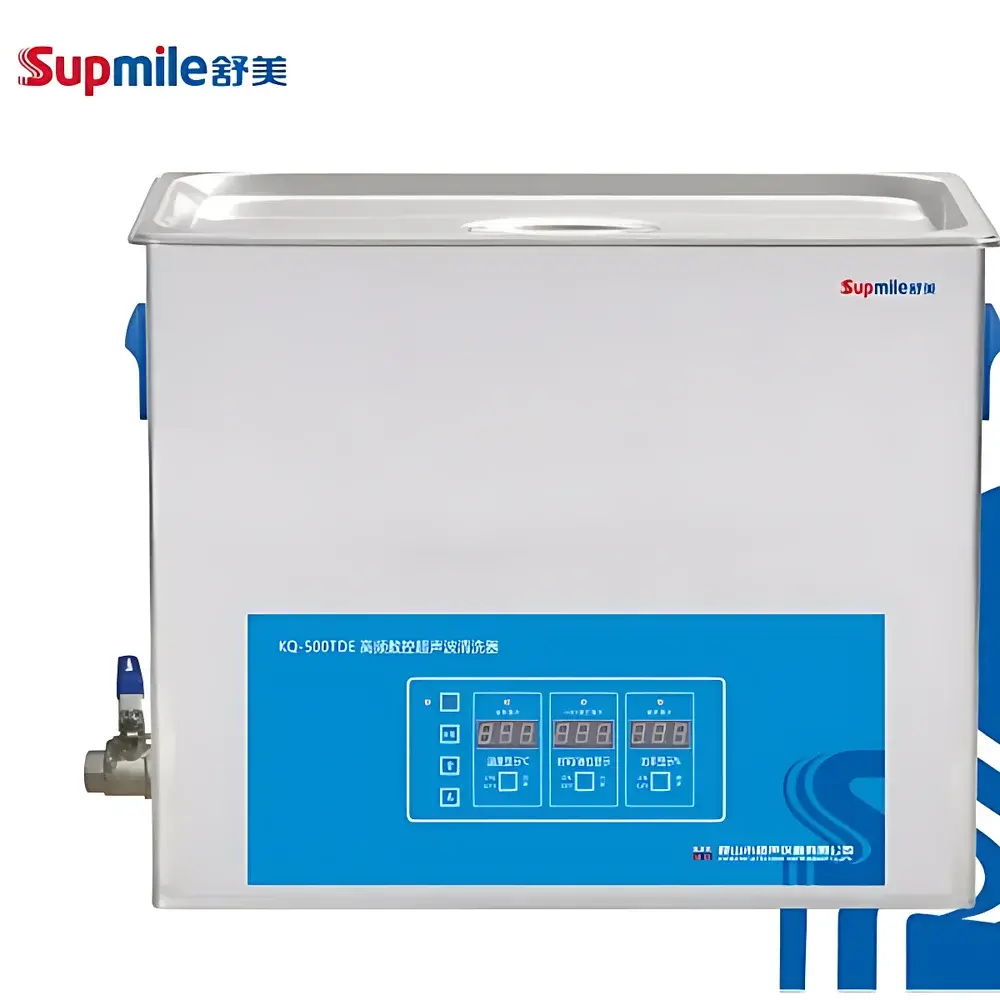
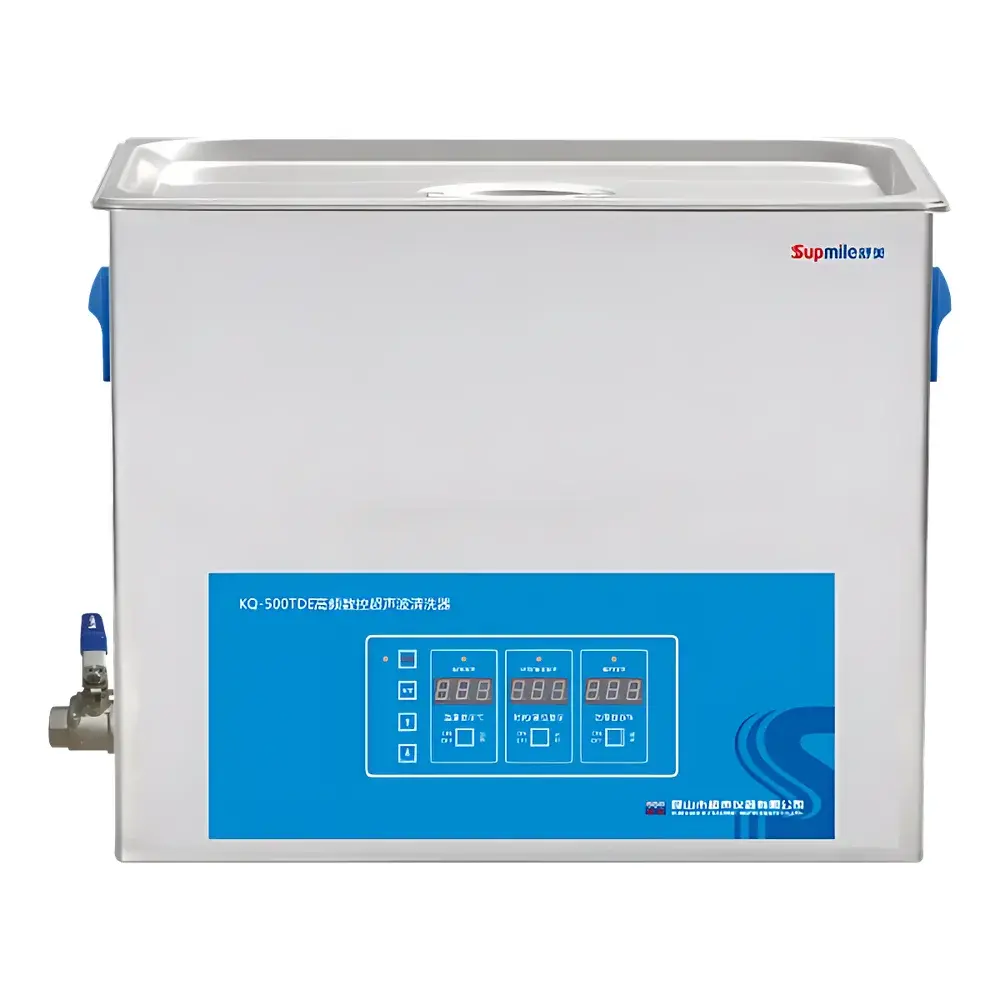
Shumei KQ-500TDE Benchtop High-Frequency Digital Ultrasonic Cleaner
| Brand | Shumei |
|---|---|
| Origin | Jiangsu, China |
| Manufacturer Type | Direct Manufacturer |
| Equipment Type | General-Purpose Ultrasonic Cleaner |
| Tank Capacity | 22.5 L |
| Ultrasonic Frequency | 80 kHz |
| Ultrasonic Power Output | 500 W |
| Power Adjustment Range | 40–100% |
| Heating Temperature Range | Ambient to 80 °C |
| Heating Power | 800 W |
| Timer Range | 1–480 min |
| Sound-Dampening Lid | Yes |
| Drain/Inlet | Manual Control |
| Tank Dimensions (L×W×H) | 500 × 300 × 150 mm |
| External Dimensions (L×W×H) | 531 × 326 × 375 mm |
| Power Supply | AC 220 V, 50 Hz |
| Protection Features | Low-level liquid detection, over-temperature, over-voltage, over-current, and dry-run safeguards |
| Display | Digital LED with real-time monitoring of temperature, power, time, and tank level |
| Standard Accessories | Stainless steel mesh basket, stainless steel rack, sound-dampening lid |
Overview
The Shumei KQ-500TDE is a benchtop high-frequency digital ultrasonic cleaner engineered for precision cleaning of delicate laboratory components, optical elements, microfluidic devices, semiconductor wafers, and analytical instrumentation parts. It operates on the principle of high-intensity cavitation generated by piezoelectric transducers operating at a fixed frequency of 80 kHz—optimized for fine particulate removal without surface erosion or acoustic damage to sensitive substrates. Unlike lower-frequency cleaners (e.g., 40 kHz), the 80 kHz output produces smaller, more densely distributed cavitation bubbles, enabling superior resolution in cleaning micro-scale features and narrow-channel geometries common in HPLC fittings, syringe filters, and MEMS devices. The unit integrates a robust 304 stainless steel tank (500 × 300 × 150 mm internal volume) with a total capacity of 22.5 L, supporting batch processing while maintaining thermal and acoustic stability across extended cycles.
Key Features
- Microprocessor-controlled digital interface with real-time LED display of ultrasonic power (%), heating temperature (°C), elapsed time (min), and liquid level status.
- Adjustable ultrasonic power output from 40% to 100% of nominal 500 W—enabling optimization for fragile samples (e.g., coated lenses, thin-film sensors) versus heavily soiled metal tools.
- Integrated heating system (800 W) with precise temperature control from ambient up to 80 °C, facilitating aqueous-based cleaning chemistries requiring elevated temperatures for enhanced surfactant activity or solvent volatility.
- Comprehensive safety architecture including automatic shutdown on low liquid level, over-temperature, over-voltage, over-current, and dry-run conditions—fully compliant with IEC 61010-1 requirements for laboratory electrical equipment.
- Acoustically insulated lid with sealing gasket reduces airborne noise to ≤65 dB(A) at 1 m distance, meeting occupational health guidelines for continuous lab operation.
- All-welded 304 stainless steel construction ensures long-term corrosion resistance against alkaline detergents, acidic rinse solutions, and organic solvents commonly used in ISO 14644 cleanroom maintenance protocols.
Sample Compatibility & Compliance
The KQ-500TDE accommodates a wide range of sample formats—including glassware (vials, cuvettes, pipette tips), metallic components (syringe needles, surgical instruments), ceramic substrates, and polymer-based microdevices—without risk of ultrasonic pitting or delamination when operated within recommended parameters. Its 80 kHz frequency minimizes mechanical stress on brittle materials such as fused silica optics or anodized aluminum housings. The unit meets CE marking requirements for electromagnetic compatibility (EMC Directive 2014/30/EU) and low-voltage safety (LVD Directive 2014/35/EU). While not certified for sterile processing per ISO 17664 or EN 285, it supports GLP-aligned cleaning validation workflows when paired with documented SOPs, traceable calibration of temperature and timer functions, and routine verification of cavitation intensity using aluminum foil erosion tests per ASTM D2603.
Software & Data Management
As a standalone hardware platform, the KQ-500TDE does not feature network connectivity or PC software integration. However, its digital control panel retains the last-used operational settings (power %, temperature setpoint, timer duration) across power cycles—a critical function for repeatable cleaning validation under ISO/IEC 17025-accredited laboratories. All parameter displays are non-volatile and calibrated during factory commissioning. For audit readiness, users may log operational records manually or via external data loggers interfaced through analog voltage outputs (optional accessory). The system supports full traceability of cleaning cycles when combined with laboratory information management systems (LIMS) via manual entry of cycle IDs, timestamps, and operator credentials.
Applications
- Cleaning of HPLC and GC autosampler vials, injection ports, and column frits prior to chromatographic analysis.
- Removal of photoresist residues and metal contaminants from silicon wafers in pre-deposition preparation.
- Decontamination of reusable cell culture inserts, transwell membranes, and electrophoresis combs in molecular biology labs.
- Routine maintenance of mass spectrometry ion sources, ESI probes, and MALDI targets.
- Preparation of reference standards and certified reference materials (CRMs) where particle-free surfaces are mandatory per ISO Guide 35.
- Supporting ASTM E1971 and USP cleaning validation studies for pharmaceutical manufacturing equipment components.
FAQ
Is the KQ-500TDE suitable for cleaning delicate optical components such as anti-reflective coated lenses?
Yes—its 80 kHz frequency and adjustable power (down to 40%) minimize cavitation collapse energy, reducing the risk of coating damage while maintaining effective contaminant removal.
Does the unit comply with FDA 21 CFR Part 11 for electronic records and signatures?
No—the device lacks audit-trail functionality, user authentication, or electronic signature capability. It is intended for use in environments where manual recordkeeping satisfies regulatory requirements.
Can deionized water alone be used, or is detergent required?
Deionized water may suffice for light particulate removal; however, validated cleaning processes typically require low-foaming, non-ionic detergents (e.g., Alconox® or Liquinox®) to ensure consistent surface tension reduction and soil emulsification.
What is the expected service life of the ultrasonic transducers under normal laboratory use?
With proper maintenance—including regular descaling, avoidance of dry operation, and use of compatible cleaning solutions—the transducers exhibit ≥5,000 hours of reliable operation before measurable output degradation occurs.
Is the tank geometry optimized for uniform cavitation distribution?
Yes—the rectangular tank design, combined with bottom-mounted transducer arrays and reflector plate geometry, has been empirically verified using hydrophone mapping to achieve ±15% spatial uniformity of acoustic intensity across the working volume.



