
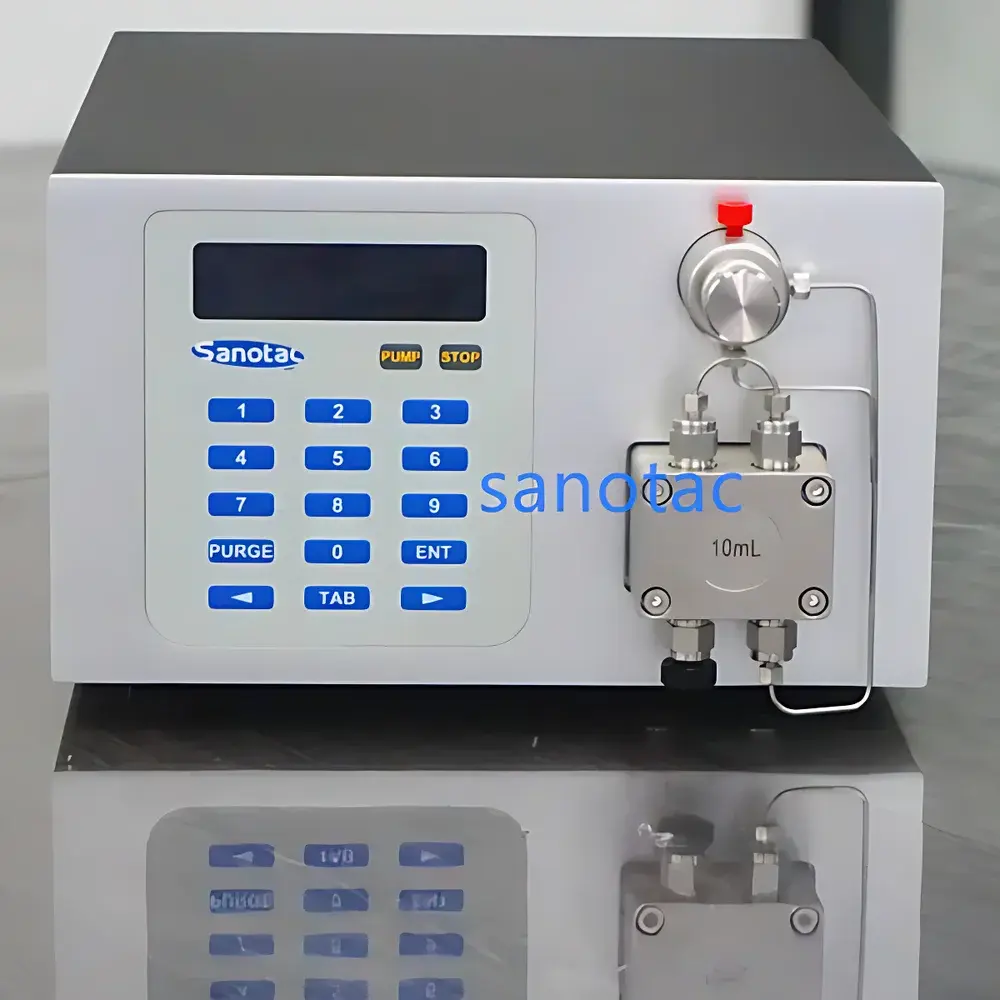
Sanotac AP-0010 High-Pressure Liquid Chromatography (HPLC) Pump
| Brand | Sanotac |
|---|---|
| Origin | Shanghai, China |
| Manufacturer Type | Manufacturer |
| Product Category | Domestic |
| Model | AP-0010 |
| Instrument Type | Isocratic Pump |
| Maximum Pressure | 42 MPa |
| Flow Rate Range | 0.001–9.999 mL/min |
| Flow Accuracy | ±0.1% |
| Flow Precision (RSD) | ≤0.1% |
| Pressure Pulsation | ≤0.1 MPa |
| Drive Mechanism | Dual-Piston Series Configuration with Floating Piston Design |
| Wetted Materials | 316L Stainless Steel, Sapphire, PTFE, Ceramic |
| Tubing Connection | 1/16″ Standard Fitting |
| Display | 256×64 Dot Matrix LCD with Backlight |
| Communication Interfaces | RS232 & USB (Standard), RS485/RS422 (Optional) |
| Protocols | Sanotac Proprietary Protocol, Modbus RTU/ASCII |
| Power Supply | 85–264 VAC, 50 Hz |
| Dimensions | 370 × 240 × 152 mm |
Overview
The Sanotac AP-0010 High-Pressure Liquid Chromatography (HPLC) Pump is an isocratic precision solvent delivery system engineered for stability, reproducibility, and long-term operational integrity in analytical and preparative chromatographic applications. Operating on a dual-piston series configuration with floating piston design, the pump delivers consistent fluid displacement across its full flow range (0.001–9.999 mL/min) while minimizing mechanical wear and pressure transients. Its maximum operating pressure of 42 MPa supports compatibility with sub-2 µm particle-packed columns and high-efficiency UHPLC workflows. The wetted path—comprising 316L stainless steel, sapphire check valves, PTFE seals, and ceramic components—is chemically inert and mechanically robust, ensuring resistance to aggressive mobile phases including strong acids, bases, and organic solvents. Designed for integration into modular analytical platforms, the AP-0010 serves as a core fluidic actuator in HPLC, ion chromatography (IC), gel permeation chromatography (GPC), post-column derivatization systems, liquid-phase atomic fluorescence spectrometry (LP-AFS), HbA1c analyzers, amino acid analyzers, and IVD diagnostic instruments.
Key Features
- Dual-piston tandem architecture with floating piston compensation reduces column loading variability and extends seal service life.
- Multi-point volumetric flow calibration across the entire range (0.001–9.999 mL/min) enables traceable accuracy of ±0.1% and repeatability ≤0.1% RSD.
- Active flow pulsation suppression via cam-profile optimization and real-time electronic feedback maintains pressure stability ≤0.1 MPa peak-to-peak.
- Integrated column protection logic allows user-defined upper pressure limits and zero-offset correction to compensate for ambient thermal drift.
- Back-of-piston wash function delivers solvent flush during idle cycles, mitigating precipitate accumulation and seal abrasion.
- Modular I/O architecture supports analog input (0–5 V / 4–20 mA), digital TTL triggers, and relay-controlled start/stop—enabling closed-loop mass-flow control in reactor feed systems.
Sample Compatibility & Compliance
The AP-0010 accommodates aqueous, organic, and mixed-phase mobile phases commonly used in reversed-phase, ion-exchange, size-exclusion, and hydrophilic interaction chromatography. Its chemically resistant fluid path complies with ISO 8573-1 (compressed air purity) for auxiliary gas interfaces and meets material biocompatibility requirements per USP Class VI for IVD applications. While not certified to CE or UL as a standalone medical device, the pump’s hardware and firmware architecture support validation under GLP and GMP environments—including audit trails, parameter locking, and electronic signature readiness when integrated with compliant host software. It is routinely deployed in laboratories adhering to ASTM E2656 (standard guide for HPLC system qualification) and ISO/IEC 17025 quality management frameworks.
Software & Data Management
The AP-0010 operates natively via front-panel controls or external command via RS232/USB; optional RS485/RS422 enables daisy-chained multi-pump coordination. Firmware supports both Sanotac’s proprietary ASCII-based command set and industry-standard Modbus RTU/ASCII protocols—facilitating seamless integration into SCADA, DCS, and PLC ecosystems. Host-side software tools (available separately) provide method editor functionality for time-programmed flow profiles (constant, linear ramp, multi-step gradient), real-time pressure/flow curve visualization, timestamped data logging (CSV export), and method library management. Calibration parameters are stored in non-volatile memory with factory-reset capability. Remote monitoring and control are achievable via optional Ethernet/WiFi gateway modules compliant with IPv4 TCP/IP stacks.
Applications
- Analytical-scale HPLC and UHPLC systems requiring high-pressure stability and low-flow precision.
- Ion chromatography setups demanding pulse-free eluent delivery for suppressed conductivity detection.
- GPC/SEC instrumentation where viscosity-induced backpressure fluctuations must be actively dampened.
- Post-column reaction manifolds requiring precise reagent metering at sub-mL/min rates.
- Automated clinical analyzers (e.g., HbA1c, amino acid quantification) subject to IVD regulatory scrutiny.
- Lab-scale continuous-flow synthesis reactors with gravimetric feed control loops.
FAQ
What is the minimum programmable flow increment?
The AP-0010 supports 0.001 mL/min resolution across its full range.
Can the pump be operated in gradient mode?
No—the AP-0010 is an isocratic pump. Gradient functionality requires external valve switching or integration with a separate low-pressure mixing module.
Is the pump compatible with FDA 21 CFR Part 11 requirements?
The pump itself does not implement electronic signatures or audit trails; however, its communication protocol and parameter-locking capabilities enable compliance when embedded within a validated host system meeting Part 11 criteria.
What maintenance intervals are recommended for the piston seals?
Under typical aqueous/organic mobile phase use at ≤30 MPa and 2 mL/min average flow, seal replacement is advised every 6–12 months based on pressure decay trends and leak detection.
Does the pump support analog flow rate control from an external process controller?
Yes—via 0–5 V or 4–20 mA analog input, enabling dynamic flow modulation synchronized with reactor temperature or pH feedback signals.




