
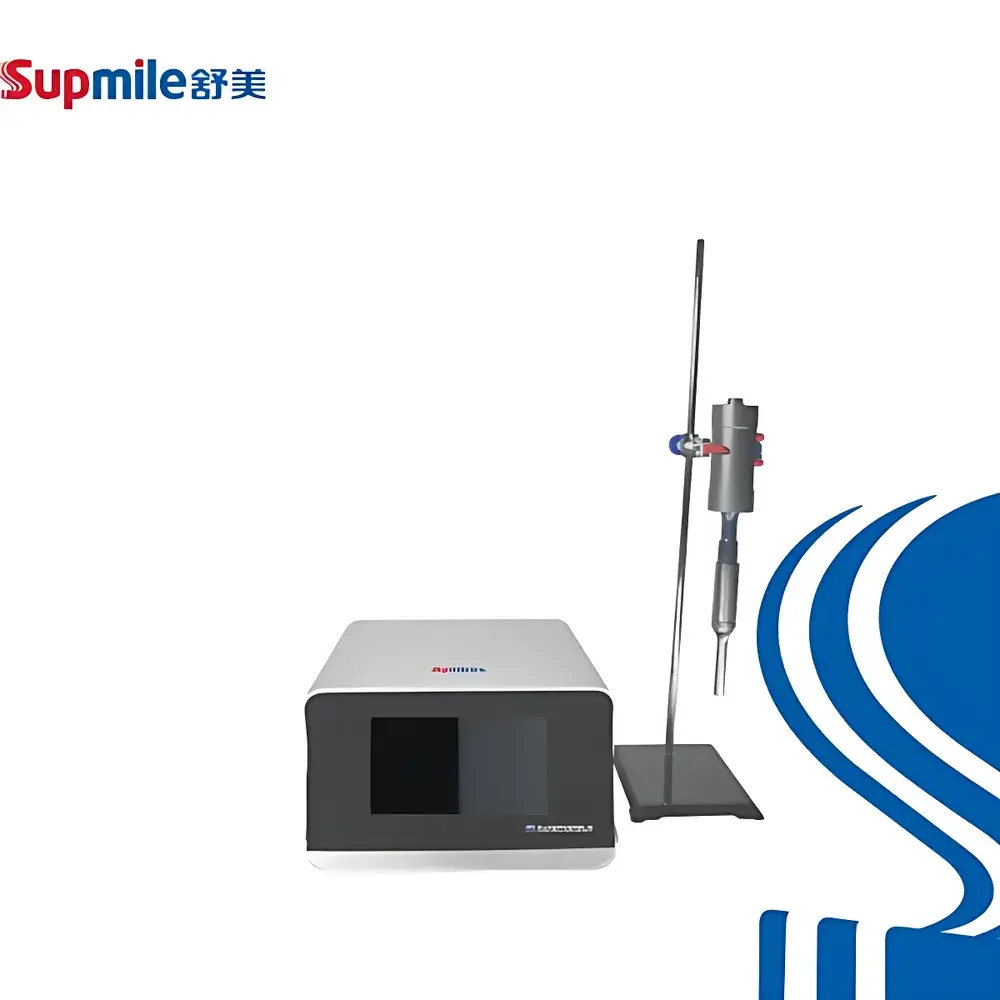
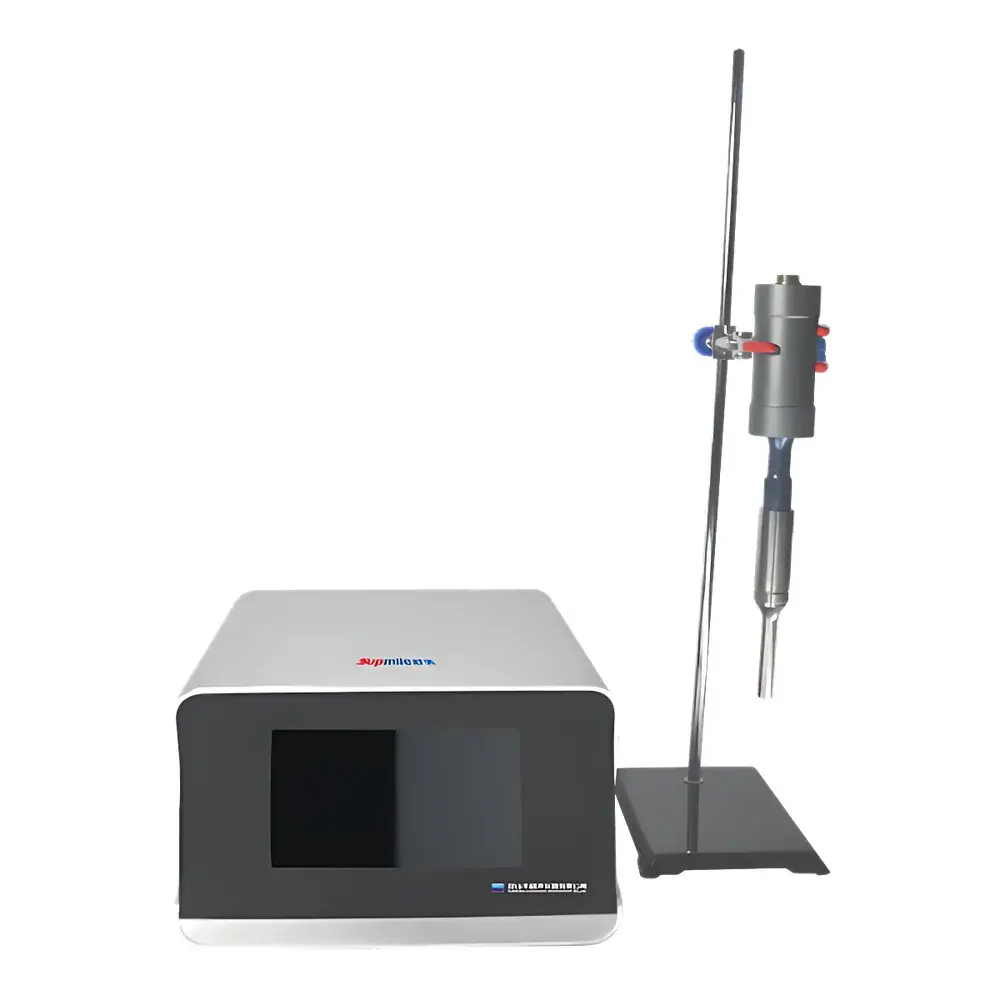
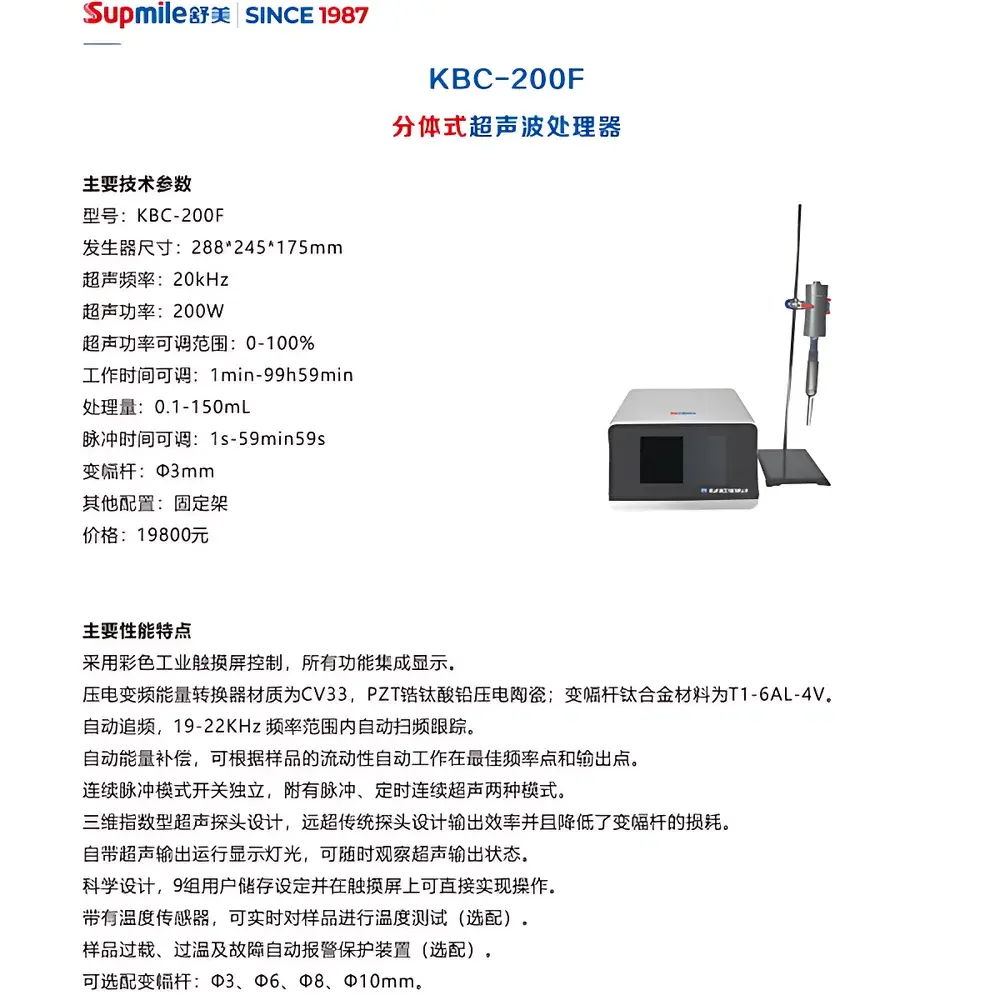
Shumei KBC-200F Split-System Ultrasonic Processor
| Brand | Shumei |
|---|---|
| Origin | Jiangsu, China |
| Manufacturer Type | OEM Manufacturer |
| Country of Origin | China |
| Model | KBC-200F |
| Price | USD 2,800 (FOB) |
| Generator Dimensions | 288 × 245 × 175 mm |
| Ultrasonic Frequency | 20 kHz (auto-tracking range: 19–22 kHz) |
| Output Power | 200 W (0–100% adjustable) |
| Processing Volume | 0.1–150 mL |
| Timer Range | 1 min – 99 h 59 min |
| Pulse Duration | 1 s – 59 min 59 s |
| Horn Diameter Options | Φ3, Φ6, Φ8, Φ10 mm (standard: Φ3 mm) |
| Transducer Material | CV33 + PZT piezoceramic |
| Horn Material | Ti-6Al-4V titanium alloy |
| Control Interface | Color industrial touchscreen |
| Operating Modes | Continuous & pulsed ultrasonication |
| Real-time power feedback | Yes |
| Optional | Integrated temperature sensor (PT100), over-temperature/overload protection, user-defined protocol storage (9 slots) |
Overview
The Shumei KBC-200F Split-System Ultrasonic Processor is an engineered solution for laboratory-scale sonochemical processing, cell disruption, emulsification, nanoparticle dispersion, and extraction applications. Unlike integrated benchtop sonicators, its split architecture separates the generator unit from the transducer-horn assembly via a robust coaxial ultrasonic cable—enabling flexible positioning, improved thermal management, and enhanced operator safety during extended operation. The system operates on the principle of piezoelectric energy conversion: high-frequency alternating voltage applied to PZT (lead zirconate titanate) ceramic elements induces mechanical resonance at 20 kHz, amplified through a precisely tuned titanium alloy (Ti-6Al-4V) horn. This generates intense cavitation in liquid media, producing localized hotspots (>5,000 K), transient pressures (>1,000 atm), and microturbulence essential for physical and chemical process intensification.
Key Features
- Intelligent Frequency Tracking: Automatic sweep and lock within 19–22 kHz ensures consistent cavitation efficiency despite load variations, viscosity shifts, or temperature drift—critical for reproducible batch-to-batch results.
- Adaptive Energy Compensation: Real-time impedance monitoring adjusts output amplitude dynamically to maintain optimal acoustic coupling, minimizing horn erosion and maximizing energy transfer efficiency.
- Industrial Touchscreen Interface: A 7-inch color LCD with intuitive GUI enables direct parameter entry, real-time power waveform visualization, and status lighting for immediate operational feedback.
- Dual Operational Modes: Independent toggle between continuous and pulsed ultrasonication; pulse width and interval are independently programmable (1 s–59 min 59 s), supporting heat-sensitive sample protocols.
- Modular Horn System: Standard Φ3 mm tapered titanium horn delivers high-intensity cavitation for low-volume samples (0.1–10 mL); optional Φ6/Φ8/Φ10 mm horns expand scalability to 150 mL while preserving amplitude linearity.
- Thermal & Safety Safeguards: Optional PT100 temperature probe integration enables closed-loop thermal monitoring; overload, over-temperature, and transducer fault detection trigger audible/visual alarms and automatic shutdown per IEC 61000-6-2 EMC compliance requirements.
Sample Compatibility & Compliance
The KBC-200F accommodates aqueous, organic, and viscous suspensions across life science, materials chemistry, and nanotechnology workflows. Its design supports ISO 13485-aligned documentation packages for regulated environments. While not certified for GMP manufacturing, the system meets GLP-ready criteria: full audit trail capability (via optional software), timestamped parameter logging, and user-access-level controls (admin/operator modes). All electrical components comply with CE marking directives (2014/30/EU EMC, 2014/35/EU LVD), and horn materials conform to USP Class VI biocompatibility standards for non-invasive contact applications.
Software & Data Management
When paired with Shumei’s optional PC-based control software (KBC-Suite v3.2), the KBC-200F supports remote parameter configuration, automated method sequencing, and export of CSV-formatted logs—including time-stamped power output (%), duration, pulse cycle count, and optional temperature readings. Data files include digital signatures compliant with FDA 21 CFR Part 11 requirements for electronic records, enabling traceability in QC/QA laboratories. Protocol templates can be saved, versioned, and recalled directly from the touchscreen or host PC—eliminating manual transcription errors.
Applications
- Biological sample preparation: Lysis of E. coli, yeast, mammalian cells, and tissue homogenates without enzymatic degradation.
- Nanomaterial synthesis: Exfoliation of graphene oxide, dispersion of carbon nanotubes, and size reduction of metal-organic frameworks (MOFs).
- Pharmaceutical formulation: Nanoemulsion stabilization, liposome sizing, and active pharmaceutical ingredient (API) solubilization enhancement.
- Environmental analysis: Extraction of PAHs, PCBs, and microplastics from soil/sediment matrices prior to GC-MS or HPLC analysis.
- Food science research: Enzyme inactivation, pectin modification, and microbial decontamination validation studies.
FAQ
What is the maximum recommended duty cycle for continuous operation?
For optimal transducer longevity and thermal stability, continuous mode is rated for ≤30 min per session; pulsed mode (e.g., 5 s ON / 5 s OFF) enables indefinite operation under ambient lab conditions.
Is calibration traceable to NIST or other national standards?
Output power is factory-calibrated using reference hydrophones per ASTM E1000-22; certificate of conformance includes uncertainty budget and traceability statement.
Can the KBC-200F be integrated into automated liquid handling platforms?
Yes—RS-232 and TTL trigger interfaces support external start/stop commands and status polling; API documentation available under NDA.
Does the system support multi-horn configurations for parallel processing?
No—the KBC-200F is designed for single-horn operation; parallel processing requires multiple independent units synchronized via external timer logic.



