
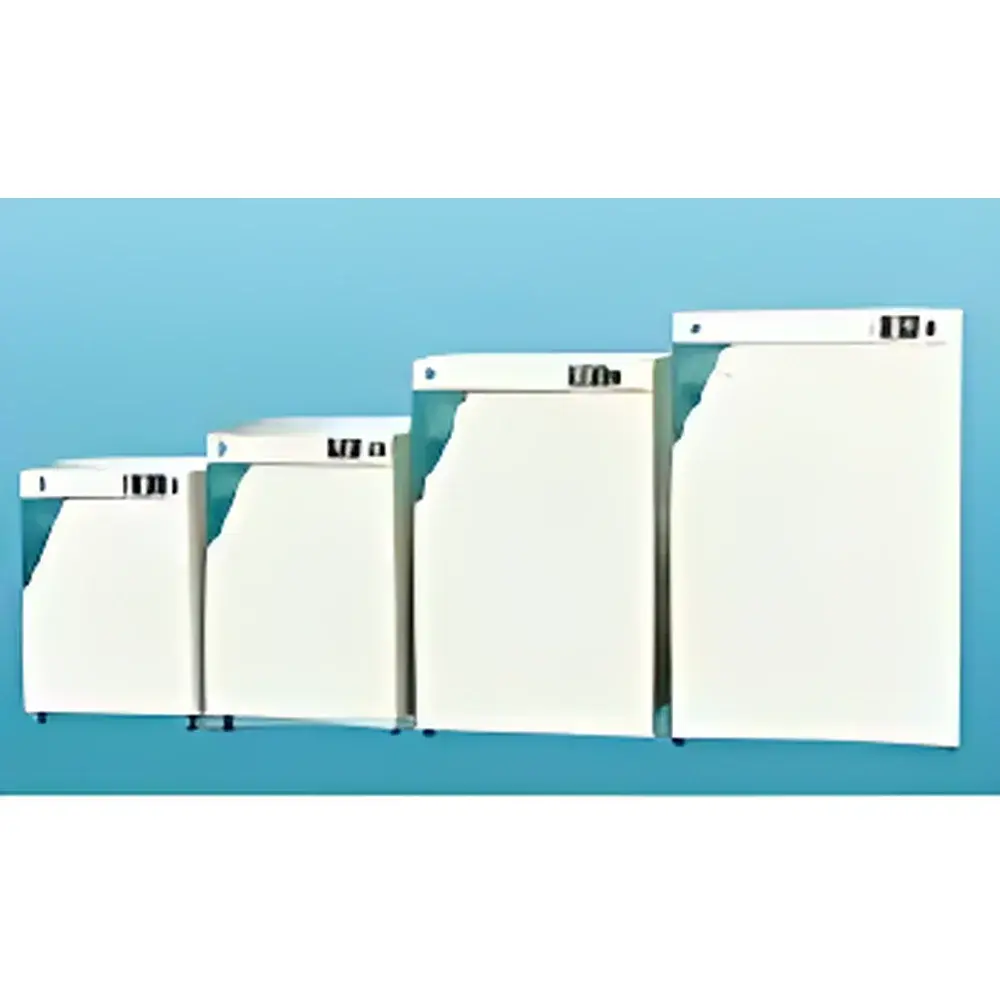
JingHong DNP-9162 Electric Constant Temperature Incubator
| Brand | JingHong |
|---|---|
| Origin | Shanghai, China |
| Model | DNP-9162 |
| Heating Method | Six-Surface Direct Heating |
| Air Circulation | Forced Convection |
| Temperature Control | Digital PID Controller |
| Temperature Range | RT + 5°C to 65°C |
| Temperature Control Accuracy | ±0.1°C |
| Temperature Uniformity | ±0.5°C |
| Temperature Fluctuation | ±0.5°C |
| Chamber Capacity | 160 L |
| External Dimensions (W×D×H) | 645 × 595 × 940 mm |
| Power Consumption | 400 W |
| Interior Material | Mirror-Finish Stainless Steel |
| Inner Door | Tempered Glass |
| Compliance | Designed for GLP-compliant laboratory environments |
Overview
The JingHong DNP-9162 Electric Constant Temperature Incubator is a precision-engineered laboratory incubation system designed for stable, uniform thermal environments essential in microbiological culture, cell propagation, enzyme activity studies, and long-term sample storage. Built upon a robust six-surface direct heating architecture with forced-air convection, the DNP-9162 ensures rapid thermal equilibration and minimal spatial temperature gradients across its 160 L working chamber. Its operational range of RT + 5°C to 65°C—combined with ±0.1°C control accuracy and ±0.5°C uniformity—meets the stringent requirements of academic research labs, pharmaceutical quality control units, and clinical diagnostics facilities where reproducible thermal conditions directly impact assay validity and colony morphology consistency.
Key Features
- Microprocessor-based PID temperature controller with dual digital display: one for setpoint, one for real-time chamber temperature—enabling precise parameter verification and eliminating analog drift.
- Six-surface heating elements integrated into all interior walls, ceiling, and floor deliver uniform thermal energy distribution without cold spots—critical for multi-tier shelf loading and stacked plate assays.
- Forced convection system with adjustable-speed fan ensures consistent airflow velocity (≥0.3 m/s at center) and minimizes boundary-layer thermal resistance, supporting high-density culture applications.
- Dual-door configuration: outer door seals with magnetic gasket; inner door constructed from fully tempered glass—permitting non-intrusive visual monitoring without compromising chamber stability or introducing ambient air infiltration.
- Chamber interior fabricated from electropolished mirror-finish stainless steel (AISI 304), featuring seamless semi-circular corners and smooth welds to eliminate microbial harborage points and simplify decontamination protocols.
- Structural design adheres to IEC 61010-1 safety standards for laboratory electrical equipment, including overtemperature protection, short-circuit safeguarding, and grounded chassis construction.
Sample Compatibility & Compliance
The DNP-9162 accommodates standard microbiological vessels—including Petri dishes (up to 150 mm diameter), test tubes (16 × 150 mm), flasks (Erlenmeyer up to 2 L), and multi-well plates—on three adjustable stainless-steel shelves. Its chamber geometry (500 × 500 × 650 mm internal) supports staggered loading configurations without impeding airflow. The unit is routinely deployed in environments requiring adherence to Good Laboratory Practice (GLP) and ISO/IEC 17025 frameworks. While not certified to FDA 21 CFR Part 11 out-of-the-box, its stable thermal profile and traceable calibration capability support integration into validated workflows when paired with external data loggers meeting NIST-traceable standards.
Software & Data Management
The DNP-9162 operates via embedded firmware without proprietary software dependencies. All operational parameters—including setpoint, actual temperature, elapsed time, and alarm status—are continuously displayed on the front-panel LED interface. Optional RS-485 serial output (available via accessory module) enables connection to SCADA systems or centralized lab monitoring platforms for time-stamped temperature logging. When used with compliant third-party acquisition software, the device supports audit-trail generation, user-access level assignment, and export of CSV-formatted thermal history reports—facilitating compliance with internal SOPs and external inspection requirements.
Applications
- Bacterial and fungal cultivation under defined thermal regimes (e.g., E. coli at 37°C, Aspergillus niger at 30°C).
- Enzyme kinetics studies requiring strict thermal control during substrate incubation periods.
- Stability testing of diagnostic reagents and vaccine components per WHO TRS Annex 2 guidelines.
- Pre-incubation of agar plates prior to streaking or pour-plating procedures in clinical microbiology.
- Long-term storage of reference strains and lyophilized cultures in biosafety-level 1 (BSL-1) laboratories.
- Supporting ASTM D3951-22 (Standard Practice for Commercial Packaging) thermal preconditioning protocols.
FAQ
What is the maximum ambient temperature at which the DNP-9162 maintains specified performance?
The incubator is rated for operation in ambient environments up to 30°C. Performance specifications assume installation in a well-ventilated, non-sunlit space with ≥10 cm clearance on all sides.
Does the unit include a built-in temperature calibration function?
Yes—the PID controller supports manual offset adjustment (±5.0°C range) using a certified reference thermometer, enabling field recalibration without disassembly.
Can the DNP-9162 be used for CO₂-sensitive applications?
No. This model lacks gas-tight sealing, humidity control, or CO₂ injection capability. It is strictly intended for dry, aerobic thermal incubation.
Is the chamber lighting compatible with photobiological assays?
The unit does not include interior illumination. For light-dependent experiments, external LED arrays with spectral output documentation must be externally mounted and validated.
What maintenance intervals are recommended for optimal thermal stability?
Biannual inspection of door gaskets, fan motor lubrication (if applicable), and verification of heater continuity using a multimeter are advised. Calibration verification should occur before each critical study cycle.




