
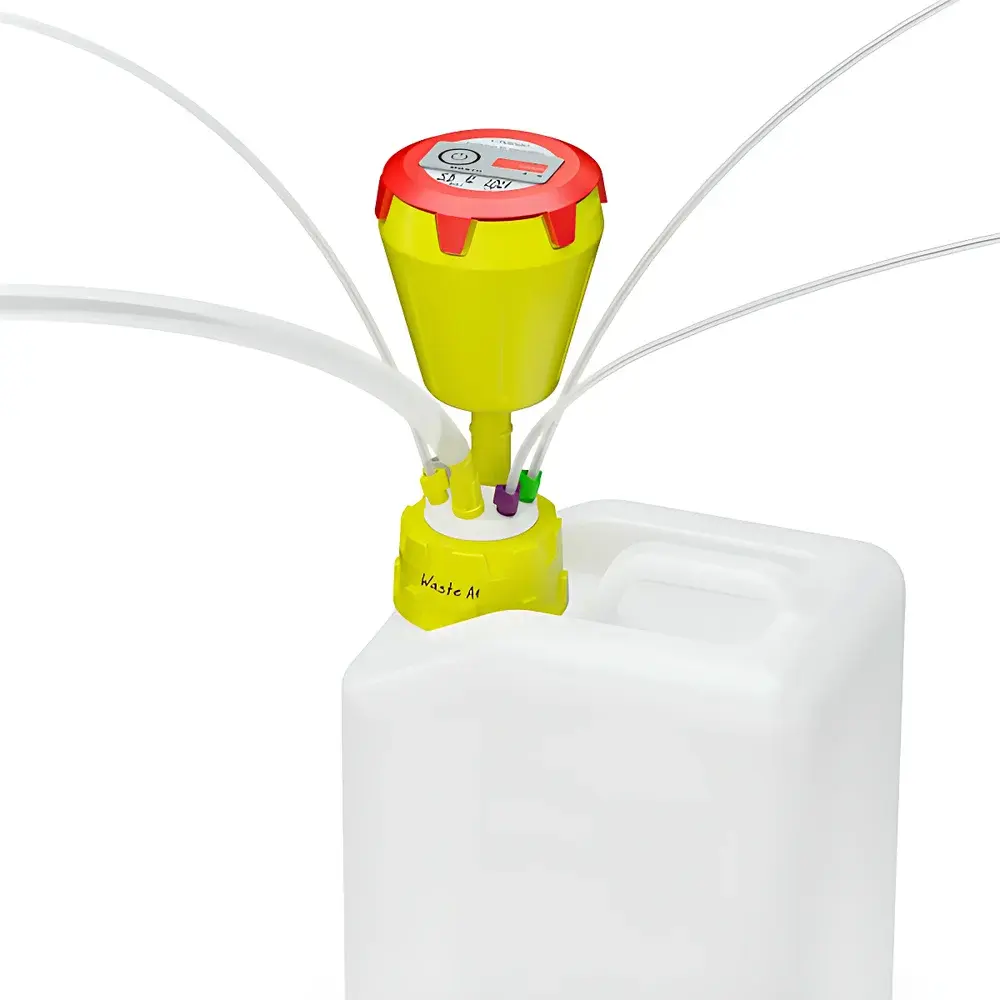
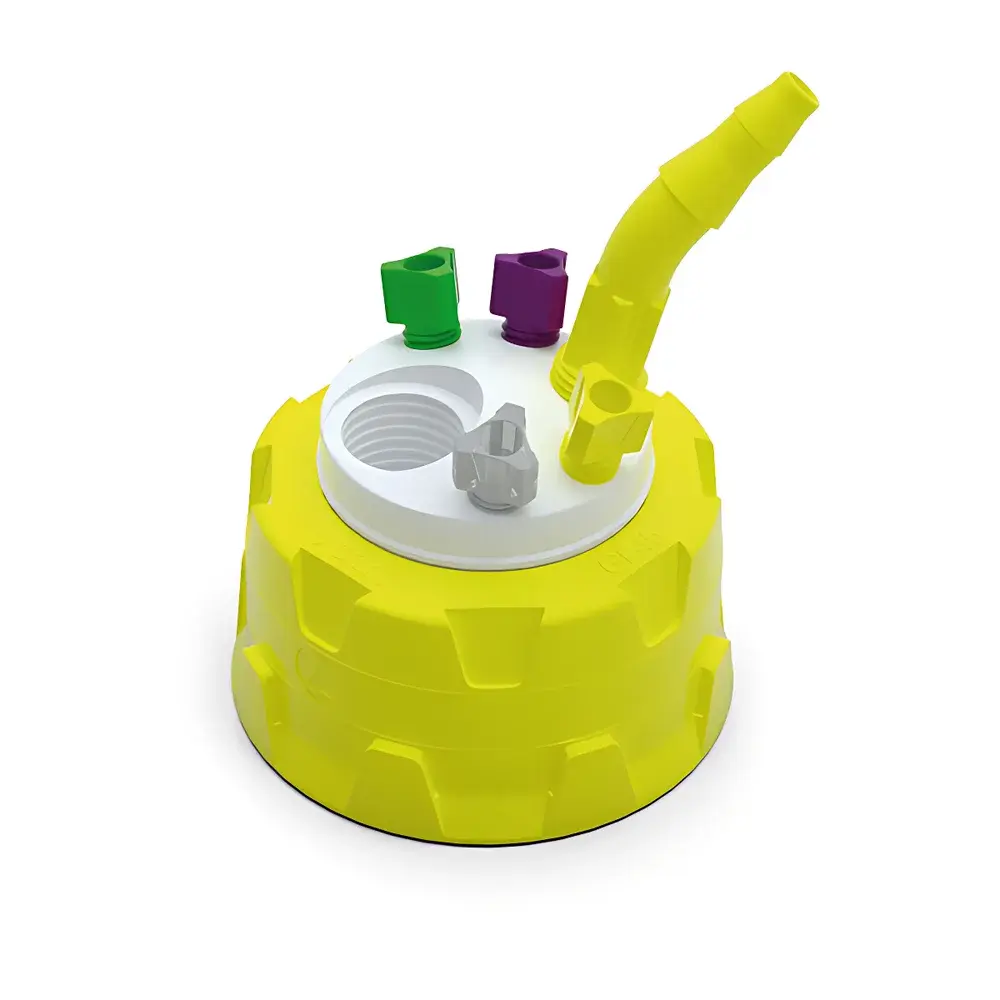
b.safe BSAFE-M345 Series Solvent Waste Collection Cap with Activated Carbon Filter
| Brand | b.safe |
|---|---|
| Origin | Germany |
| Model | BSAFE-M345 Series |
| Material | PPS outer cap, PTFE inner core & sealing components |
| Temperature Resistance | –20 °C to +200 °C |
| Chemical Resistance | +++ (excellent for HPLC solvents including acetonitrile, methanol, THF, chloroform, DCM, acetone, and dilute acids/bases) |
| Filtration | Integrated activated carbon exhaust filter with visual service-life indicator |
| Sealing Interface | GL14 thread for filter housing |
| Tubing Compatibility | 1.6 mm (green), 2.2 mm (purple), 3.2 mm (yellow), and 5.5–8 mm (white) ID PFA/PTFE tubing |
| Sterilization | Autoclavable at 200 °C |
| Seal Type | Viton® flat gasket + PTFE lip seal for vapor-tight isolation |
Overview
The b.safe BSAFE-M345 Series Solvent Waste Collection Cap is an engineered containment solution designed specifically for safe, compliant handling of volatile organic solvent waste generated during high-performance liquid chromatography (HPLC), preparative chromatography, and other analytical or synthesis workflows. Unlike standard drum lids, this system implements a dual-barrier vapor containment strategy: first, a mechanically robust, chemically inert sealing interface between the cap and waste container; second, an integrated, replaceable activated carbon exhaust filter that captures solvent vapors before atmospheric release. The cap operates on passive diffusion-controlled venting—no pumps or electronics—ensuring intrinsic safety, silent operation, and zero energy consumption. Its design conforms to internationally recognized occupational hygiene principles defined in ISO 8573-1 (compressed air purity), EN 14175 (fume hood performance), and OSHA 1910.1200 (Hazard Communication Standard), supporting institutional compliance with laboratory chemical hygiene plans (CHPs) and risk assessments under EU REACH and CLP regulations.
Key Features
- Multi-port modular inlet system: Accepts up to four standardized tubing diameters (1.6 mm, 2.2 mm, 3.2 mm, and 5.5–8 mm ID) via color-coded PFA/PTFE compression fittings—green, purple, yellow, and white—enabling simultaneous connection of multiple HPLC waste lines without cross-contamination.
- Vapor-tight dual-seal architecture: Combines a Viton® flat gasket for primary compression sealing with a secondary PTFE lip seal that physically isolates the gasket from solvent vapor exposure—extending gasket service life and maintaining integrity across repeated thermal cycling.
- Rotatable PTFE inner core: Allows full 360° rotation of the internal manifold during installation or maintenance, eliminating the need to disconnect tubing when tightening or removing the cap from the waste drum.
- GL14-threaded exhaust port: Dedicated mounting interface for the replaceable activated carbon filter cartridge (sold separately), ensuring consistent filtration performance and straightforward field replacement.
- Visual service-life indicator: Embedded dye-based sensor changes from white to fully red as carbon saturation progresses—providing objective, non-instrumental verification of filter exhaustion per manufacturer’s validated protocol.
- Autoclavable construction: Outer shell fabricated from polyphenylsulfone (PPS); inner core and seals from virgin PTFE—rated for repeated sterilization at 200 °C/4 bar saturated steam, meeting ISO 17664 requirements for reprocessable labware.
Sample Compatibility & Compliance
The BSAFE-M345 cap supports collection of aqueous-organic mixtures and pure organic solvents commonly used in chromatographic methods, including but not limited to acetonitrile, methanol, ethanol, isopropanol, tetrahydrofuran (THF), dichloromethane (DCM), chloroform, ethyl acetate, and acetone. It is incompatible with strong oxidizers (e.g., concentrated nitric or sulfuric acid), molten alkali metals, fluorine gas, or sodium hypochlorite solutions above 5% w/w. All materials comply with USP Class VI biological reactivity testing and FDA 21 CFR §177.1550 (PTFE) and §177.2470 (PPS). The system meets CE marking requirements under Directive 2014/34/EU (ATEX Category 3G for Group II environments) and supports GLP/GMP documentation through traceable filter replacement logs and autoclave cycle records.
Software & Data Management
As a passive mechanical device, the BSAFE-M345 requires no firmware, drivers, or software integration. However, its service-life indicator enables structured manual data capture: users may record filter installation dates in electronic lab notebooks (ELNs) such as LabArchives or Benchling, or embed timestamps in LIMS entries linked to specific HPLC method runs. For facilities implementing 21 CFR Part 11 compliance, the visual indicator serves as an auditable, human-readable control point—eliminating reliance on electronic sensors subject to calibration drift or failure. Maintenance logs—including autoclave cycles, visual inspection outcomes, and filter change events—can be exported as CSV or PDF reports for internal QA audits or regulatory inspections.
Applications
- HPLC and UHPLC waste stream containment in QC/QA laboratories operating under ISO/IEC 17025 accreditation.
- Preparative LC fraction collection where solvent recovery or environmental emission control is mandated.
- Automated synthesis platforms (e.g., peptide synthesizers, flow reactors) requiring continuous, low-backpressure venting.
- Teaching labs seeking pedagogically transparent vapor containment systems aligned with ACS Safety Guidelines.
- Pharmaceutical R&D environments managing legacy instruments lacking built-in solvent scrubbers.
FAQ
What solvent vapors does the activated carbon filter effectively adsorb?
The filter demonstrates ≥95% adsorption efficiency for common HPLC-grade solvents including acetonitrile, methanol, THF, and dichloromethane at ambient temperatures (20–25 °C) and typical exhaust flow rates (<50 mL/min).
Can the cap be used with non-b.safe waste containers?
Yes—provided the container features a standard GL14 neck thread (ISO 2858) and sufficient wall rigidity to withstand vacuum-induced deformation during active pumping scenarios.
Is the cap suitable for acidic or basic aqueous waste streams?
It is rated for pH 2–12 when diluted below 10% v/v concentration; prolonged exposure to >1 M HCl or NaOH will degrade Viton® gaskets and is not recommended.
How often must the activated carbon filter be replaced?
Replacement frequency depends on total solvent mass processed; under typical HPLC usage (≤2 L/day of 50:50 ACN:water), filters last 4–6 weeks—confirmed by full red transition of the indicator or calendar-based schedule per institutional SOP.
Does the cap meet explosion-proof requirements for flammable solvent storage?
While not intrinsically spark-proof, the absence of electronics, static-dissipative PTFE surfaces, and passive venting design align with NFPA 30 Chapter 9.4.2 provisions for non-ignition-capable containment—when used with grounded metal drums and proper grounding straps.



