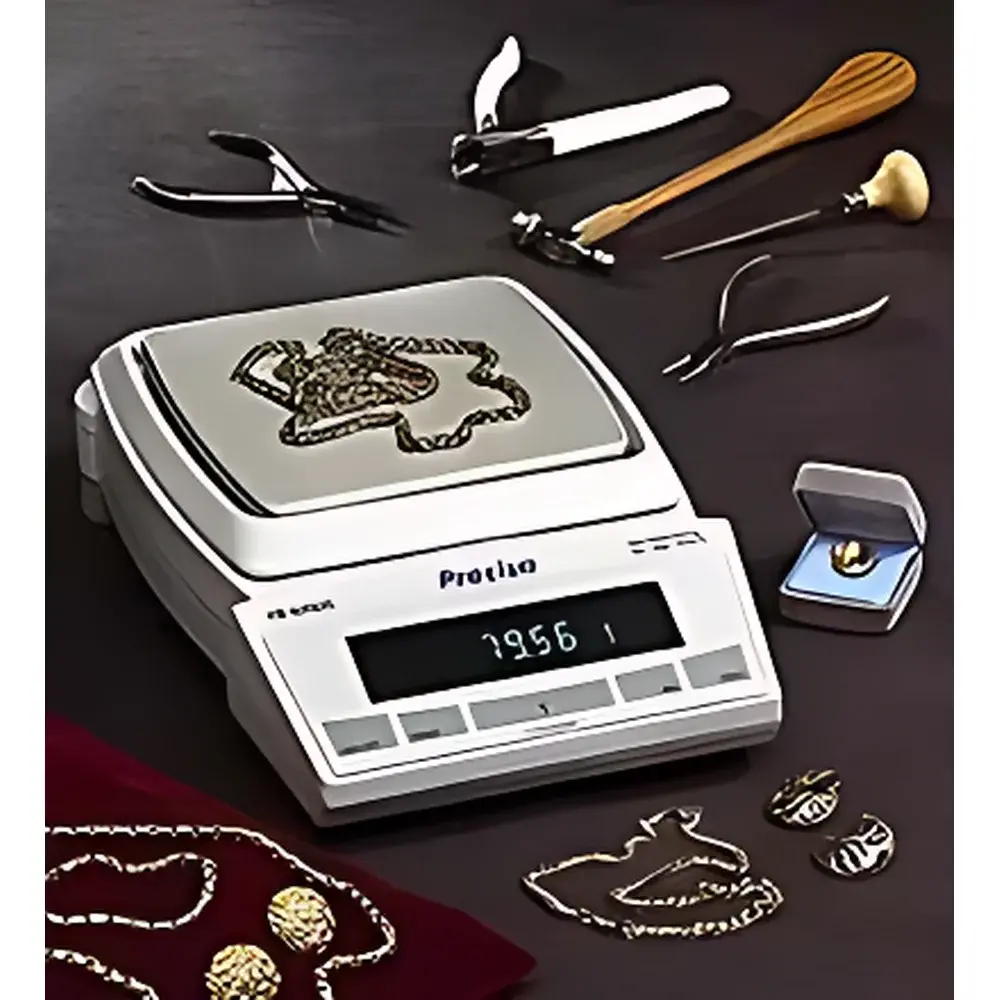
Precisa XS4250C Precision Laboratory Balance
| Brand | Precisa |
|---|---|
| Model | XS4250C |
| Weighing Range | 4250 g |
| Readability | 10 mg |
| Taring Range | 4250 g |
| Reproducibility | ≤10 mg |
| Linearity | ±15 mg |
| Response Time | 2–3 s |
| Stability Adjustment | 3-step adjustable |
| Operating Temperature | 0–40 °C |
| Sensitivity Drift | ±2 ppm/°C (10–30 °C) |
| Voltage | 115/230 V AC |
| Voltage Tolerance | +15% / −20% |
| Frequency | 50–60 Hz |
| Power Consumption | 6 VA |
| Display | Optional fluorescent display |
| Dimensions (L×W×H) | 210 × 340 × 89 mm |
| Pan Size | 170 × 170 mm (chromium-nickel steel) |
| Net Weight | 4.5 kg |
Overview
The Precisa XS4250C is a high-stability, general-purpose precision laboratory balance engineered for routine mass measurement tasks in quality control laboratories, educational institutions, and industrial preparation areas. It operates on electromagnetic force compensation (EMFC) principle — the industry-standard transduction method for analytical and precision balances — ensuring consistent linearity, low thermal drift, and minimal mechanical hysteresis. With a 4250 g maximum capacity and 10 mg readability, the XS4250C bridges the performance gap between top-loading and semi-micro balances, delivering metrologically sound results under ambient lab conditions (0–40 °C). Its robust chassis, corrosion-resistant chromium-nickel steel weighing pan, and optimized air-damping design contribute to rapid stabilization (2–3 seconds) and high reproducibility (≤10 mg), meeting essential requirements for ISO/IEC 17025-compliant weighing procedures where intermediate precision is critical but microgram-level resolution is not required.
Key Features
- Three-step adjustable stability setting — enables user-selectable filtering to optimize response speed versus noise rejection based on environmental vibration or sample volatility.
- Optional fluorescent display — provides high-contrast, wide-angle legibility under variable lighting conditions including low-illumination or oblique viewing angles, eliminating parallax errors common with LCD-only interfaces.
- Internal self-calibration with customizable reference weight support — allows users to perform traceable calibration using their own certified weights, reducing dependency on external calibration services and supporting internal audit readiness per ISO 9001 and GLP guidelines.
- Automatic power management — includes auto-on at mains power restoration and programmable auto-off after user-defined idle periods (configurable via front-panel interface), minimizing energy consumption without compromising operational continuity.
- Wide operating voltage tolerance (+15% / −20%) and dual-voltage compatibility (115/230 V AC, 50–60 Hz) ensure reliable operation across global laboratory infrastructures, including regions with unstable grid supply.
- Compact footprint (210 × 340 × 89 mm) and lightweight construction (4.5 kg net) facilitate flexible benchtop integration, mobile deployment in multi-station workflows, or use in confined fume hood environments.
Sample Compatibility & Compliance
The XS4250C accommodates a broad range of solid and granular samples up to 4250 g, including powders, reagents, packaged goods, and small hardware components. Its 170 × 170 mm stainless-steel pan offers ample surface area for stable placement of standard weigh boats, beakers, and crucibles. The balance complies with OIML R76-1 (2021) class III requirements for non-automatic weighing instruments and satisfies essential metrological criteria referenced in USP , ASTM E898, and ISO 17025 Annex A.3 for calibration and verification of mass-measurement equipment. While not designed for regulated GMP environments requiring full 21 CFR Part 11 compliance (e.g., electronic signatures, audit trails), its deterministic behavior, documented linearity (±15 mg), and sensitivity drift specification (±2 ppm/°C over 10–30 °C) support validated use in pre-GMP screening, raw material receipt inspection, and educational metrology training.
Software & Data Management
The XS4250C features an RS232 interface as standard, enabling direct connection to PCs, printers, or LIMS systems for real-time data export. ASCII-formatted output supports seamless integration with Excel-based reporting templates, statistical process control (SPC) software, and custom LabVIEW or Python acquisition scripts. No proprietary driver or cloud platform is required — raw mass values, tare status, and unit identifiers are transmitted in plain-text format with configurable delimiters and carriage-return handling. For laboratories implementing digital record-keeping, this open-protocol architecture facilitates alignment with ALCOA+ principles (Attributable, Legible, Contemporaneous, Original, Accurate) when paired with timestamped external logging.
Applications
- Raw material and finished product batch weighing in pharmaceutical excipient handling and dietary supplement manufacturing.
- Preparation of standard solutions and buffer formulations in chemical and biological labs.
- Quality assurance checks for packaging fill weight consistency in food and cosmetics production lines.
- Teaching fundamental metrology concepts — including repeatability assessment, calibration interval validation, and uncertainty estimation — in university physics and chemistry courses.
- Field-deployable mass verification in maintenance workshops and calibration service vans where portability and AC independence are prioritized.
FAQ
Is the XS4250C suitable for GLP-compliant environments?
Yes — its documented metrological performance, traceable calibration capability, and stable mechanical design meet core GLP expectations for equipment qualification; however, full GLP documentation packages (e.g., IQ/OQ/PQ protocols) must be developed internally or by a qualified third party.
Can the balance be calibrated with non-Precisa weights?
Yes — the user-accessible calibration mode accepts any NIST-traceable or equivalent certified weight within the 10 mg–4250 g range, provided it meets OIML M-class tolerances appropriate for class III instruments.
Does the fluorescent display require special ambient conditions?
No — the display operates independently of ambient light intensity and maintains contrast across viewing angles from −60° to +60°, making it suitable for both brightly lit cleanrooms and dimly lit storage areas.
What is the recommended recalibration frequency?
Per ISO/IEC 17025:2017 Clause 6.4.10, recalibration intervals should be risk-based; typical practice is daily zero-check, weekly span verification, and formal calibration every 3–6 months depending on usage intensity and environmental stability.
Is firmware upgrade supported?
Firmware updates are available exclusively through authorized Precisa service centers and require physical connection via service-mode interface; no over-the-air or end-user-upgradable firmware is provided.