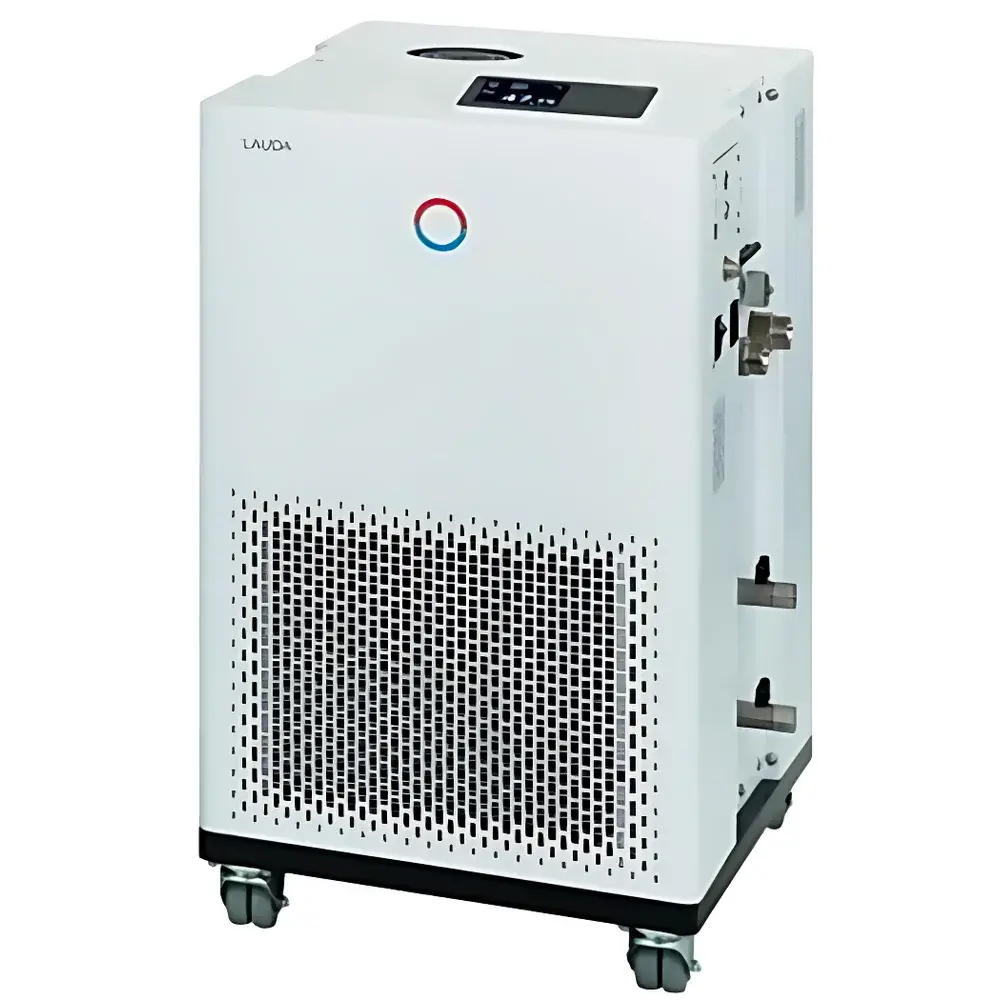
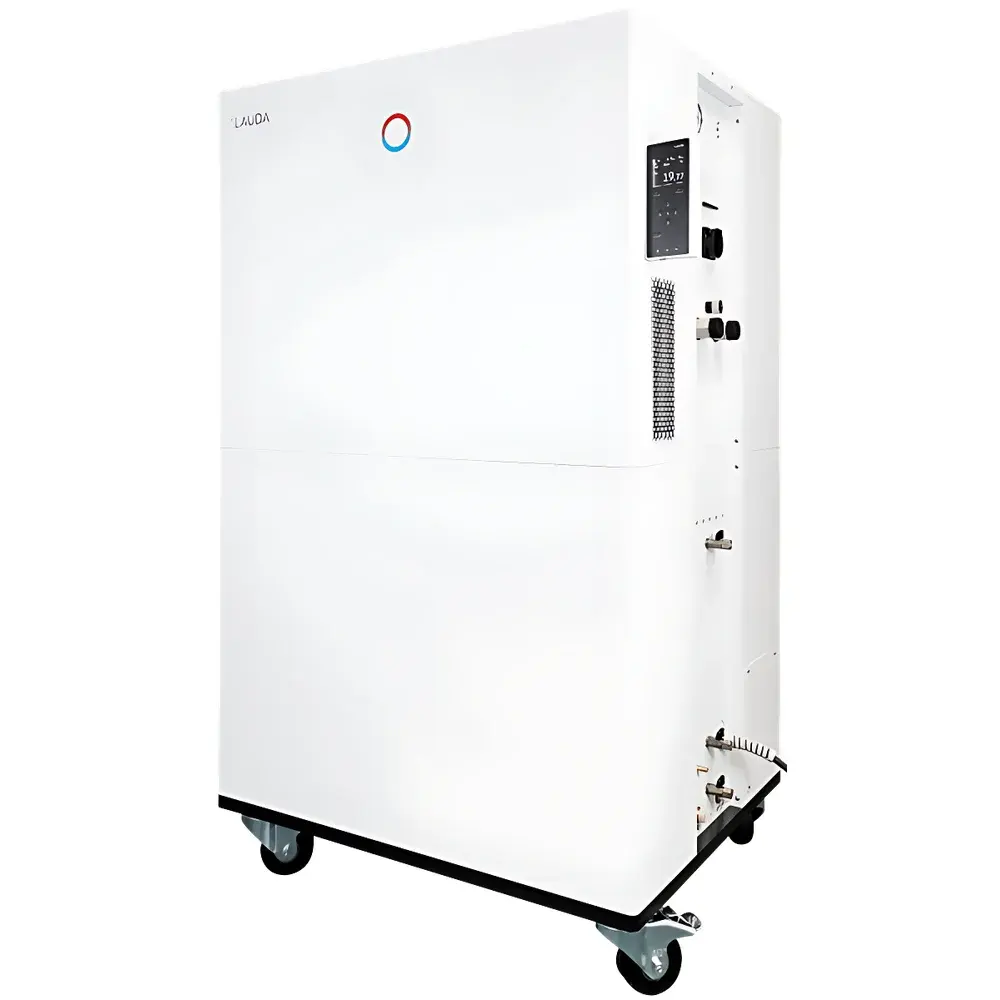
LAUDA Integral XT Process Development Heating and Cooling Circulator
| Brand | LAUDA |
|---|---|
| Origin | Germany |
| Model | IN250XTW |
| Temperature Range | -45 °C to +220 °C |
| Heating Power | 3.5 kW |
| Refrigeration Capacity (at 20 °C) | 2.1 kW |
| Max. Flow Rate / Pump Pressure | 65 L/min / 3.1 bar |
| Bath Volume | 2.5–8.7 L |
| Dimensions (W×D×H) | 430 × 550 × 760 mm |
| Compliance | DIN EN 61010-1 |
Overview
The LAUDA Integral XT Process Development Heating and Cooling Circulator is an engineered thermal management platform designed for demanding semiconductor process development, pilot-scale synthesis, and high-precision materials testing. It operates on a closed-loop thermofluid principle—circulating heat-transfer media (e.g., silicone oil, glycol/water, or specialized low-temperature fluids) within a fully sealed system—eliminating exposure to ambient air, oxidation, moisture ingress, or volatile loss. This architecture ensures long-term fluid stability, repeatable thermal performance, and intrinsic safety during extended operation at extreme temperatures. With a certified operating range of –45 °C to +220 °C, the IN250XTW model supports both cryogenic process validation and high-temperature curing or annealing steps common in semiconductor packaging, thin-film deposition precursor conditioning, and wafer-level thermal cycling protocols. Its compliance with DIN EN 61010-1 permits safe operation even when setpoint exceeds the flash point of the working fluid by up to 25 K—a critical requirement for solvent-based lithography or etch chemistry development.
Key Features
- Proportional refrigeration control: Dynamically modulates compressor output based on real-time thermal load, minimizing energy consumption and temperature overshoot.
- Dual-circuit pumping architecture: Independent internal recirculation maintains bath homogeneity and sensor accuracy—even when external flow is interrupted or throttled—ensuring uninterrupted temperature stability at the circulator’s core.
- Vario-speed circulation pump (8-step digital regulation): Enables precise matching of flow rate and pressure to diverse external equipment configurations—from microfluidic manifolds to large-volume reactor jackets—without manual valve adjustments.
- Integrated digital pressure controller: Delivers stable, programmable outlet pressure (range: 2.5–8.7 bar), essential for maintaining consistent heat transfer across high-resistance secondary loops or pressurized reaction vessels.
- Large-diameter fluid connections (standard G1¼” or larger): Reduce hydraulic resistance and pressure drop, maximizing thermal efficiency and enabling compatibility with high-flow industrial peripherals.
- Self-Check diagnostic assistant: Continuously monitors refrigerant pressure, pump status, level sensors, heater integrity, and safety interlocks; logs fault codes and provides actionable guidance via the front-panel display.
- Compact footprint with optimized thermal mass: Small bath volume (2.5–8.7 L depending on configuration) enables rapid temperature ramping (e.g., <10 min from –40 °C to +200 °C with appropriate fluid), accelerating process parameter screening.
Sample Compatibility & Compliance
The Integral XT series accommodates a broad spectrum of thermally sensitive process fluids—including synthetic oils (e.g., Marlotherm SH, Therminol VP-1), aqueous glycols, and low-viscosity fluorinated solvents—subject to chemical compatibility verification per LAUDA’s Material Compatibility Guide. All units are manufactured in Germany under ISO 9001-certified production processes and conform to DIN EN 61010-1 (Safety Requirements for Electrical Equipment for Measurement, Control, and Laboratory Use). The sealed-loop design inherently satisfies containment requirements outlined in semiconductor cleanroom standards (e.g., SEMI F57) and supports GLP-compliant documentation when integrated with validated data acquisition systems. Optional accessories include explosion-proof variants (ATEX Zone 2), inert gas purging kits for oxygen-sensitive applications, and traceable calibration certificates aligned with ISO/IEC 17025.
Software & Data Management
The Integral XT features a built-in RS485 interface (Modbus RTU protocol) and optional Ethernet connectivity for integration into centralized process control environments (e.g., DeltaV, Siemens PCS7, or LabVIEW-based SCADA). LAUDA’s PC-based software—ThermoChill Pro—enables full remote operation, multi-segment temperature programming, real-time trend logging (≥10,000 data points), and export to CSV or XML formats. Audit trails, user access levels, and electronic signatures can be implemented to meet FDA 21 CFR Part 11 requirements when deployed in regulated semiconductor R&D or qualification labs. All temperature and pressure data are timestamped with millisecond resolution and linked to hardware-calibrated Pt100 sensors (Class A tolerance, ±0.15 °C at 0 °C).
Applications
- Thermal qualification of photoresist formulations and developer solutions across sub-zero to >200 °C ranges.
- Temperature-controlled testing of die-attach adhesives, underfill materials, and encapsulants during cure profiling.
- Stabilization of laser diodes, optical detectors, and RF components during parametric characterization.
- Process simulation for atomic layer deposition (ALD) and chemical vapor deposition (CVD) precursor delivery lines.
- Calibration and verification of infrared thermography systems and contact thermometers used in wafer metrology.
- Controlled cooling/heating of electrochemical cells during battery-material synthesis relevant to advanced packaging substrates.
FAQ
What temperature stability and uniformity can be expected across the bath volume?
Typical stability is ±0.03 °C at steady state; bath uniformity is ±0.05 °C (measured at 3 spatial points, 5 cm below surface) when operating within ±10 °C of ambient.
Is the IN250XTW compatible with silicone-based heat-transfer fluids rated to 300 °C?
Yes—provided the selected fluid has a minimum flash point ≥245 °C and is chemically compatible with stainless steel 316 and EPDM seals; consult LAUDA’s Fluid Compatibility Database before selection.
Can the unit operate unattended for extended periods (e.g., overnight or weekend runs)?
Yes—the Self-Check system continuously validates operational integrity, and optional alarm relay outputs can trigger shutdown or notification via building management systems.
Does LAUDA provide IQ/OQ documentation packages for GMP environments?
Yes—validated installation and operational qualification templates, along with factory-as-tested calibration reports, are available upon request for regulated semiconductor manufacturing support labs.