
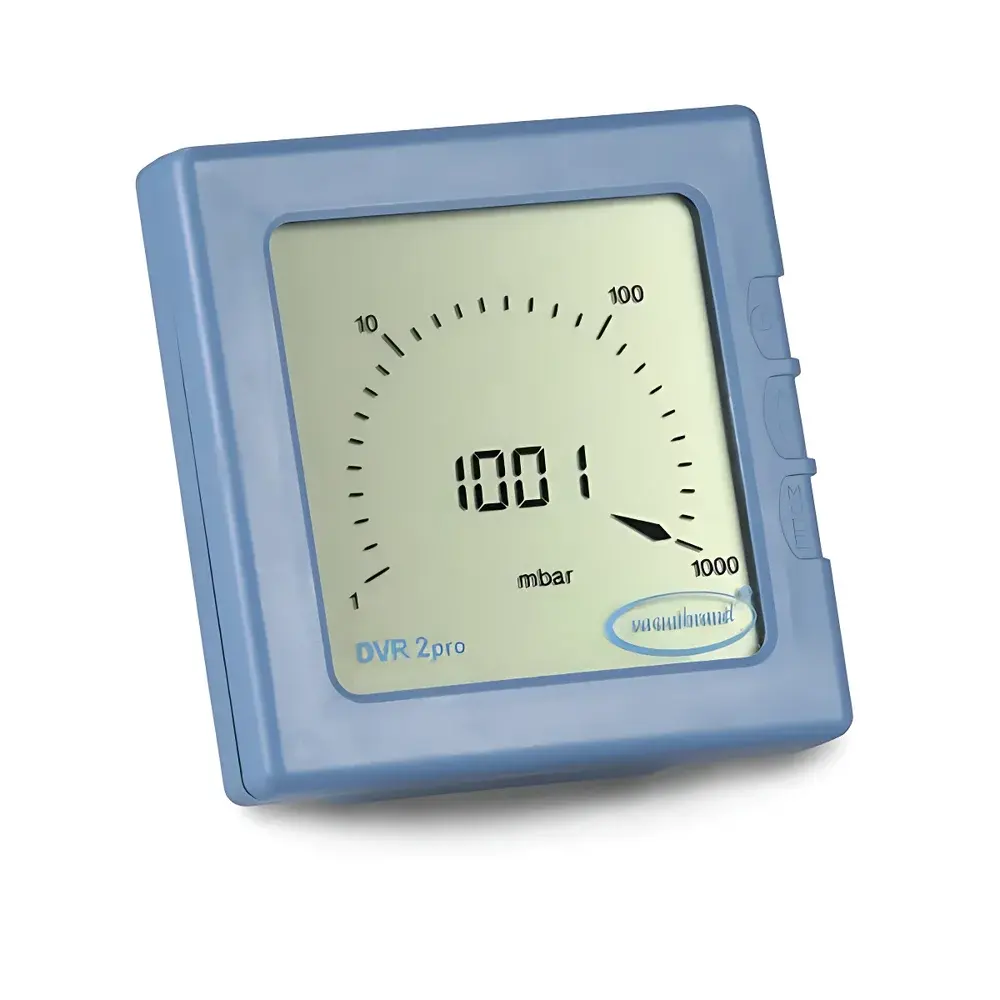
VACUUBRAND DVR2 PRO Digital Vacuum Gauge
| Brand | VACUUBRAND® |
|---|---|
| Origin | Germany |
| Model | DVR2 PRO |
| Measurement Range | 1060 mbar to 1 mbar |
| Principle | Capacitive ceramic diaphragm (Al₂O₃) |
| Accuracy | ±1 mbar/hPa/Torr (calibrated, isothermal) |
| Vacuum Interface | KF DN 16 flange + DN 6/10 mm hose nipple |
| Power Supply | 9 V lithium battery (Ultralife U9VL, 1.2 Ah) |
| Dimensions (L×W×H) | 115 × 115 × 66 mm |
| Weight | 0.375 kg |
| Display | Graphic LCD with dual numeric/trend visualization |
| Pressure Units | Selectable (mbar, hPa, Torr) |
| Chemical Resistance | Full gas-path compatibility with aggressive media (ceramic sensor & PTFE/FKM wetted materials) |
Overview
The VACUUBRAND DVR2 PRO Digital Vacuum Gauge is a precision-engineered, battery-powered capacitance manometer designed for reliable absolute pressure measurement across a broad vacuum range—from ambient atmospheric pressure (1060 mbar) down to 1 mbar. It employs a robust alumina (Al₂O₃) ceramic diaphragm sensor, offering inherent chemical inertness and long-term stability in demanding laboratory environments. Unlike thermal or Pirani-based gauges, the DVR2 PRO utilizes capacitive transduction, delivering high repeatability and minimal drift under isothermal conditions. Its all-electronic architecture eliminates moving parts or filament dependencies, ensuring consistent performance across variable gas compositions—including corrosive, condensable, or solvent-laden vapors commonly encountered in rotary evaporation, vacuum drying, distillation, and glovebox monitoring applications.
Key Features
- Capacitive ceramic diaphragm sensor (Al₂O₃) with full chemical resistance to acids, bases, halogenated solvents, and organic vapors—no oil contamination or sensor degradation over time
- High-contrast graphical LCD display showing real-time numeric pressure value plus dynamic trend bar for rapid qualitative assessment of vacuum evolution
- Three selectable pressure units (mbar, hPa, Torr) configurable via intuitive menu navigation—no external software required
- Modular mechanical design featuring dual interface options: standardized KF DN 16 vacuum flange and dual-port elastomeric hose nipples (DN 6 mm and DN 10 mm) for flexible integration into benchtop systems, vacuum manifolds, or custom enclosures
- Integrated adjustable support stand with 360° rotation and tilt-lock mechanism—enables optimal viewing angle on cluttered workbenches or inside fume hoods
- Low-power electronics optimized for extended battery life; firmware-controlled sleep mode and auto-shutdown reduce consumption without compromising responsiveness
- 9 V lithium primary battery (Ultralife U9VL, 1.2 Ah) housed in bottom-access compartment—tool-free replacement ensures minimal downtime during routine maintenance
Sample Compatibility & Compliance
The DVR2 PRO is engineered for direct contact with process gases and vapors typical in academic, pharmaceutical, and materials science laboratories. All wetted components—including the ceramic sensing element, PTFE-sealed housing gaskets, and FKM O-rings—are selected per ISO 2852 and ASTM F2248 standards for chemical compatibility. The device complies with IEC 61000-6-3 (EMC emission) and IEC 61000-6-2 (immunity) requirements. While not intrinsically safe-certified, its low-energy operation (<18 W peak draw) and absence of ignition sources make it suitable for use in non-hazardous classified areas (Zone 2 / Class I, Division 2) when installed per local electrical codes. Calibration traceability follows DIN EN ISO/IEC 17025 guidelines, with factory certification provided for each unit.
Software & Data Management
The DVR2 PRO operates as a standalone instrument with no proprietary software dependency. All configuration—including unit selection, backlight timeout, and zero-offset adjustment—is performed locally via tactile membrane buttons. The device does not store historical data or generate audit trails; however, its stable analog output (0–10 V or 4–20 mA optional via external adapter module) supports integration into SCADA or LIMS platforms compliant with FDA 21 CFR Part 11 when paired with validated data acquisition hardware. For GLP/GMP workflows requiring documentation, users may pair the gauge with third-party chart recorders or programmable logic controllers that maintain timestamped logs and user access controls.
Applications
- Monitoring vacuum integrity during rotary evaporation of acid-sensitive or moisture-reactive compounds
- Process control in freeze-drying cycles where pressure stability below 10 mbar is critical for sublimation rate optimization
- Leak testing of vacuum chambers, gloveboxes, and Schlenk lines using decay-rate analysis
- Calibration reference for mechanical vacuum gauges (e.g., Bourdon tubes, McLeod gauges) in metrology labs
- Teaching instrumentation principles in undergraduate physical chemistry labs—demonstrating capacitive transduction, gas law deviations, and vacuum system dynamics
- Integration into automated synthesis reactors where compact size and chemical resilience prevent cross-contamination between reaction steps
FAQ
Is the DVR2 PRO compatible with aggressive solvents such as HF, Cl₂, or hot chlorinated hydrocarbons?
Yes—the ceramic diaphragm and fluoropolymer wetted materials are rated for continuous exposure to most common laboratory chemicals per manufacturer’s compatibility charts. However, prolonged contact with anhydrous HF or molten alkali metals is not recommended.
Can the DVR2 PRO be used for rough vacuum measurements below 1 mbar?
No—it is specified for 1060 mbar to 1 mbar only. For lower pressures (e.g., high vacuum), a separate Pirani or cold cathode gauge must be employed.
Does the device require periodic recalibration?
Annual verification against a NIST-traceable reference is recommended for GLP-compliant operations; field zeroing via atmospheric venting is supported for routine checks.
Is the battery replaceable in the field without tools?
Yes—the bottom-mounted battery compartment opens without screws or tools, enabling quick replacement during active experiments.
What is the temperature operating range for accurate measurement?
The specified accuracy (±1 mbar) applies between 15 °C and 35 °C. Outside this range, thermal compensation algorithms maintain <±3 mbar deviation up to 50 °C.



