
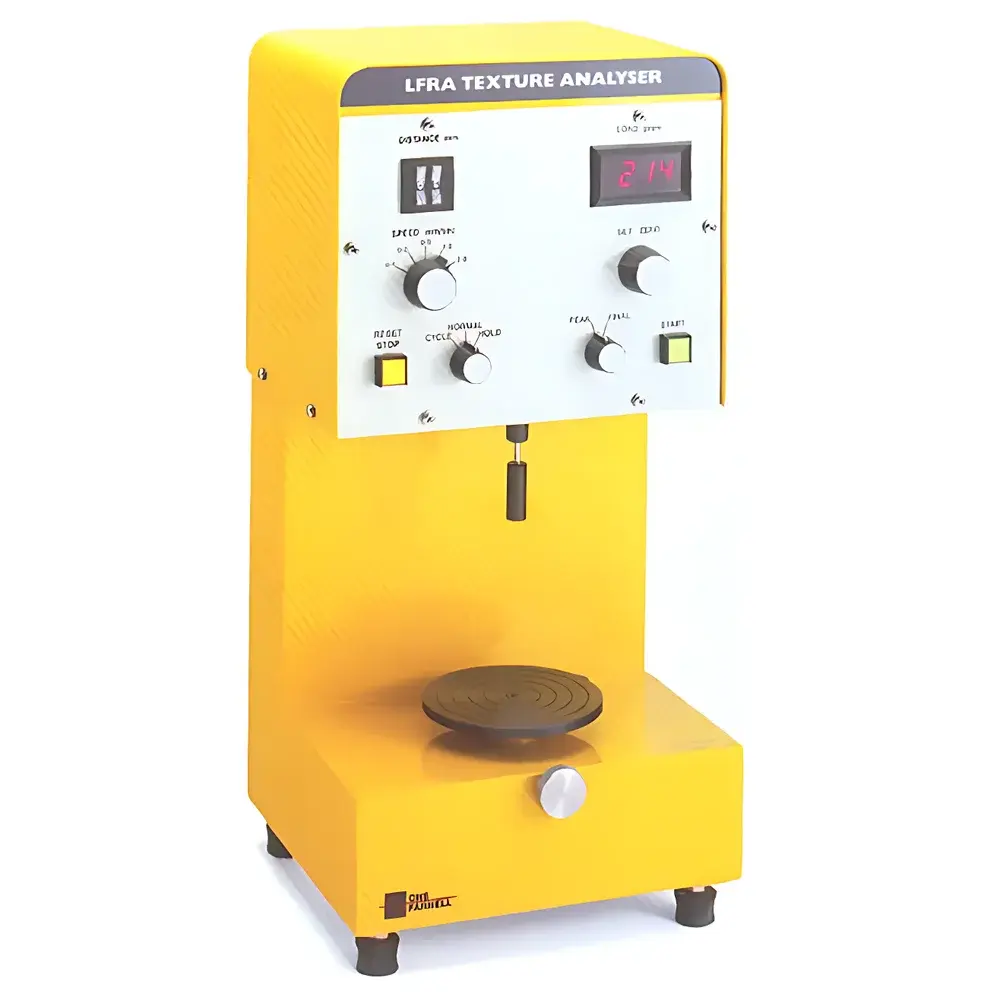
LFRA Texture Analyzer (Gel Strength & Physical Property Tester)
| Origin | USA |
|---|---|
| Manufacturer Type | Authorized Distributor |
| Origin Category | Imported |
| Pricing | Available Upon Request |
Overview
The LFRA Texture Analyzer is a precision-engineered mechanical testing system designed for objective, quantitative measurement of textural and mechanical properties of soft-solid and semi-solid materials. Operating on the principle of controlled axial compression and penetration, the instrument applies a defined force through standardized probes at regulated speed and displacement, capturing real-time load–deformation profiles. Its core methodology aligns with established rheological and material science frameworks—specifically, uniaxial compression testing under quasi-static conditions—enabling derivation of fundamental mechanical parameters including gel strength, hardness, cohesiveness, adhesiveness, and rupture force. As the reference instrument for Bloom gel strength determination in the global gelatin industry, the LFRA conforms to AOAC Official Method 952.03 and BS 757:1968, ensuring regulatory traceability and inter-laboratory comparability across food, pharmaceutical, cosmetic, and polymer quality control environments.
Key Features
- Compliant with AOAC 952.03 and BS 757:1968 for standardized Bloom gel strength testing—validated for routine use in gelatin specification and certification.
- Modular probe architecture supporting over 50 interchangeable stainless-steel and custom-designed probes—including Bloom pistons (12.7 mm diameter), spherical, cylindrical, wedge, and puncture tips—enabling method-specific configuration for diverse sample geometries and failure modes.
- High-resolution load cell with extended dynamic range (typically ±0.1–500 N, depending on model configuration), engineered for sub-milligram force resolution and high reproducibility across repeated cycles.
- Programmable test sequences with adjustable pre-test speed, trigger threshold, test speed, hold time, and return speed—fully customizable via intuitive software interface to replicate ASTM F3142 (for food texture), USP , or internal SOPs.
- Robust electromechanical drive system featuring brushless DC motor and precision ball-screw actuator, delivering stable crosshead velocity control (0.01–20 mm/s) with minimal vibration and thermal drift.
- Integrated safety interlocks, emergency stop, and overload protection compliant with IEC 61000-6-2/6-4 and CE Machinery Directive 2006/42/EC.
Sample Compatibility & Compliance
The LFRA accommodates a broad spectrum of viscoelastic and heterogeneous materials—including gelatin gels, hydrocolloid matrices, dairy products (yogurts, cheeses), confectionery (gummies, marshmallows), baked goods, rubber compounds, waxes, soaps, asphalt binders, adhesives, and cosmetic emulsions. Sample holders are configurable for Petri dishes, beakers, standard Bloom tubes (11.5 mm ID × 100 mm height), or custom fixtures. All testing protocols support GLP-compliant documentation workflows. When paired with audit-trail-enabled software, the system meets data integrity requirements under FDA 21 CFR Part 11 and EU Annex 11 for regulated laboratories conducting QC/QA, stability studies, or supplier qualification.
Software & Data Management
The LFRA operates with dedicated Windows-based analysis software supporting multi-language UI, real-time graphing, and automated parameter extraction—including peak force (Bloom value), slope (stiffness), area under curve (toughness), distance to break, and relaxation modulus. Raw force–distance data is exported in CSV, TXT, or XML formats for integration into LIMS or statistical process control (SPC) platforms. Software features include user-level access control, electronic signatures, version-controlled method libraries, and full audit trail logging of all test executions, parameter changes, and data exports—ensuring full compliance with ISO/IEC 17025 and GMP documentation standards.
Applications
- Gelatin quality control: Bloom strength quantification per AOAC/BS standards for raw material acceptance and batch release.
- Food product development: Texture profiling of plant-based alternatives, infant formulas, and ready-to-eat meals to correlate instrumental data with sensory panel outcomes.
- Pharmaceutical excipient characterization: Hardness and disintegration behavior of chewable tablets and gel-cap formulations.
- Adhesive and sealant R&D: Cohesive strength, tack, and peel resistance evaluation under controlled humidity and temperature conditions.
- Polymer and elastomer testing: Compression set, resilience, and stress-relaxation behavior in rubber and silicone compounds.
- Regulatory submission support: Generation of repeatable, defensible mechanical data for FDA GRAS dossiers, EFSA scientific opinions, and patent applications.
FAQ
What standards does the LFRA Texture Analyzer comply with for gelatin testing?
It is fully aligned with AOAC Official Method 952.03 and British Standard BS 757:1968 for Bloom gel strength determination.
Can the LFRA be used for non-food applications such as adhesives or polymers?
Yes—the instrument’s modular probe design and programmable test logic support mechanical characterization across food, pharma, cosmetics, and industrial materials.
Is the system compliant with FDA 21 CFR Part 11?
When operated with validated software featuring electronic signatures, audit trails, and role-based access control, it meets Part 11 requirements for electronic records and signatures.
Does the LFRA require annual calibration by an accredited service provider?
Yes—routine calibration using NIST-traceable force and displacement standards is recommended annually or per internal quality protocol to maintain measurement uncertainty within specified tolerances.
Are probe calibration certificates included with each accessory?
Each probe is supplied with individual dimensional verification documentation; force calibration certificates are provided with the base system and must be renewed per ISO/IEC 17025-accredited procedures.





