
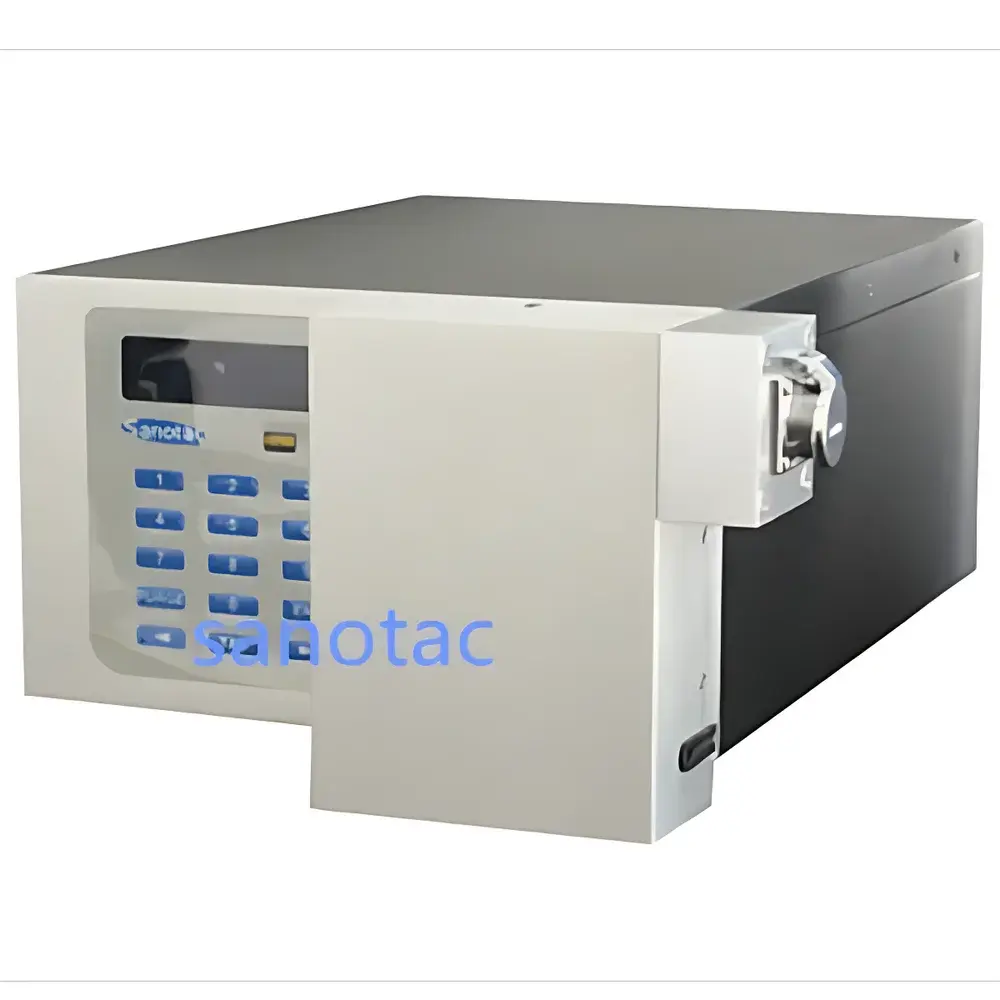
Sanotac TH1010 High-Temperature Hastelloy Constant Flow Pump
| Brand | Sanotac |
|---|---|
| Origin | Shanghai, China |
| Manufacturer Type | Direct Manufacturer |
| Product Origin | Domestic (China) |
| Model | TH1010 |
| Flow Rate | 0.01–100.00 mL/min |
| Pressure Rating | ≤10 MPa |
| Temperature Control Range | Ambient to 100 °C |
| Temperature Accuracy | ±1 °C |
| Flow Accuracy | ±0.5% |
| Flow Precision (RSD) | ≤0.1% |
| Flow Increment | 0.01 mL/min |
| Pressure Pulsation | ≤0.2 MPa |
| Fluid Path Materials | Hastelloy C-276, Sapphire, PTFE, PCTFE, Ceramic |
| Drive Mechanism | Dual Parallel Piston with Floating Piston Design |
| Display | 256×64 Dot Matrix Self-Illuminating LCD |
| Communication Interfaces | RS232, RS485 |
| Protocol | Modbus RTU |
| Digital I/O | Switch Input for Start/Stop |
| Power Supply | 85–264 VAC, 50 Hz |
Overview
The Sanotac TH1010 High-Temperature Hastelloy Constant Flow Pump is an engineered solution for precise, thermally stable fluid delivery in demanding laboratory and pilot-scale process environments. Designed around a dual parallel piston architecture with floating piston compensation, the pump delivers high reproducibility under elevated temperature and pressure conditions—critical for applications where thermal expansion, fluid viscosity drift, or material compatibility compromise conventional stainless-steel or PEEK-based systems. Its core operating principle relies on positive displacement via synchronized reciprocating pistons, with real-time electronic pulse suppression and cam-profile flow compensation to minimize volumetric deviation across the full 0.01–100.00 mL/min range. Unlike ambient-only constant flow pumps, the TH1010 integrates zone-specific thermal management: independent heating control of inlet, pump head, and outlet zones ensures uniform fluid temperature throughout the entire wetted path—eliminating thermal gradients that induce flow instability or phase separation in reactive or viscous streams.
Key Features
- Zone-controlled heating system maintaining consistent fluid temperature from inlet to outlet (ambient to 100 °C), with ±1 °C accuracy verified by embedded PT100 sensors
- Hastelloy C-276 wetted components—including pump head, valves, and tubing connectors—providing exceptional resistance to chloride-induced stress corrosion cracking, acidic media, and high-temperature oxidizing environments
- Advanced flow calibration architecture supporting both volumetric and gravimetric delivery modes, with client-side multi-point flow curve correction and factory-traceable calibration certificates
- Integrated electronic pulse damping and dynamic cam compensation algorithms reducing flow pulsation to ≤0.1% RSD at all operating points
- Modular mechanical design offering both monolithic (integrated heater/pump body) and split configurations for flexible integration into reactor skids, catalytic test benches, or continuous flow synthesis platforms
- Dual-channel thermal monitoring with real-time display of inlet, cavity, and outlet temperatures alongside pressure and flow rate on a 256×64 self-illuminating LCD
Sample Compatibility & Compliance
The TH1010 accommodates aggressive process fluids including concentrated mineral acids (HCl, HNO₃, HF up to 20%), molten salts, organometallic catalysts, supercritical CO₂ co-solvents, and high-viscosity polymer melts (up to 50,000 cP at 100 °C). All wetted surfaces conform to ASTM B575 Grade C-276 specifications for Hastelloy alloys. Non-metallic components meet USP Class VI and FDA 21 CFR 177.1550 standards for fluoropolymer contact materials. The pump supports GLP/GMP-aligned operation through audit-trail-capable firmware logging (via optional Ethernet module), timestamped parameter records, and configurable alarm thresholds compliant with IEC 61508 functional safety principles for process instrumentation.
Software & Data Management
The TH1010 supports native integration into industrial automation ecosystems via multiple deterministic communication layers: RS232/RS485 serial interfaces (Modbus RTU), isolated digital I/O for PLC-triggered start/stop, and optional Ethernet/WiFi modules enabling Profinet, Profibus DP, and OPC UA interoperability. Local configuration and diagnostics are accessible through the onboard LCD interface; remote supervision is enabled via SCADA-compatible protocols. Firmware includes built-in data logging (internal flash memory, 10,000+ event capacity), time-stamped pressure–flow correlation plots, and CSV export capability for post-run analysis in MATLAB, Python, or LIMS platforms. All calibration coefficients and thermal offset parameters are stored in non-volatile memory with write-protection logic to prevent unauthorized modification.
Applications
- Catalytic reaction engineering: Controlled co-feeding of corrosive catalyst precursors (e.g., TiCl₄, AlEt₃) and monomers into fixed-bed or slurry-phase reactors
- High-temperature electrochemical synthesis: Stable delivery of molten salt electrolytes (LiCl–KCl eutectic) at 450 °C-equivalent equivalent viscosity profiles
- Continuous hydrothermal carbonization: Metering of lignocellulosic feedstock slurries under subcritical water conditions (200–350 °C simulated via pre-heated inlet)
- Advanced battery material processing: Precise dosing of fluoride-containing cathode precursors (e.g., LiNi₀.₈Co₀.₁₅Al₀.₀₅O₂ slurries) without metal leaching
- Fuel upgrading research: High-pressure injection of hydrogen donors (tetralin, decalin) into heavy oil fractions during hydrotreating simulations
FAQ
What is the maximum allowable fluid temperature at the pump head?
The pump head is rated for continuous operation at fluid temperatures up to 100 °C. External pre-heating beyond this limit is not recommended, as thermal expansion mismatch may affect seal integrity and piston alignment.
Can the TH1010 be integrated into a distributed control system (DCS)?
Yes—via RS485 Modbus RTU or optional Ethernet module supporting Modbus TCP, Profinet, or OPC UA, enabling bidirectional setpoint control and real-time telemetry within DCS/SCADA architectures.
Is traceable calibration documentation provided with each unit?
Each TH1010 ships with a factory-issued calibration report listing flow accuracy (±0.5%) and repeatability (≤0.1% RSD) measurements at five points across the operational range, certified per ISO/IEC 17025-accredited procedures.
How is thermal uniformity maintained across the fluid path?
Three independently controlled heating zones (inlet, pump cavity, outlet) are regulated using PID algorithms with feedback from embedded Pt100 sensors, ensuring ΔT ≤ 0.5 °C between any two measurement points under steady-state conditions.
What maintenance intervals are recommended for continuous 24/7 operation?
Piston seals and check valves require inspection every 2,000 hours; full wetted component replacement is recommended every 8,000 hours under typical high-purity chemical service. Preventive maintenance schedules align with ISO 13374 condition monitoring standards.



