
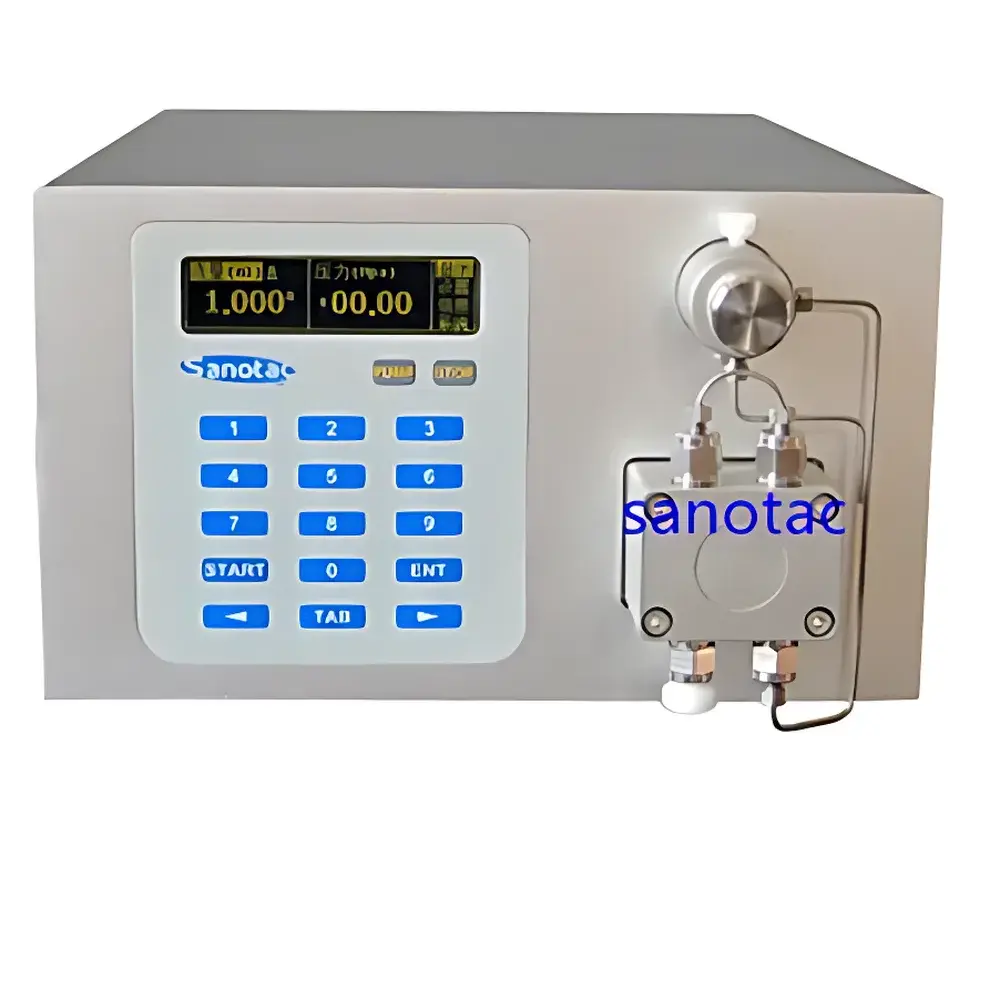
Sanotac S0140n High-Pressure Precision Metering Pump for Ultra-Pure Water & Electrolyte Delivery in Hydrogen Fuel Cell and Advanced Battery Manufacturing
| Brand | Sanotac |
|---|---|
| Model | S0140n |
| Origin | Shanghai, China |
| Manufacturer Type | Direct Manufacturer |
| Flow Range | 0.001–100.00 mL/min |
| Max Pressure | 40 MPa |
| Flow Accuracy | ±0.5% |
| Flow Repeatability | ≤0.1% |
| Pressure Pulsation | ≤0.1 MPa |
| Wetted Materials | 316L Stainless Steel, Sapphire, PTFE, Ceramic |
| Communication Interfaces | USB, RS232, RS485/422 (optional), Modbus RTU/ASCII/TCP, Profinet |
| Power Supply | 85–264 VAC, 50 Hz |
| Power Consumption | 75 W |
| Dimensions | 260 × 110 × 110 mm (standard) |
Overview
The Sanotac S0140n is a high-precision, high-pressure positive displacement metering pump engineered for critical fluid delivery tasks in next-generation electrochemical energy systems. It operates on a dual-cam reciprocating plunger principle with integrated real-time flow measurement and digital pressure feedback—eliminating the need for external flow meters or pressure transducers. Designed specifically for ultra-pure water, deionized (DI) water, and low-conductivity electrolytes used in proton exchange membrane (PEM) hydrogen fuel cells, solid oxide fuel cells (SOFCs), and lithium-ion battery electrode coating and electrolyte filling processes, the S0140n delivers traceable, repeatable volumetric dosing under sustained pressures up to 40 MPa. Its architecture complies with fundamental requirements of ISO 8503-2 (surface roughness for wetted components), ASTM D1193 (Type I DI water specifications), and supports process validation frameworks aligned with ICH Q5, Q7, and FDA 21 CFR Part 11 when paired with audit-trail-enabled control software.
Key Features
- Integrated metrology: Onboard flow calibration and real-time pressure sensing with digital display—no external instrumentation required.
- Multi-point flow correction algorithm: Compensates across full dynamic range (0.001–100.00 mL/min) to maintain ±0.5% accuracy and ≤0.1% repeatability per ISO 5725-2.
- Active pulsation suppression: Dual-stage mitigation combining optimized cam profile design and electronic flow pulse compensation, limiting pressure ripple to ≤0.1 MPa RMS at rated load.
- Column cleaning cycle: Automated post-stroke plunger rinse function reduces particulate accumulation at seal interfaces, extending service life of sapphire/PTFE seals by >300% under continuous DI water operation.
- Compression compensation logic: Dynamically adjusts stroke volume based on fluid compressibility and system backpressure—essential for accurate delivery of low-viscosity, near-incompressible media such as DI water at 40 MPa.
- Industrial-grade communications: Native support for Modbus RTU/ASCII over RS485, Modbus TCP via Ethernet, and Profinet IRT for deterministic cycle times <1 ms—enabling seamless integration into ISA-88/ISA-95 compliant automation architectures.
Sample Compatibility & Compliance
The S0140n accommodates chemically aggressive and ultra-low-particulate fluids common in clean-energy manufacturing. Wetted path materials include electropolished 316L stainless steel (Ra ≤ 0.4 µm), synthetic sapphire (Vickers hardness 2000 HV), virgin PTFE (ASTM D4894 compliant), and alumina ceramic—validated for compatibility with ASTM D1193 Type I water, 0.1 M KOH, 1 M H₂SO₄, LiPF₆-based carbonate solvents, and Nafion® dispersion media. All models meet CE Machinery Directive 2006/42/EC, RoHS 2011/65/EU, and EMC Directive 2014/30/EU. Optional ATEX Zone 2/22 certification is available for solvent-handling variants.
Software & Data Management
The pump supports both embedded and host-based control via optional Sanotac FlowMaster™ software (Windows/Linux). Key capabilities include: configurable flow unit switching (mL/min, g/min, µL/s); programmable delivery profiles (constant, linear ramp, multi-step gradient); real-time overlay of flow vs. pressure trend curves; timestamped CSV export with metadata (operator ID, method name, ambient temperature, system uptime); and GLP-compliant audit trail logging (user login/logout, parameter changes, calibration events). When deployed with SCADA or DCS systems, it satisfies FDA 21 CFR Part 11 requirements for electronic records and signatures through role-based access control, digital signature enforcement, and immutable event logs.
Applications
- Hydrogen fuel cell MEA (membrane electrode assembly) humidification and catalyst ink dispensing at controlled stoichiometric ratios.
- In-line DI water circulation in PEM electrolyzer stack cooling loops with closed-loop conductivity monitoring.
- Electrolyte filling of prismatic and pouch lithium-ion cells under vacuum-assisted pressure control (0.1–10 MPa).
- Delivery of nanoscale slurry suspensions during slot-die coating of solid-state battery cathodes (e.g., LiCoO₂, NMC811).
- Calibration fluid supply in high-pressure chromatography systems for battery degradation product analysis (ICP-MS, LC-MS).
- Process validation studies requiring GMP-grade traceability in pilot-scale battery dry room environments (ISO 14644 Class 5–7).
FAQ
Does the S0140n require external flow calibration to maintain accuracy?
No. The pump features factory-traceable multi-point internal calibration stored in non-volatile memory. Field recalibration can be performed using certified gravimetric standards without disassembly.
Can it operate continuously at 40 MPa with DI water?
Yes—provided inlet water meets ASTM D1193 Type I specifications (resistivity ≥18.2 MΩ·cm, TOC <10 ppb) and temperature remains within 10–35°C. Thermal expansion compensation is active above 25°C.
Is Profinet communication compatible with Siemens SIMATIC S7-1500 PLCs?
Yes. Pre-certified GSDML v2.3 files are supplied, and cyclic I/O mapping supports process data exchange at 1 ms update intervals with synchronized clock alignment.
What maintenance intervals are recommended for 24/7 operation in battery coating lines?
Plunger seals and check valves require inspection every 2000 operating hours; full metrological verification is recommended annually or after 10,000 cycles, whichever occurs first.
How is zero-point drift compensated during long-duration constant-flow runs?
The firmware executes automatic zero-offset correction every 30 minutes using dual-sensor differential pressure referencing and thermal drift modeling based on internal thermistor readings.



