
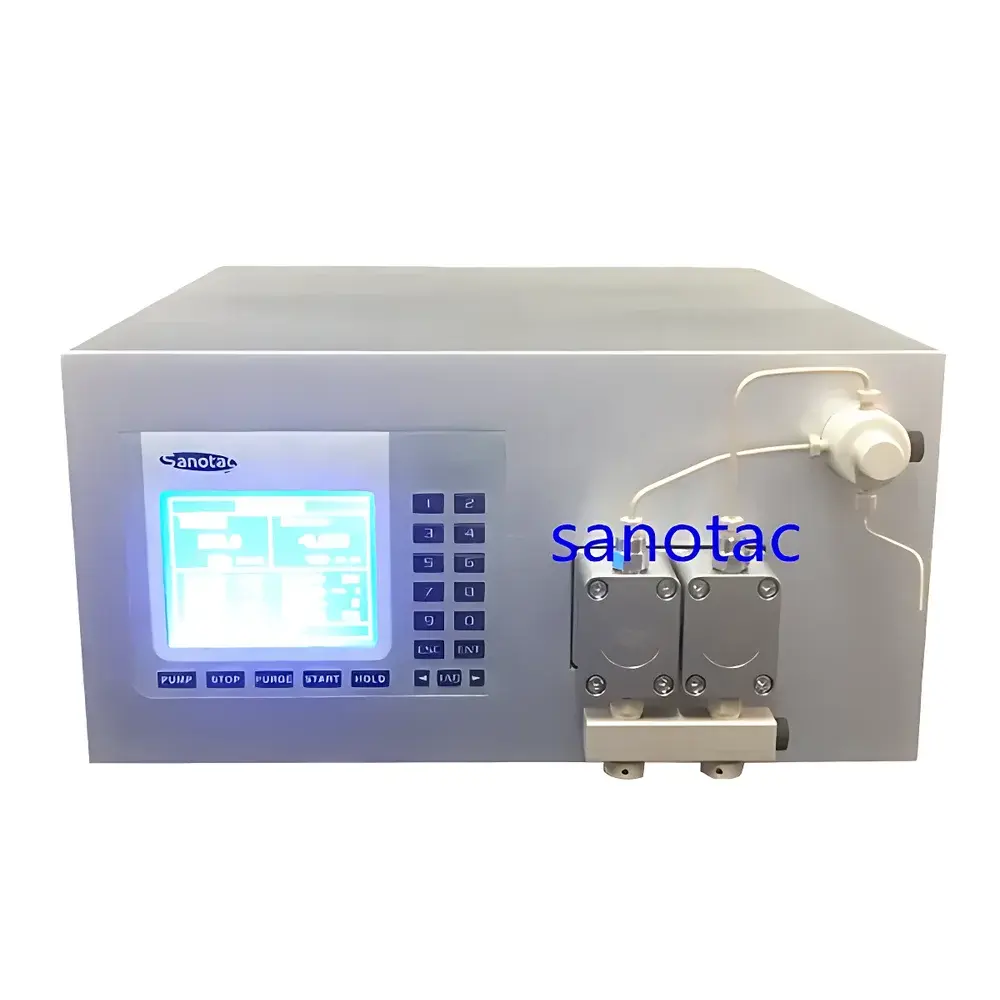
Sanotac LPK0105 High-Flow PEEK High-Pressure Solvent Delivery Pump (Micro-Pulse Precision)
| Brand | Sanotac |
|---|---|
| Origin | Shanghai, China |
| Manufacturer Type | Direct Manufacturer |
| Region of Origin | Domestic (China) |
| Model | LPK0105 (1000 mL/min max flow) |
| Pressure Rating | ≤ 5 MPa |
| Flow Accuracy | ±0.5% |
| Flow Precision (RSD) | ≤ 0.5% |
| Flow Range | 0.1–1000.0 mL/min |
| Increment | 0.1 mL/min |
| Pressure Pulsation | ≤ 0.5 MPa |
| Wetted Materials | PEEK, Sapphire, PTFE, Ceramic (Embedded PEEK Pump Head) |
| Tubing Connection | 1/8" Standard Fitting |
| Display | 256×64 Dot Matrix Backlit LCD |
| Control Interface | Front Panel + Open-Protocol RS232/USB Computer Remote Control |
| Power Supply | 85–264 VAC, 50 Hz |
| Dimensions | 550 × 420 × 222 mm³ |
Overview
The Sanotac LPK0105 is a high-flow, high-pressure solvent delivery pump engineered for precision fluid handling in demanding laboratory and pilot-scale applications. Based on dual-piston parallel architecture with floating piston design, it operates on positive displacement principles—leveraging synchronized cam-driven actuation to deliver consistent volumetric flow across a wide dynamic range (0.1–1000.0 mL/min) while maintaining pressure stability up to 5 MPa. Its core engineering addresses two critical challenges in high-throughput fluidic systems: pulse suppression and solvent compressibility compensation. By integrating cam profile optimization, real-time electronic pulse damping, and multi-point flow calibration algorithms, the LPK0105 achieves ≤0.5% flow RSD and ±0.5% absolute accuracy—performance metrics validated under ISO 5725-2 traceable test conditions. Unlike conventional single-piston pumps, its dual-head configuration enables continuous flow without dead volume interruption, making it suitable for uninterrupted operation in reaction feeding, supercritical fluid delivery, and continuous chromatographic workflows.
Key Features
- Dual-piston parallel pumping mechanism with floating piston assembly to minimize seal wear and extend service life of high-pressure PEEK seals
- Micro-pulse flow control architecture incorporating cam curve compensation and active electronic pulsation suppression, reducing pressure ripple to ≤0.5 MPa (peak-to-peak)
- Solvent compressibility compensation algorithm dynamically adjusts stroke volume based on solvent type and operating pressure, ensuring volumetric fidelity across mobile phases
- Multi-point flow calibration across the full range (0.1–1000 mL/min), enabling linear and non-linear gradient generation with programmable ramp profiles
- Chemically inert fluid path constructed from PEEK housing, sapphire check valves, ceramic plungers, and PTFE seals—compatible with aggressive solvents, acids, bases, and SCF media
- Open communication protocol (RS232/USB) compliant with industry-standard ASCII command sets, enabling integration with third-party CDS platforms or custom LabVIEW/Python control environments
- Self-luminous 256×64 dot-matrix LCD display with intuitive menu navigation and real-time parameter feedback including flow rate, pressure, gradient progress, and error codes
Sample Compatibility & Compliance
The LPK0105 is designed for compatibility with a broad spectrum of process fluids—including aqueous buffers, organic solvents (acetonitrile, THF, DCM), supercritical CO₂, ionic liquids, catalyst slurries, and polymer melt precursors. Its PEEK-based wetted path meets USP Class VI biocompatibility requirements and resists hydrolysis, oxidation, and halogen-induced degradation. The pump conforms to IEC 61010-1 for electrical safety in laboratory equipment and supports GLP/GMP operational traceability through timestamped audit logs (when used with compatible host software). While not certified for FDA 21 CFR Part 11 out-of-the-box, its open control protocol allows integration into validated systems where electronic signatures and audit trail functionality are implemented at the workstation level.
Software & Data Management
The pump supports both standalone operation and computer-controlled sequencing via bidirectional ASCII command protocol. Ten onboard user-defined methods store flow profiles, gradient schedules, and pressure limits—each editable via front panel or external host. When connected to a PC, raw operational data (flow setpoint vs. actual, pressure readings, valve status, temperature warnings) can be streamed at 10 Hz and logged in CSV format. Optional SDK documentation is provided for developers requiring integration with LIMS, MES, or automated reactor control systems. All firmware updates are delivered via signed binary packages to ensure integrity and version control compliance.
Applications
- HPLC and preparative LC systems requiring >500 mL/min flow rates at moderate backpressure (e.g., large-bore column screening, purification scale-up)
- Continuous-flow catalytic reactors—precise co-feeding of reagents, catalysts, and initiators under elevated pressure and temperature
- Supercritical fluid processing (SFE, SFC, impregnation), where stable CO₂ delivery at 5–20 MPa equivalent density is critical
- Electrochemical synthesis cells requiring pulse-free electrolyte circulation to avoid current transients
- Materials science workflows: polymer foaming extrusion, nanomaterial dispersion, battery slurry metering
- Green chemistry research involving switchable solvents, deep eutectic solvents, and biomass-derived feedstocks
FAQ
What is the maximum recommended operating pressure for the LPK0105?
The pump is rated for continuous operation up to 5 MPa (725 psi); pressure relief is managed internally via calibrated mechanical bypass and monitored via integrated pressure transducer.
Can the LPK0105 be used with corrosive solvents such as concentrated HCl or HF?
PEEK and sapphire provide excellent resistance to most mineral acids below 120°C; however, hydrofluoric acid (HF) is not recommended due to potential etching of sapphire components.
Does the pump support gradient mixing at high flow rates?
Yes—the LPK0105 implements gradient generation via time-based flow ratio modulation between two independent channels (when paired with a second unit) or via internal proportional valve sequencing in single-pump configurations.
Is firmware update capability available remotely?
Firmware updates require local USB connection and authenticated binary upload; no cloud-based or OTA update functionality is implemented for security and regulatory compliance reasons.
How often should maintenance be performed on the pump head and seals?
Under typical lab use (8 h/day, aqueous/organic solvents), PEEK seals and sapphire valves require inspection every 6 months; replacement intervals extend to 12+ months when operated below 3 MPa and with filtered, particulate-free fluids.



