
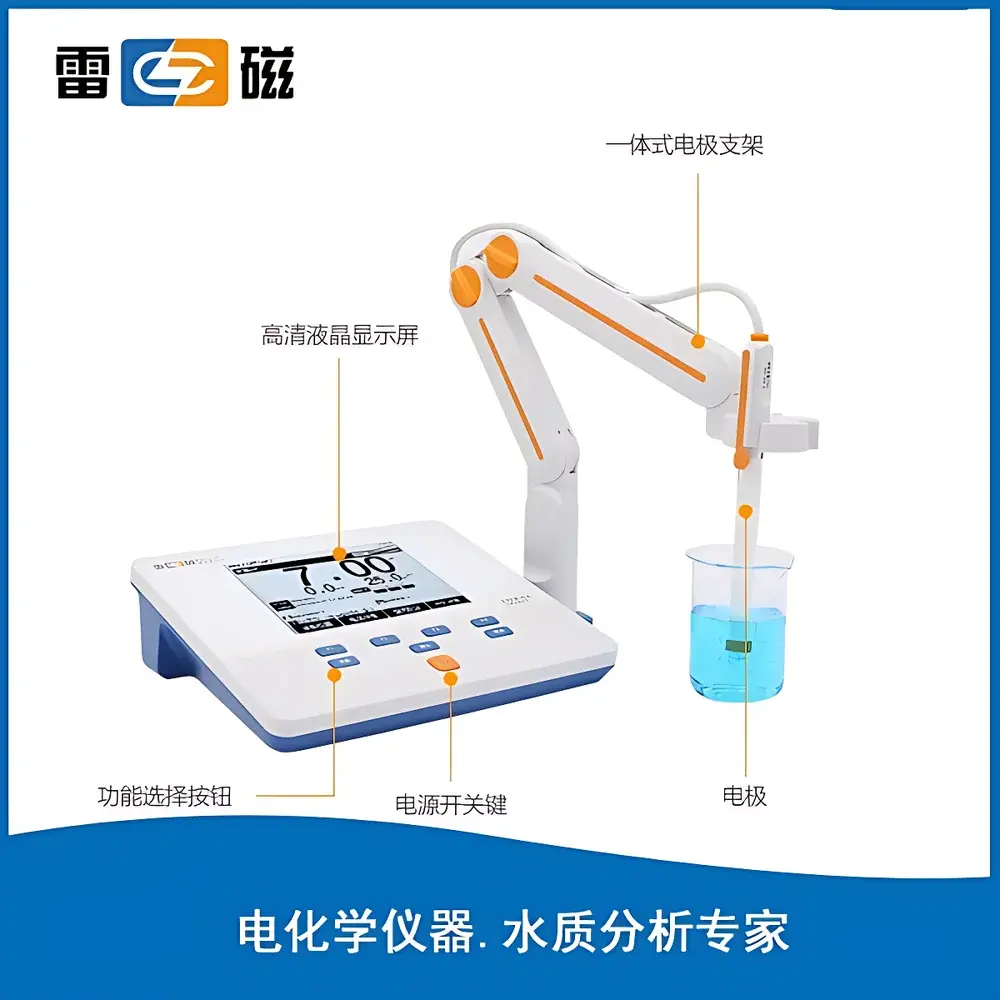
Leici PHSJ-3F Benchtop pH Meter
| Key | Brand: Leici |
|---|---|
| Origin | Shanghai, China |
| Instrument Type | Benchtop |
| Measurement Range | -2.00–20.00 pH |
| Resolution | 0.01 pH |
| Accuracy | ±0.01 pH |
| mV Range | -2000–2000 mV |
| Temperature Range | -5.0–110.0 °C |
| Temperature Resolution | 0.1 °C |
| Input Impedance | ≥1×10¹² Ω |
| Stability | (±0.01 pH ±1 digit)/3 h |
| Calibration Points | Up to 5-point |
| Buffer Recognition | GB, DIN, NIST |
| Data Storage | 500 sets |
| Interface | RS-232, USB |
| Compliance | GLP-supporting |
| Power Supply | AC 100–240 V input / DC 9 V output |
| Dimensions | 242 × 195 × 68 mm |
| Weight | ~1 kg |
Overview
The Leici PHSJ-3F Benchtop pH Meter is a high-precision electrochemical analyzer engineered for routine and regulatory-compliant pH and mV measurements in academic, industrial, and quality control laboratories. Based on potentiometric measurement principles—detecting the electromotive force (EMF) generated across a glass pH electrode relative to a stable reference electrode—the instrument delivers traceable, reproducible results across an extended pH range of –2.00 to 20.00. Its 0.01-class accuracy (±0.01 pH), combined with ≥1×10¹² Ω input impedance, ensures minimal loading error even with high-resistance electrodes or low-conductivity samples such as dilute buffers, organic solvents, or mildly alkaline process streams. Designed for stability-critical environments, the PHSJ-3F maintains measurement integrity over time, exhibiting drift of no more than (±0.01 pH ±1 digit) per 3 hours under controlled conditions.
Key Features
- Triple-mode measurement operation: continuous real-time monitoring, equilibrium-based endpoint detection, and programmable timed acquisition (interval or single-trigger)
- Intelligent equilibrium assessment algorithm with visual and audible prompts when stable potential is achieved
- GLP-compliant data management: user ID and sample ID assignment, timestamped records, and audit-ready storage of up to 500 measurement sets
- Multi-standard buffer recognition: automatic identification of GB (Chinese national standard), DIN (German), and NIST-traceable pH calibration solutions
- Flexible calibration architecture: supports 1–5 point pH calibration with slope and offset diagnostics; displays theoretical and measured electrode response (% theoretical slope)
- Dual-parameter capability: simultaneous pH and mV measurement with ±0.1% FS accuracy in mV mode (–2000 to +2000 mV)
- Integrated temperature compensation: manual or automatic (via optional T818B6 probe), covering –5.0 to 110.0 °C with 0.1 °C resolution
- Robust connectivity: RS-232 port for direct thermal printer output (e.g., TP-16); USB interface compatible with Leici’s certified PC communication software for raw data export and report generation
Sample Compatibility & Compliance
The PHSJ-3F accommodates a broad spectrum of aqueous and semi-aqueous matrices—including buffer solutions, pharmaceutical formulations, food extracts, wastewater effluents, and mild caustic cleaning agents—within its extended pH range. Its high-input-impedance circuitry minimizes polarization effects during measurement of low-conductivity samples. The instrument conforms to fundamental requirements of ISO/IEC 17025 for testing laboratory competence and supports adherence to Good Laboratory Practice (GLP) and Good Manufacturing Practice (GMP) documentation workflows. While not inherently 21 CFR Part 11 compliant out-of-the-box, its structured data logging, user authentication fields, and immutable timestamping provide a foundational architecture for validation under regulated environments when paired with validated software and procedural controls.
Software & Data Management
Leici’s proprietary communication software enables bidirectional data exchange via USB, supporting CSV and Excel-compatible export formats for integration into LIMS or statistical analysis platforms. Each stored record includes pH/mV values, temperature, calibration status, electrode ID (if entered), operator ID, sample ID, and full timestamp (date, time, timezone). The system enforces sequential record numbering and prohibits manual editing of stored entries—ensuring data integrity. Optional firmware updates (distributed via Leici’s authorized support channels) maintain compatibility with evolving operating systems and security standards.
Applications
- Quality assurance of raw materials and finished products in pharmaceutical, cosmetic, and food & beverage manufacturing
- Environmental monitoring of surface water, groundwater, and treated effluent per EPA and ISO 10523 protocols
- Academic teaching labs requiring robust, entry-level potentiometric instrumentation with intuitive operation
- Routine calibration verification and performance qualification of pH electrodes and buffer standards
- Process development studies involving non-standard pH regimes (e.g., strong acid hydrolysis or concentrated alkali neutralization)
- Supporting ASTM D1293 (Standard Test Method for pH of Water) and USP (pH Measurement) procedures
FAQ
What pH calibration standards are supported by default?
The PHSJ-3F automatically recognizes GB (pH 4.01, 6.86, 9.18), DIN (pH 1.68, 4.01, 6.86, 9.22), and NIST (pH 4.01, 6.86, 9.18, 10.01, 12.45) buffer sets. Users may also define custom calibration points.
Can the instrument measure pH in non-aqueous solvents?
Yes—provided appropriate electrodes (e.g., double-junction or solvent-resistant reference systems) are used and calibrated in matching media; however, accuracy and response time may vary versus aqueous systems.
Is temperature compensation mandatory for accurate pH readings?
While manual temperature entry is possible, automatic compensation using a certified Pt1000 or thermistor probe (e.g., T818B6) is strongly recommended to correct for the Nernstian temperature dependence of electrode potential.
Does the PHSJ-3F meet international metrological traceability requirements?
When calibrated with certified reference materials (CRM) traceable to NIM (National Institute of Metrology, China) or NIST, and operated within specified environmental conditions, the instrument supports metrological traceability per ISO/IEC 17025 clause 6.6.
How is data security handled during PC transfer?
Data transmission occurs over standard USB CDC ACM protocol without encryption; users deploying in regulated settings must implement network-level safeguards and document data handling procedures per internal SOPs.




