
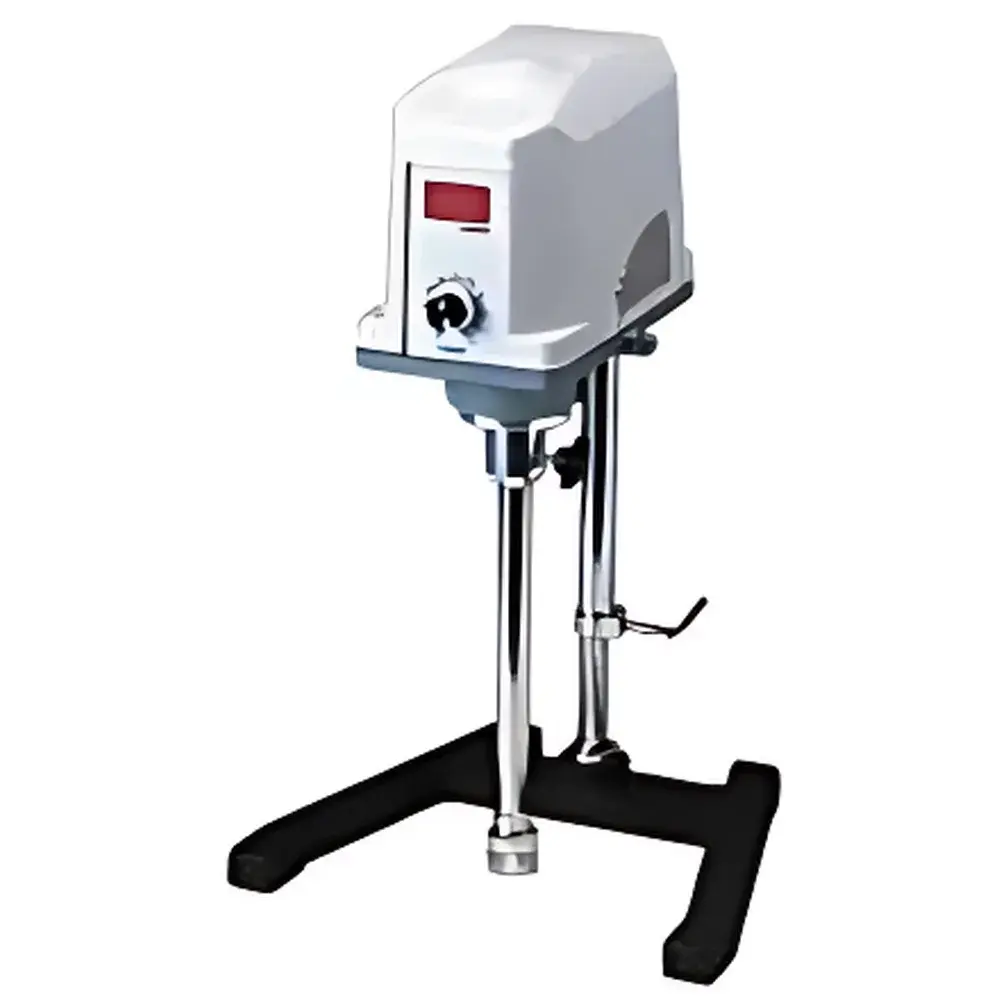
Prema HG200 High-Speed Probe Homogenizer
| Brand | Prema |
|---|---|
| Origin | Taiwan |
| Model | HG200 |
| Instrument Type | Probe-Type Rotor-Stator Homogenizer |
| Dimensions (W×D×H) | 310 × 270 × 670 mm |
| Speed Range | 0–20,000 rpm |
| Motor | DC 250 W |
| Speed Display | Digital LED |
| Processing Volume | 0.3–3000 mL |
| Safety Features | Thermal Cut-off, Overload Protection, Fuse Integration |
| Mounting | Spring-Loaded Vertical Stand |
| Optional Accessories | Automatic Lift System, HM Emulsifying Head, HD Dispersing Head |
Overview
The Prema HG200 is a high-performance, probe-type rotor-stator homogenizer engineered for precise mechanical disruption, emulsification, dispersion, and homogenization of diverse laboratory samples. Operating on the principle of high-shear fluid dynamics—where rapid rotation of a precision-machined rotor within a fixed stator generates intense hydrodynamic forces—the HG200 delivers reproducible particle size reduction and phase stabilization across liquid, semi-solid, and soft-tissue matrices. Its 250 W DC motor enables stable speed control from 0 to 20,000 rpm, supporting applications requiring both gentle mixing and aggressive cell lysis or nano-emulsion formation. Designed for routine use in academic research labs, QC/QA facilities, and pilot-scale formulation development, the HG200 complies with fundamental electrical safety standards (IEC 61010-1) and incorporates structural safeguards aligned with GLP-aligned operational practices.
Key Features
- Digitally controlled variable-speed operation (0–20,000 rpm) with real-time LED speed readout for traceable parameter logging.
- Spring-loaded vertical stand enables rapid, tool-free height adjustment—minimizing cross-contamination risk during sequential sample processing.
- Modular probe system: all rotor-stator assemblies are fully disassemblable for autoclaving (121 °C, 20 min), chemical sterilization, or ultrasonic cleaning—ensuring compliance with biosafety Level 2 (BSL-2) protocols.
- Integrated dual-protection circuitry: thermal cut-off activates at ≥65 °C internal motor temperature; electronic overload protection interrupts power upon sustained current surge beyond rated capacity.
- Universal compatibility with standard labware: accepts vessels ranging from microcentrifuge tubes (0.3 mL) to beakers and jacketed reactors up to 3 L—no custom adapters required.
- Optional automation interface: compatible with Prema’s programmable lift module (HG-LIFT-AUTO) for timed immersion depth control and repeatable stroke profiles.
Sample Compatibility & Compliance
The HG200 accommodates a broad spectrum of sample types—including mammalian tissue homogenates, bacterial lysates, polymer dispersions, pigment suspensions, cosmetic emulsions, and pharmaceutical nanosuspensions—without requiring solvent modification or pre-dilution. Its stainless-steel probe variants (e.g., narrow-tip for low-volume nucleic acid extraction, wide-blade for high-viscosity resins) meet ASTM D4290 (Standard Practice for Homogenization of Polymer Samples) and ISO 13320:2020 (Laser Diffraction Particle Size Analysis—sample preparation guidance). All electrical components conform to CE marking requirements under Directive 2014/30/EU (EMC) and 2014/35/EU (LVD). Device firmware supports audit-trail-capable operation when paired with validated data acquisition software—facilitating alignment with FDA 21 CFR Part 11 expectations for electronic records in regulated environments.
Software & Data Management
While the base HG200 operates as a standalone instrument, its digital speed controller provides analog output (0–10 V DC) and RS-232 serial interface for integration into centralized lab management systems. When used with optional Prema ControlSuite™ v3.2 (sold separately), users gain access to method-based protocol storage, time-stamped run logs, RPM ramp profiling, and exportable CSV reports compliant with ISO/IEC 17025 documentation requirements. All stored methods include operator ID fields, timestamped start/stop events, and error-code history—supporting internal quality audits and external accreditation reviews.
Applications
- Biomedical research: nuclear isolation from cultured cells, mitochondrial enrichment, viral capsid disruption.
- Pharmaceutical development: preparation of submicron drug suspensions, lipid nanoparticle (LNP) pre-emulsions, excipient dispersion in topical gels.
- Materials science: exfoliation of graphene oxide dispersions, carbon nanotube deagglomeration, ceramic slurry homogenization.
- Food & cosmetics: stabilization of oil-in-water emulsions (e.g., mayonnaise analogs, sunscreen bases), pigment dispersion in aqueous colorants.
- Environmental testing: extraction of microplastics from sediment matrices, homogenization of biofilm-coated filters prior to DNA recovery.
FAQ
What is the maximum recommended viscosity for continuous operation?
The HG200 is optimized for Newtonian fluids ≤5,000 mPa·s at 20 °C. For non-Newtonian or highly viscous samples (e.g., polymer melts), intermittent duty cycles (≤30 sec ON / 60 sec OFF) are advised to prevent thermal drift.
Can the HG200 be used under inert atmosphere conditions?
Yes—when fitted with gas-tight probe seals and operated inside gloveboxes or sealed reactor vessels equipped with feedthrough ports, provided ambient temperature remains within 15–35 °C and relative humidity <80% RH.
Is calibration traceable to national standards?
Speed calibration is performed using NIST-traceable optical tachometry during factory acceptance testing; certificate of conformance (CoC) includes uncertainty budget per ISO/IEC 17025 Annex A.3.
How often should the rotor-stator assembly be replaced?
Under typical usage (≤4 hrs/day, aqueous buffers), replacement is recommended every 12 months or after 500 operational hours—whichever occurs first—to maintain shear consistency within ±3% of nominal specification.



