
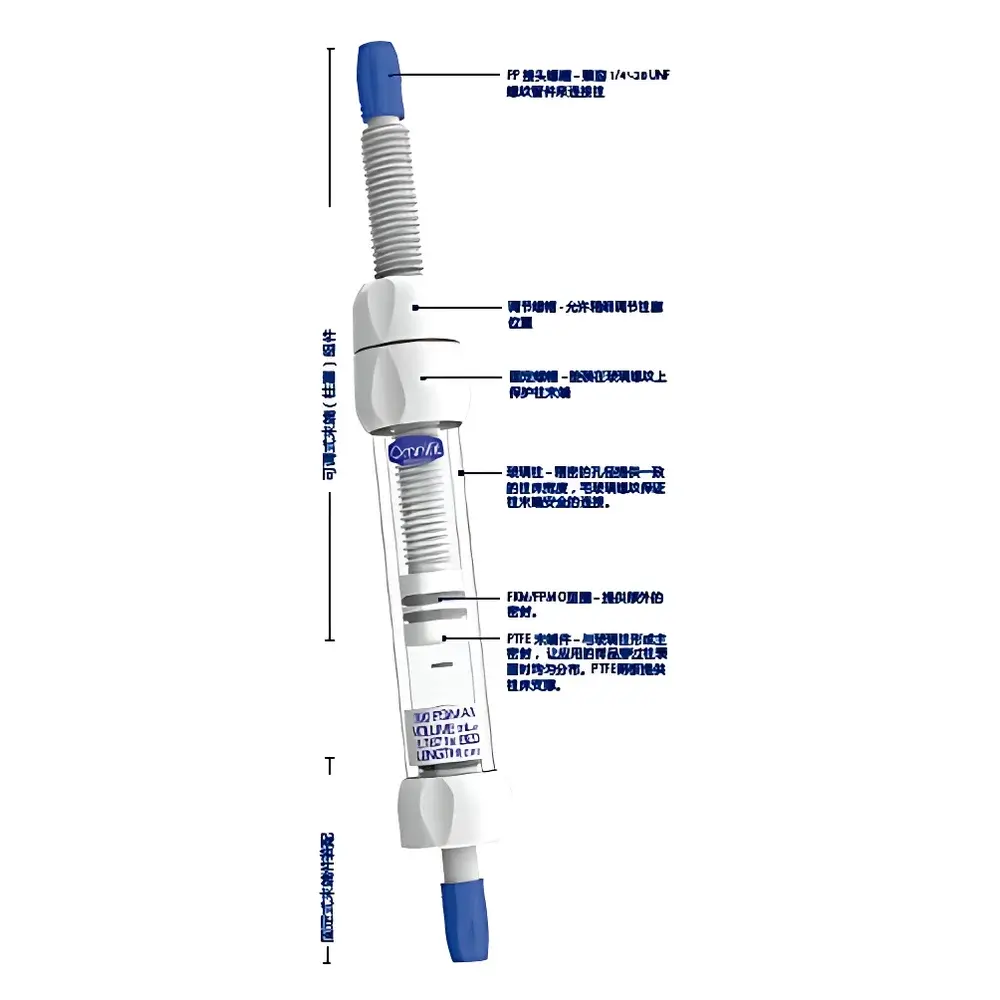
Omnifit EZ SolventPlus Axial Compression Chromatography Column for Antibody and Peptide Purification
| Origin | UK |
|---|---|
| Manufacturer Type | Authorized Distributor |
| Product Origin | Imported |
| Model | 006EZS-10-33-AF |
| Price Range | USD 13,500–27,000 (FOB) |
| Application Level | Laboratory-Scale Preparative Purification |
| Instrument Class | Medium-Low Pressure Preparative Liquid Chromatography System |
| Max Operating Pressure | 900 psi (62 bar) |
| Temperature Range | 4–40 °C |
| pH Stability | 1–14 |
| Chemical Compatibility | Fully compatible with aqueous buffers, acetonitrile, methanol, isopropanol, chloroform, DCM, DMF, DMSO, pyridine, toluene, and formamide |
| Column Construction | Borosilicate glass tube, PEEK™ end fittings, Chemraz® O-rings, PTFE frits (10 µm), ETFE compression nuts and ferrules |
| Axial Compression | Single-ended adjustable (AF configuration) |
| Internal Diameter | 10 mm |
| Bed Height | 330 mm |
| Total Volume | ~25.9 mL |
| Flow Rate Range | 0.1–25 mL/min (system-dependent) |
| Flow Precision & Reproducibility | ≤±1% RSD (with calibrated pump) |
| UV Transparency | Full spectral transmission from 190–800 nm (glass + PEEK path) |
| Base Noise (UV-Vis detector compatible) | < ±0.5 mAU (typical, 1 s response) |
| Data Acquisition Rate | Up to 10 Hz (dependent on connected detector) |
Overview
The Omnifit EZ SolventPlus Axial Compression Chromatography Column (Model 006EZS-10-33-AF) is a high-integrity, laboratory-scale preparative column engineered for reproducible purification of monoclonal antibodies (mAbs), recombinant peptides, fusion proteins, and other biopharmaceutical intermediates under medium-pressure liquid chromatography (MPLC) conditions. Designed around the principles of axial compression chromatography, this column maintains consistent bed density and minimizes channeling or void formation during extended gradient elution—critical for maintaining resolution across multi-gram purification campaigns. Its borosilicate glass body provides optical clarity for real-time bed inspection, while chemically inert wetted materials—including PTFE frits (10 µm pore size), Chemraz® elastomeric seals, and ETFE compression hardware—ensure compatibility with aggressive organic solvents used in reversed-phase peptide purification (e.g., TFA/acetonitrile gradients) as well as aqueous-based ion exchange or affinity protocols. The 10 mm internal diameter and 330 mm bed height support scalable loading capacities (typically 5–50 mg mAb per run on Protein A resin; up to 200 mg synthetic peptide on C18 media), making it suitable for process development, QC batch release testing, and early-stage GMP-aligned purification workflows.
Key Features
- Single-ended axial compression mechanism (AF configuration) enables precise, repeatable bed packing and post-packing consolidation without disassembly—reducing column-to-column variability and extending resin lifetime.
- Borosilicate glass column body (Class A, ISO 3585 compliant) offers mechanical rigidity up to 900 psi (62 bar) at 25 °C and full UV transparency for in-line absorbance monitoring.
- Chemically resistant fluid path: PEEK™ end fittings, PTFE frits (10 µm), Chemraz® O-rings (resistant to swelling in DMSO, DMF, and halogenated solvents), and ETFE compression nuts ensure long-term integrity in multi-solvent sequences.
- Standardized 1/4″-28 UNF inlet/outlet threads enable direct integration with AKTA avant, NGC Discover, Bio-Rad Econo-Pac, and Sanotac Biolot purification systems via PTFE tubing (included).
- Validated operating range: pH 1–14, temperature 4–40 °C, compatible with cleaning-in-place (CIP) protocols using 0.1–1.0 M NaOH, 70% ethanol, or 30% isopropanol.
Sample Compatibility & Compliance
This column supports a broad spectrum of biomolecular purification modalities, including protein A/G/L affinity chromatography for IgG isolation, immobilized metal affinity chromatography (IMAC) for His-tagged constructs, anion/cation exchange (AEX/CEX) for charge-based fractionation, hydrophobic interaction chromatography (HIC), size exclusion chromatography (SEC), and reversed-phase (RP) separation of synthetic peptides. It conforms to key regulatory expectations for lab-scale purification equipment: materials meet USP Class VI biocompatibility requirements; construction avoids leachable metals or plasticizers; and design supports traceable, auditable operation when paired with 21 CFR Part 11–compliant chromatography data systems (CDS). While not a GMP-certified device per se, its dimensional consistency, pressure rating, and chemical resilience align with ICH Q5A/Q5D guidance for purification process characterization and comparability studies.
Software & Data Management
The column itself is hardware-only and requires integration with external control software (e.g., UNICORN 7.x, Bio-Rad Biologics, or third-party LabVIEW-based CDS). When operated with compliant systems, full audit trails—including method parameters, pressure logs, flow rate setpoints, UV chromatograms, and user authentication—are retained per GLP/GMP data integrity standards. Column dimensions, packing history, and maintenance records can be digitally linked to sample IDs via LIMS integration. Optional RFID tagging (available through OEM partners) enables automated column identification and usage tracking across shared core facilities.
Applications
- Monoclonal antibody capture and polishing steps in upstream/downstream process development
- Synthetic peptide purification following solid-phase synthesis (SPPS), especially for >15-mer sequences requiring RP-HPLC resolution
- Purification of bispecific antibodies, antibody-drug conjugates (ADCs), and Fc-fusion proteins
- Removal of endotoxins, host cell proteins (HCP), and DNA impurities via multimodal resins
- Buffer exchange and desalting of concentrated protein solutions using SEC media
- Method scouting and optimization for clinical trial material (CTM) production under non-GMP or GMP-light environments
FAQ
What resin types are validated for use with this column?
Protein A, Protein G, Q Sepharose FF, SP Sepharose FF, Phenyl Sepharose CL-4B, Superdex 200 Increase, and Kromasil C18 are routinely packed and operated within specification. Resin slurry concentration, settling time, and compression force must follow manufacturer guidelines.
Can this column be sterilized?
Yes—autoclaving is not recommended due to PEEK/ETFE thermal limits, but steam-in-place (SIP) at ≤121 °C for ≤15 min is feasible for glass body only; all polymer components must be removed prior. Ethylene oxide (EtO) and gamma irradiation (≤25 kGy) are validated alternatives.
Is column regeneration supported between runs?
Yes—standard CIP protocols (e.g., 0.5 M NaOH × 3 CV, followed by water and storage buffer equilibration) maintain performance over ≥100 cycles when using chemically stable resins.
How is bed homogeneity verified post-packing?
Via step-gradient acetone/water test injections and front-face UV imaging; acceptable asymmetry factor (As) is 0.9–1.2 measured at 280 nm across 10%–90% peak height.
Does this column support method transfer to analytical or production-scale systems?
Yes—its geometric similarity (L/D ratio = 33) and pressure rating allow linear scale-up to 26 mm ID (Omnifit EZ-26-33-AA) and 50 mm ID (Omnifit EZ-50-33-AA) variants, enabling direct correlation of retention time, resolution (Rs), and peak capacity.



