
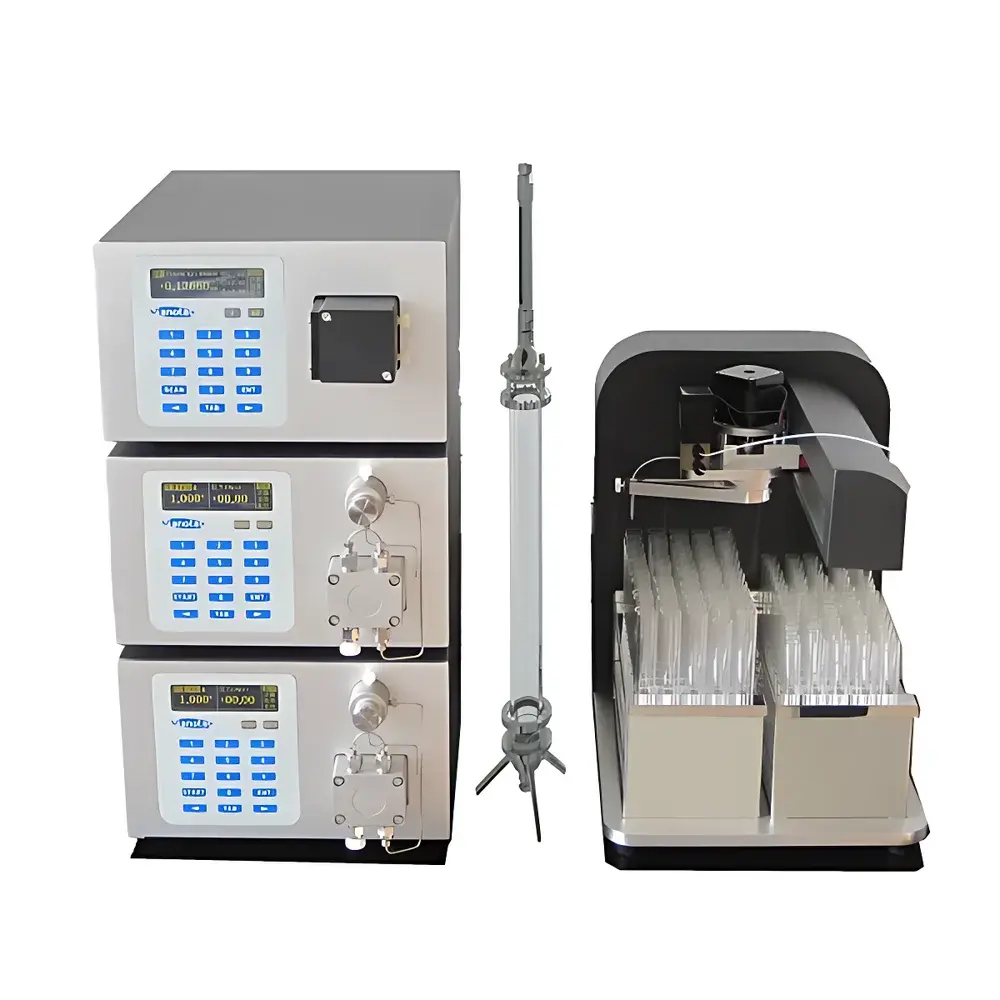
Sanotac Purifier 100 Medium-Pressure Preparative Liquid Chromatography System
| Brand | Sanotac |
|---|---|
| Origin | Shanghai, China |
| Manufacturer Type | Direct Manufacturer |
| Product Category | Domestic |
| Model | Purifier 100 |
| Application Level | Laboratory Grade |
| Instrument Type | Medium-to-Low Pressure Preparative LC |
| Flow Rate Range | 0.01–100.00 mL/min |
| Flow Accuracy | ±1% |
| Flow Precision (RSD) | ≤0.5% |
| Maximum Pressure | 20 MPa |
| Wavelength Range | 190–800 nm |
| Wavelength Accuracy | ±1 nm |
| Wavelength Repeatability | 0.2 nm |
| Baseline Noise | ±0.75×10⁻⁵ AU (254 nm, TC = 1 s) |
| Data Acquisition Rate | 10 Hz |
Overview
The Sanotac Purifier 100 is a medium-pressure preparative liquid chromatography (PLC) system engineered specifically for the isolation and purification of bioactive natural product constituents—including alkaloids, flavonoids, terpenoids, saponins, and glycosides—from complex botanical matrices such as traditional Chinese medicinal herbs, plant extracts, and fermentation broths. It operates on the principle of differential partitioning of analytes between a stationary phase (e.g., C18, silica, or specialized natural product columns) and mobile phases under controlled pressure and gradient elution conditions. Designed for reproducible fractionation at milligram-to-gram scale, the system bridges the gap between analytical HPLC and industrial-scale purification—delivering robust performance in academic phytochemistry labs, natural product discovery units, and preclinical drug development settings where compound purity, structural integrity, and batch-to-batch consistency are critical.
Key Features
- Microprocessor-controlled dual-piston parallel pump architecture with real-time chamber pressure feedback, enabling precise compensation for solvent compressibility and refill dynamics across the full flow range (0.01–100.00 mL/min).
- Cam-profile flow pulsation suppression technology minimizes baseline noise, achieving <±0.75×10⁻⁵ AU at 254 nm (1 s time constant), essential for detecting low-abundance metabolites in crude extracts.
- Multi-point flow calibration curves ensure ±1% flow accuracy and ≤0.5% RSD across the entire dynamic range—validated per ISO 11607-2 and ASTM E2656 protocols for quantitative preparative workflows.
- Floating plunger design extends high-pressure seal lifetime under sustained 20 MPa operation, reducing maintenance frequency and downtime.
- 10 user-defined method programs support fully automated gradient profiling, flow ramping, and dwell-volume-compensated step gradients—critical for resolving co-eluting isomers in herbal fingerprints.
- Dual-wavelength UV-Vis detection (190–800 nm) with deuterium/tungsten lamp auto-switching, wavelength time-programming, and stop-flow spectral scanning—enabling simultaneous monitoring of major actives, degradation products, and process-related impurities.
- Modular autosampler with programmable valve-based solid/liquid injection (standard 10 mL loop) and optional heated sample tray for thermally labile natural compounds.
Sample Compatibility & Compliance
The Purifier 100 accommodates diverse sample formats: crude methanolic/water-acidic extracts, partially purified fractions from open-column chromatography, synthetic intermediates, and biologically derived small molecules (<3 kDa). Its stainless-steel (316L) and PEEK-compatible fluidic path ensures compatibility with aggressive solvents (e.g., DMSO, THF, TFA-containing mobile phases) commonly used in natural product dereplication. The system conforms to GLP-compliant laboratory practices and supports audit trails, electronic signatures, and data integrity requirements under FDA 21 CFR Part 11 via Sanochrom™ chromatography software. All hardware components meet CE and RoHS directives; pressure sensors and detectors are calibrated traceable to NIST standards.
Software & Data Management
Sanochrom™ v4.2 workstation software provides unified control of pump, detector, fraction collector, and injection valve through a Windows 10–compatible GUI. It supports real-time dual-wavelength chromatogram overlay, peak tracking with retention time locking, and integrated fraction decision logic based on absorbance threshold, slope change, or time window. Method files include metadata tagging (operator, date, sample ID, column lot), and raw data (.chd/.raw) are stored in vendor-neutral HDF5 format for third-party processing (e.g., MZmine, Compound Discoverer). Electronic records comply with ALCOA+ principles—attributable, legible, contemporaneous, original, accurate—and include automatic backup to network drives with version-controlled archive retention.
Applications
- Isolation of reference standards from plant material for pharmacopoeial authentication (e.g., ginsenosides from *Panax ginseng*, berberine from *Coptis chinensis*).
- Purification of lead compounds prior to NMR structure elucidation and biological assay validation.
- Removal of chlorophyll, tannins, and polysaccharide interferences during natural product library generation.
- Scale-up of synthetic analogs for SAR studies—particularly for compounds exhibiting poor crystallinity or thermal instability.
- Preparative separation of enantiomeric pairs using chiral stationary phases (e.g., Chiralpak AD-H, OD-H) under isocratic or shallow gradient conditions.
- Downstream processing of microbial secondary metabolites (e.g., macrolides, nonribosomal peptides) following fermentation broth extraction.
FAQ
What is the maximum column inner diameter compatible with the Purifier 100?
The system supports columns up to 40 mm ID for semi-preparative applications and up to 80 mm ID when configured with optional high-flow manifolds and low-backpressure detectors.
Can the system be validated for GMP environments?
Yes—full IQ/OQ documentation packages, including pump linearity tests, detector linearity (0–2 AU), gradient accuracy verification, and fraction collector positional accuracy reports, are available upon request.
Is the Sanochrom software compatible with LIMS integration?
It supports ASTM E1578-compliant instrument driver APIs and exports CSV/Excel-formatted summary reports with embedded chromatograms for direct ingestion into common LIMS platforms.
What maintenance intervals are recommended for routine operation?
Pump seals should be inspected every 500 hours of operation; UV lamp replacement is advised at 1,000 hours or when energy output drops below 85% of initial intensity (monitored via built-in diagnostics).
Does the system support pH-sensitive separations?
Yes—the fluidic path is compatible with mobile phases ranging from pH 2.0 to 10.5; optional titanium or Hastelloy components are available for extended acidic/alkaline stability.
Related Products






