
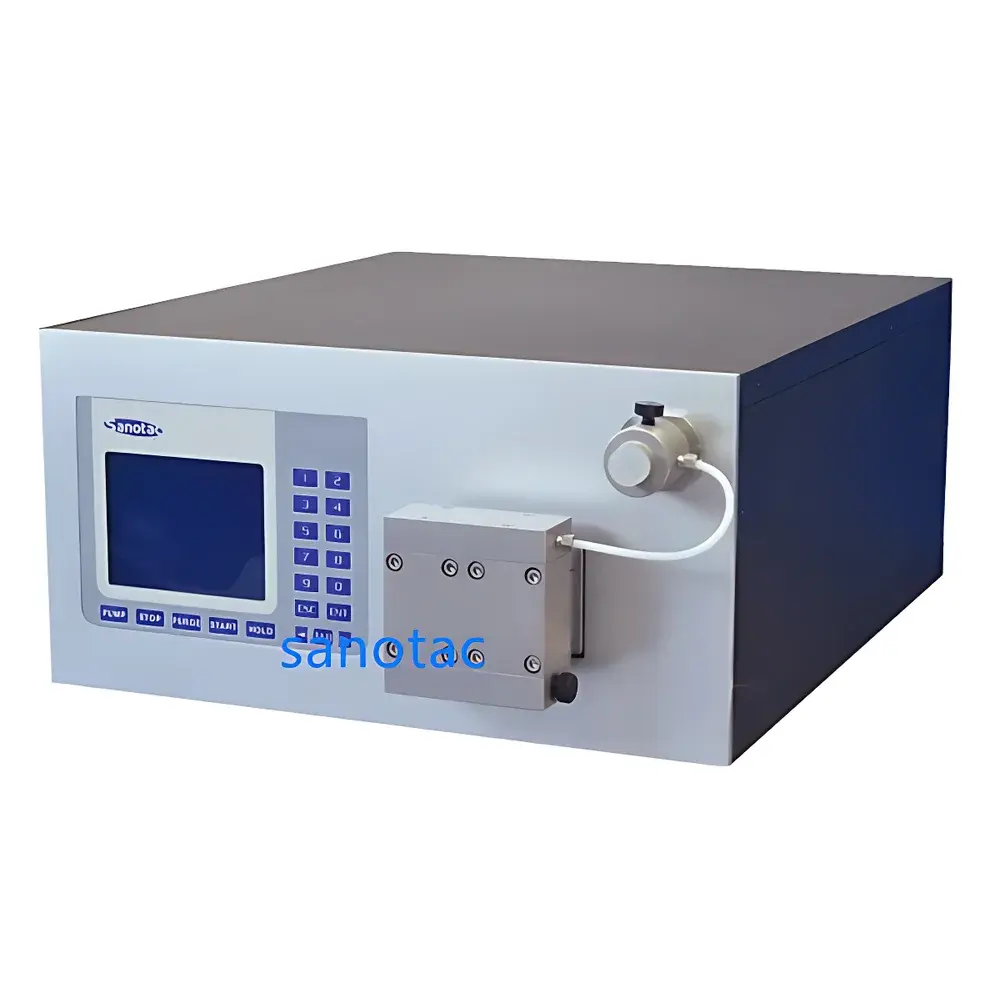
Sanotac LF0104A High-Pressure PTFE-Lined Constant Flow Pump
| Brand | Sanotac |
|---|---|
| Model | LF0104A |
| Origin | Shanghai, China |
| Manufacturer Type | Direct Manufacturer |
| Flow Rate | 0.1–1000.0 mL/min |
| Pressure Rating | Up to 4 MPa |
| Flow Accuracy | ±0.5% |
| Flow Precision (RSD) | ≤0.5% |
| Pressure Pulsation | ≤0.2 MPa |
| Pump Head Material | Stainless Steel with PCTFE Lining |
| Plunger Configuration | Dual Parallel Plungers with Floating Design |
| Wetted Materials | PCTFE, PTFE, Sapphire, Ceramic, Hastelloy C-276 |
| Seal Structure | Open-Type Seal with Hastelloy Spring in Fluid Path |
| Communication Interfaces | RS232 (standard), USB (standard), RS485/RS422 (optional) |
| Protocols | Modbus RTU, ASCII |
| Control Inputs | 0–5 V DC, 4–20 mA analog |
| Software | SanoFlu Fluid Control Management System |
| Power Supply | 85–264 VAC, 50 Hz |
| Dimensions | 550 × 420 × 222 mm |
| Compliance | Designed for GLP/GMP-aligned process instrumentation environments |
Overview
The Sanotac LF0104A is a high-pressure, constant-flow positive displacement pump engineered for precise, pulse-minimized delivery of aggressive fluids in demanding laboratory and pilot-scale chemical process applications. Based on dual parallel plunger architecture with floating plunger dynamics and cam-profile flow compensation, the LF0104A operates under the principles of reciprocating volumetric displacement—ensuring repeatable metering across wide flow ranges while maintaining mechanical integrity under sustained 4 MPa backpressure. Its fluoropolymer-wetted fluid path—including PCTFE-lined stainless steel pump heads, sapphire check valves, ceramic plungers, and Hastelloy C-276 spring-loaded open seals—is specifically validated for continuous exposure to concentrated mineral acids (e.g., HCl, HNO₃, HF up to 40%), strong alkalis (e.g., 50% NaOH), oxidizers (e.g., H₂O₂, peracetic acid), and supercritical CO₂ or organic solvents used in catalytic evaluation and microreactor feed systems. Unlike diaphragm or peristaltic alternatives, this design eliminates elastomer degradation pathways and supports long-term operation in corrosion-critical environments without flow drift or seal extrusion.
Key Features
- Dual parallel plunger system with real-time electronic pulsation suppression and cam-based mechanical compensation—reducing pressure ripple to ≤0.2 MPa (peak-to-peak) across full operating range
- User-configurable pressure protection: programmable upper/lower pressure limits with automatic shutdown and alarm logging
- Volumetric (mL/min) and gravimetric (g/min) delivery modes, enabling direct integration with loss-in-weight feeding systems via analog 4–20 mA feedback loops
- On-device flow calibration wizard supporting multi-point correction across 0.1–1000.0 mL/min, compensating for fluid density, viscosity, and system compliance effects
- Two operational profiles: constant-flow mode for steady-state dosing and gradient mode for time-programmed flow ramps (e.g., catalyst ramping in fixed-bed reactors)
- Real-time dual-curve visualization: synchronized pressure vs. time and flow vs. time plots displayed locally and exportable to Excel (.xlsx) with timestamped metadata
- Modular communication architecture: native RS232 and USB for local PC control; optional RS485/RS422 for industrial daisy-chaining; full support for Modbus RTU and ASCII protocols for PLC/HMI interoperability
- Scalable control topology: single-pump standalone operation or master-slave configurations supporting up to 32 units under one controller—ideal for multistream catalytic screening rigs
- Plunger rod auto-cleaning sequence activated during idle periods to prevent crystallization and particulate buildup at sealing interfaces
- Persistent parameter storage: retains all configuration settings—including serial port parameters, pressure thresholds, calibration coefficients, and gradient programs—after power cycle
Sample Compatibility & Compliance
The LF0104A accommodates a broad spectrum of chemically aggressive media, including but not limited to hydrofluoric acid (≤40%), fuming nitric acid, aqua regia, molten alkali carbonates, anhydrous HF/amine complexes, and supercritical fluids (scCO₂, scCHF₃). All wetted surfaces conform to ASTM D471 and ISO 1817 standards for elastomer resistance—though no elastomers are present in the primary flow path. The pump’s construction satisfies mechanical design requirements outlined in ASME BPE-2022 for sanitary process equipment and aligns with material selection guidance in ISO 21028-1 for safety-critical fluid handling systems. While not certified for explosive atmospheres (ATEX/IECEx), its non-sparking metallic architecture and absence of ignition sources make it suitable for Class I Division 2 installations when housed in appropriate enclosures. Data logging functionality meets audit-trail requirements for GLP-compliant catalysis studies and supports FDA 21 CFR Part 11 readiness when deployed with validated SanoFlu software and electronic signature modules.
Software & Data Management
The SanoFlu Fluid Control Management System provides a Windows-based interface for configuration, monitoring, and data archival. It enables remote setup of flow gradients, pressure limits, and calibration tables; captures synchronized pressure/flow datasets at user-defined sampling intervals (10 ms–10 s); and exports time-stamped .xlsx files containing raw sensor values, calculated mass flow equivalents, and system status flags (e.g., overpressure event, motor stall, communication timeout). Audit trails record all parameter changes with operator ID, timestamp, and pre-/post-value deltas—essential for regulatory review in pharmaceutical process development or DOE-funded energy research. The software supports OPC UA server integration for enterprise-level SCADA connectivity and includes built-in diagnostic tools for detecting valve wear, plunger misalignment, or seal leakage through trending of pressure decay rates during hold phases.
Applications
- Catalytic reaction evaluation: precise co-feeding of liquid reagents and gaseous precursors into fixed-bed, slurry-phase, or microchannel reactors under elevated pressure
- Continuous flow chemistry: stable delivery of corrosive reagents (e.g., TiCl₄, AlCl₃ solutions) in halogenation, Friedel-Crafts, or hydrosilylation sequences
- Supercritical fluid processing: metering of scCO₂ with dissolved catalysts or monomers for polymer impregnation or nanoparticle synthesis
- Electrochemical synthesis: controlled addition of electrolyte components or pH modifiers in flow electrolyzers
- Fuel cell membrane testing: calibrated injection of humidified reformate streams into PEM test stations
- Advanced materials processing: dispensing of fluoride-containing precursors for solid-state battery cathode slurries or metal-organic framework (MOF) synthesis
- Loss-in-weight (LIW) closed-loop feeding: real-time adjustment of pump output based on gravimetric feedback from reactor inlet load cells
FAQ
What materials are in contact with the fluid path?
The wetted components consist of PCTFE-lined stainless steel pump heads, sapphire inlet/outlet check valves, ceramic-coated plungers, PTFE/PCTFE tubing (φ4 mm OD), and open-type seals incorporating Hastelloy C-276 springs directly exposed to the process fluid.
Is the pump compatible with FDA-regulated processes?
While the LF0104A itself carries no FDA clearance, its material certifications (ASTM/ISO), traceable calibration capability, and SanoFlu software’s audit-trail and electronic signature features support qualification within FDA 21 CFR Part 11–compliant workflows when installed and validated per site-specific SOPs.
Can it operate in gradient mode with multiple pumps simultaneously?
Yes—the system supports synchronized multi-pump gradient programming via Modbus RTU master-slave topology, allowing independent or correlated flow ramps across up to 32 units using a single host controller.
How is flow accuracy maintained across varying fluid viscosities?
Accuracy is preserved through factory-characterized plunger displacement curves, user-executed multi-point volumetric calibration at operational temperatures, and optional integration with inline density meters for real-time gravimetric correction.
Does the pump include overload protection?
Yes—programmable pressure limits trigger immediate motor stoppage, visual/audible alarms, and event logging; recovery requires manual reset after root-cause verification.



