
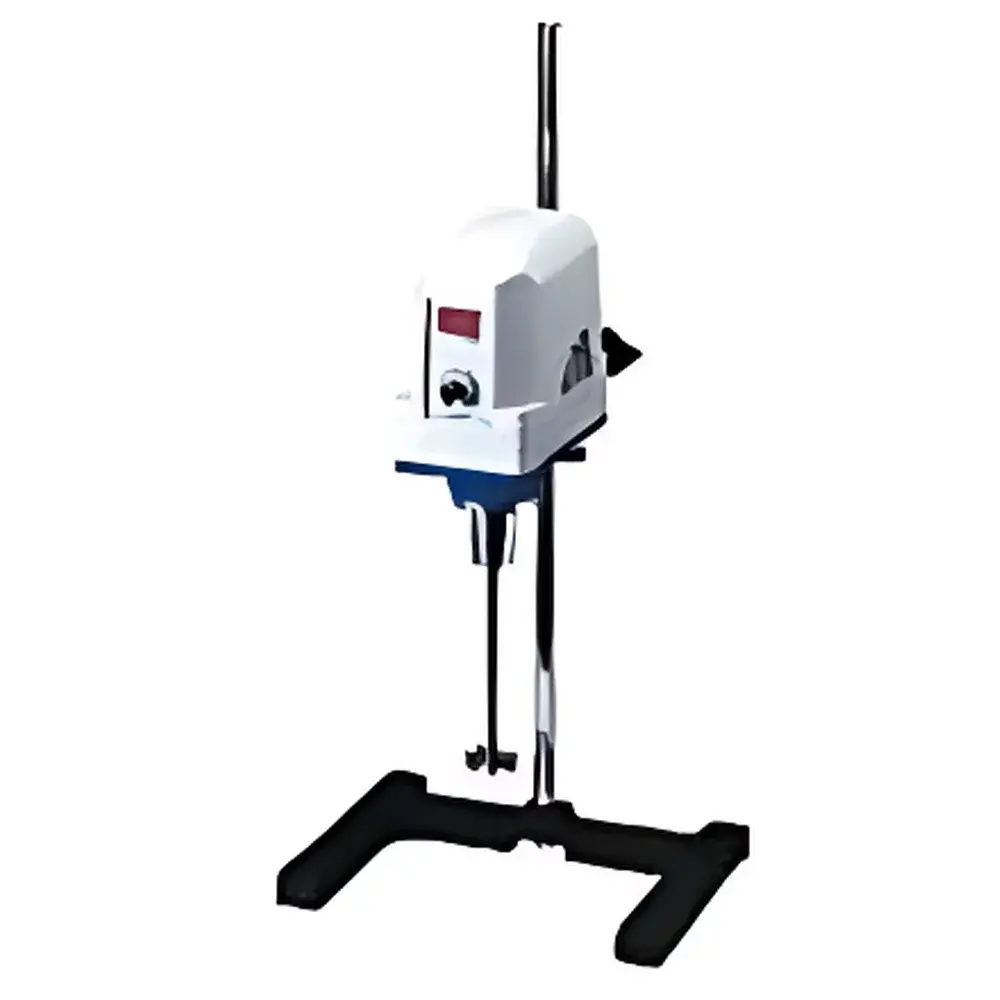
Prema HD-400 High-Torque Laboratory Emulsifier and Homogenizer
| Brand | Prema |
|---|---|
| Origin | Taiwan |
| Model | HD-400 |
| Motor | DC 350 W |
| Speed Range | 0–7000 rpm |
| Maximum Torque | 5.4 kg·cm |
| Weight | 18 kg |
| Shaft Material | Full Stainless Steel (AISI 316) |
| Drive System | Continuously Variable Electronic Speed Control |
| Safety Features | Integrated Ammeter, Thermal Fuse Protection |
| Surface Finish | Chemically Resistant Epoxy Coating |
Overview
The Prema HD-400 is a precision-engineered laboratory-scale emulsifier and homogenizer designed for reproducible high-shear mixing, dispersion, and emulsification of viscous and sensitive formulations. Operating on the principle of rotor-stator mechanical shear, the unit generates controlled hydrodynamic cavitation and intense laminar-to-turbulent flow transitions within the sample chamber—enabling effective particle size reduction, phase stabilization, and uniform distribution of immiscible components. Its robust DC motor drive delivers consistent torque across the full speed range, making it suitable for both low-viscosity aqueous systems and higher-viscosity polymer dispersions encountered in pharmaceutical suspension development, cosmetic emulsion R&D, and fine chemical synthesis. The HD-400 is not intended for sterile processing or pressurized operation; it functions as an open-vessel benchtop unit optimized for batch processing volumes between 50 mL and 2 L.
Key Features
- High-torque DC motor (350 W) engineered for sustained load stability—maintains rated speed under variable viscosity conditions without thermal drift or RPM sag.
- Continuously variable electronic speed control (0–7000 rpm) with real-time analog ammeter feedback, enabling precise correlation between current draw and process load.
- Full stainless-steel (AISI 316) shaft and impeller assembly ensures corrosion resistance against organic solvents, acids, alkalis, and surfactant-rich media—critical for GMP-aligned formulation screening.
- Epoxy-powder-coated housing provides Class C chemical resistance per ISO 12944, protecting internal electronics from incidental splashes of ethanol, acetone, glycols, and aqueous surfactant solutions.
- Low-noise, vibration-damped mechanical architecture—meets ISO 20483 acoustic emission limits (<62 dB(A) at 1 m) during continuous operation at 6000 rpm.
- Integrated dual-stage safety system: thermally activated fuse (IEC 60127-1 compliant) plus overcurrent cutoff triggered at 120% nominal draw—designed to prevent motor winding degradation during stalled-rotor events.
Sample Compatibility & Compliance
The HD-400 accommodates glass, stainless-steel, and PTFE-lined vessels (diameters 40–100 mm). It supports Newtonian and mildly pseudoplastic fluids up to 15,000 mPa·s (measured at 25°C with spindle #4 at 1000 rpm). The unit complies with IEC 61000-6-2 (immunity) and IEC 61000-6-4 (emission) for laboratory electromagnetic environments. While not certified to UL/CSA standards, its construction aligns with general-purpose equipment requirements under ISO 13850 (emergency stop) and ISO 12100 (risk assessment framework). Documentation includes traceable calibration records for speed accuracy (±1.5% full scale, NIST-traceable tachometer verification) and torque linearity (±2.0% FS per DIN 53019-1 Annex B).
Software & Data Management
The HD-400 operates as a standalone analog-controlled instrument with no embedded firmware or digital connectivity. Process parameters—speed, duration, and observed current—are manually logged per batch. For laboratories requiring audit-ready records, integration with external data acquisition systems (e.g., LabVIEW or Delta Tau PMAC) is supported via 0–10 V analog output (speed reference) and isolated 4–20 mA current loop (motor load monitoring). This configuration satisfies basic ALCOA+ data integrity criteria when paired with validated electronic lab notebooks (ELNs) compliant with 21 CFR Part 11—provided handwritten logs are replaced by timestamped, user-authenticated digital entries with change history.
Applications
- Pharmaceutical: Preparation of oil-in-water microemulsions for transdermal delivery; dispersion of nanosuspensions prior to lyophilization cycle development.
- Cosmetics: Stabilization of silicone-based antiperspirant actives in aqueous gels; homogenization of pigment-loaded foundation bases.
- Chemical R&D: Exfoliation of graphite in NMP for conductive ink precursors; dispersion of TiO₂ nanoparticles in acrylic resin matrices.
- Textile Auxiliaries: Blending of reactive dye carriers with pH-sensitive buffers; emulsification of fluorocarbon water-repellent agents.
- Academic Research: Shear-history-dependent rheological preconditioning of model colloidal gels prior to small-angle X-ray scattering (SAXS) analysis.
FAQ
What is the maximum recommended working volume for the HD-400?
Optimal performance is achieved with 200–1000 mL in standard cylindrical beakers (ID 60–80 mm); exceeding 1.2 L increases vortexing risk and reduces shear gradient uniformity.
Can the HD-400 be used with abrasive fillers such as silica or calcium carbonate?
Yes—provided the impeller is inspected for wear after every 20 hours of cumulative operation; we recommend using the optional tungsten-carbide-coated rotor for extended service life.
Is speed calibration traceable to national standards?
Yes—each unit ships with a certificate of conformance referencing speed verification performed using a NIST-traceable handheld laser tachometer (accuracy ±0.05% FS).
Does the HD-400 meet FDA requirements for pharmaceutical manufacturing?
It is suitable for non-sterile R&D and pilot-scale formulation work under cGMP guidelines but lacks 21 CFR Part 11-compliant electronic controls required for commercial production environments.
What maintenance intervals are specified for the motor and bearings?
Motor brushes require replacement every 1,500 operating hours; sealed ball bearings are lifetime-lubricated and require no scheduled servicing under normal ambient conditions (20–25°C, <60% RH).





