
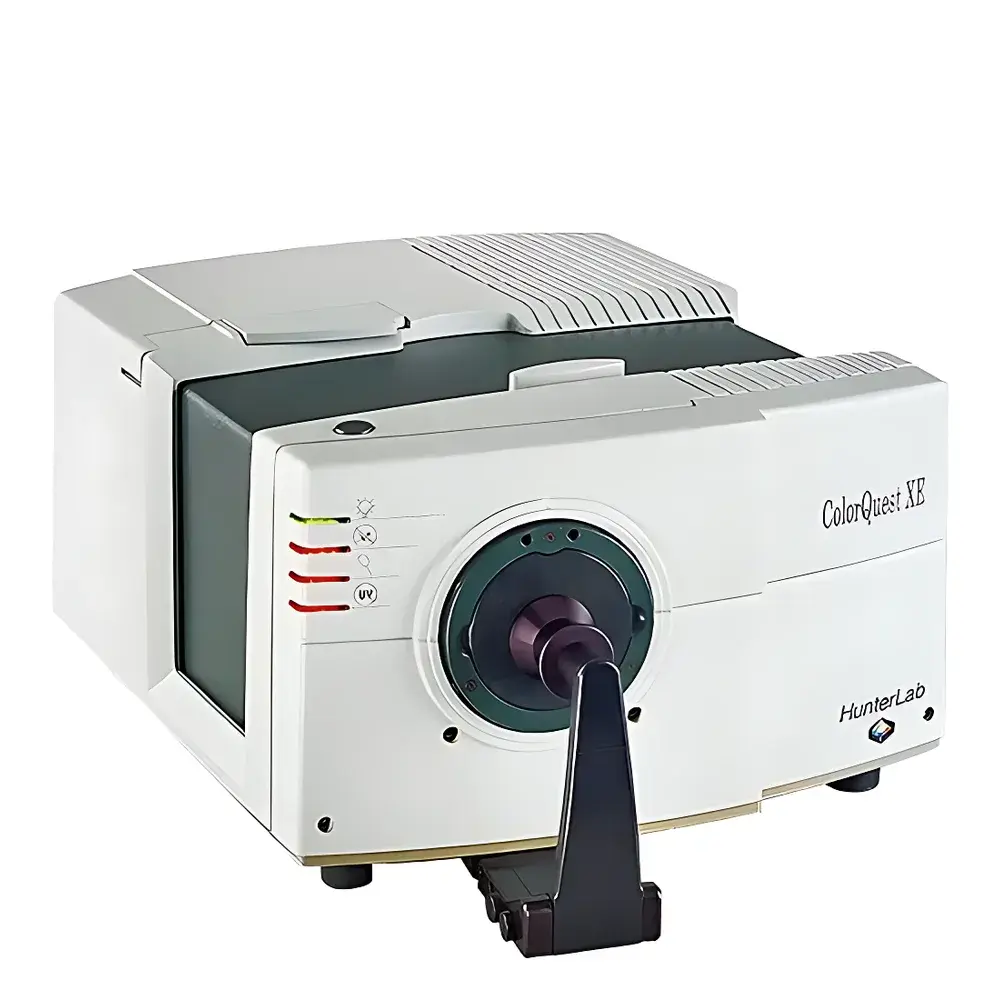
HunterLab CQXE D/8° Integrating Sphere Spectrophotometer
| Brand | HunterLab |
|---|---|
| Origin | USA |
| Model | CQXE |
| Instrument Type | Benchtop |
| Optical Geometry | d/8° integrating sphere |
| Light Source | Pulsed Xenon Lamp (CIE Illuminant D65) |
| Spectral Range | 400–700 nm |
| Spectral Resolution | <3 nm, FWHM: 10 nm |
| Reflectance Range | 0–200% |
| Photometric Resolution | 0.003% |
| Repeatability | ΔE* < 0.03 in CIE L*a*b* on certified white tile |
| Aperture Sizes | 25.4 mm (standard), 9.5 mm (optional) |
| Transmission Chamber Dimensions | 35.6 × 16.5 × 10.2 cm |
| Mirror Finish Compensation | Automatic Specular Component Included/Excluded |
| Compliance | ASTM E308, ISO 7724-1, ISO 11664, CIE No. 15, DIN 5033, JIS Z 8722 |
Overview
The HunterLab CQXE is a high-precision benchtop spectrophotometer engineered for rigorous color measurement across diverse material classes—including opaque, translucent, transparent solids, and liquids. It operates on the d/8° integrating sphere geometry, conforming to international standards for reflectance and transmittance measurement (ASTM E308, ISO 7724-1, CIE 15:2018). The instrument employs a pulsed xenon lamp calibrated to CIE Standard Illuminant D65, ensuring stable, daylight-simulated spectral output without thermal drift or lamp aging effects common in tungsten-halogen sources. Its 6-inch integrating sphere is internally coated with Spectraflect®, a proprietary barium sulfate–free diffusing material that maintains spectral neutrality over time—resisting yellowing, cracking, and degradation under repeated UV exposure. This coating delivers superior BRDF uniformity and long-term photometric stability compared to conventional BaSO₄ coatings, supporting traceability to NIST and NPL reference standards.
Key Features
- D/8° optical geometry with integrated specular component (SCI) and specular-excluded (SCE) modes, enabling consistent evaluation of both matte and glossy surfaces.
- 256-element silicon photodiode array coupled with a precision holographic grating, delivering spectral data at <3 nm resolution and 10 nm full-width half-maximum (FWHM) bandwidth.
- Large transmission chamber (35.6 × 16.5 × 10.2 cm) with tri-directional sliding access doors (left/right/top), accommodating oversized or irregularly shaped samples without repositioning.
- Auto-switching dual-aperture optics (25.4 mm standard, 9.5 mm optional) with motorized focus adjustment—optimized for both bulk materials and small-area measurements.
- Fanless, air-core-free thermal design ensures silent operation (<25 dB(A)) and eliminates vibration-induced spectral noise or airflow interference with sample positioning.
- Integrated illumination system within the sample viewing window supports consistent visual assessment alongside instrumental data.
Sample Compatibility & Compliance
The CQXE supports quantitative analysis of reflectance, transmittance, haze, APHA/Pt-Co/Yellowness Index, whiteness (CIE, Ganz, Berger), opacity, color strength, and metamerism indices. It is validated for use in regulated environments requiring audit-ready documentation: software-generated reports include instrument ID, calibration timestamp, operator ID, and measurement conditions—all compliant with GLP and GMP documentation frameworks. Full traceability to NIST-traceable ceramic tiles and liquid standards is maintained via factory-certified calibration kits. Regulatory alignment includes ASTM D1003 (haze), ASTM D5386 (liquid color), ISO 27677 (paper brightness), and ISO 11475 (wood-based panels), making it suitable for QC labs in plastics, textiles, paints, pharmaceuticals, food packaging, and pulp & paper industries.
Software & Data Management
The CQXE is controlled via HunterLab’s EasyMatch QC software (Windows-compatible), which provides real-time spectral visualization, multi-instrument fleet management, and customizable pass/fail tolerancing against master standards. All raw spectral data (31-point or full 10-nm interval) are stored in vendor-neutral CSV and XML formats. Audit trail functionality records every user action—including parameter changes, calibration events, and report exports—with timestamps and operator authentication. Optional 21 CFR Part 11 compliance modules support electronic signatures, role-based access control, and immutable data archiving for FDA-regulated applications.
Applications
The CQXE serves as a primary metrology tool in R&D laboratories developing new pigments, polymer formulations, and optical filters; in production QA/QC for batch-to-batch color consistency in injection-molded parts, spun-dyed fibers, and coated substrates; and in regulatory testing for APHA color limits in purified water (USP ), yellowness index in pharmaceutical excipients (EP 2.2.17), and haze in medical-grade PET films (ISO 14782). Its ability to switch seamlessly between reflectance and transmittance modes—without hardware reconfiguration—enables rapid method development for complex multilayer assemblies and laminated composites.
FAQ
Does the CQXE support measurement of fluorescent or phosphorescent samples?
Yes—the pulsed xenon source minimizes thermal excitation artifacts, and EasyMatch QC includes fluorescence correction algorithms aligned with CIE Technical Report 214 for UV-excited materials.
Can the instrument be integrated into an automated manufacturing line?
It features RS-232C serial interface and optional Ethernet connectivity, supporting SCADA integration via Modbus RTU or custom API scripting for inline color verification.
Is NIST traceability provided with each unit?
Each CQXE ships with a Certificate of Calibration referencing NIST SRM 2010 (white reflectance standard) and NIST SRM 2035 (liquid transmittance standard), with full uncertainty budgets per ISO/IEC 17025.
What maintenance is required beyond routine calibration?
No consumables or scheduled servicing are required—the xenon lamp lifetime exceeds 1 million flashes, and the Spectraflect coating is warrantied for 10 years against spectral shift >0.1% ΔR.
How does the CQXE handle highly scattering or textured surfaces?
The large 6-inch sphere and diffuse illumination geometry ensure uniform irradiance distribution across rough, granular, or fibrous samples, minimizing directional bias in L*a*b* calculation per CIE 116-1995 guidelines.





