
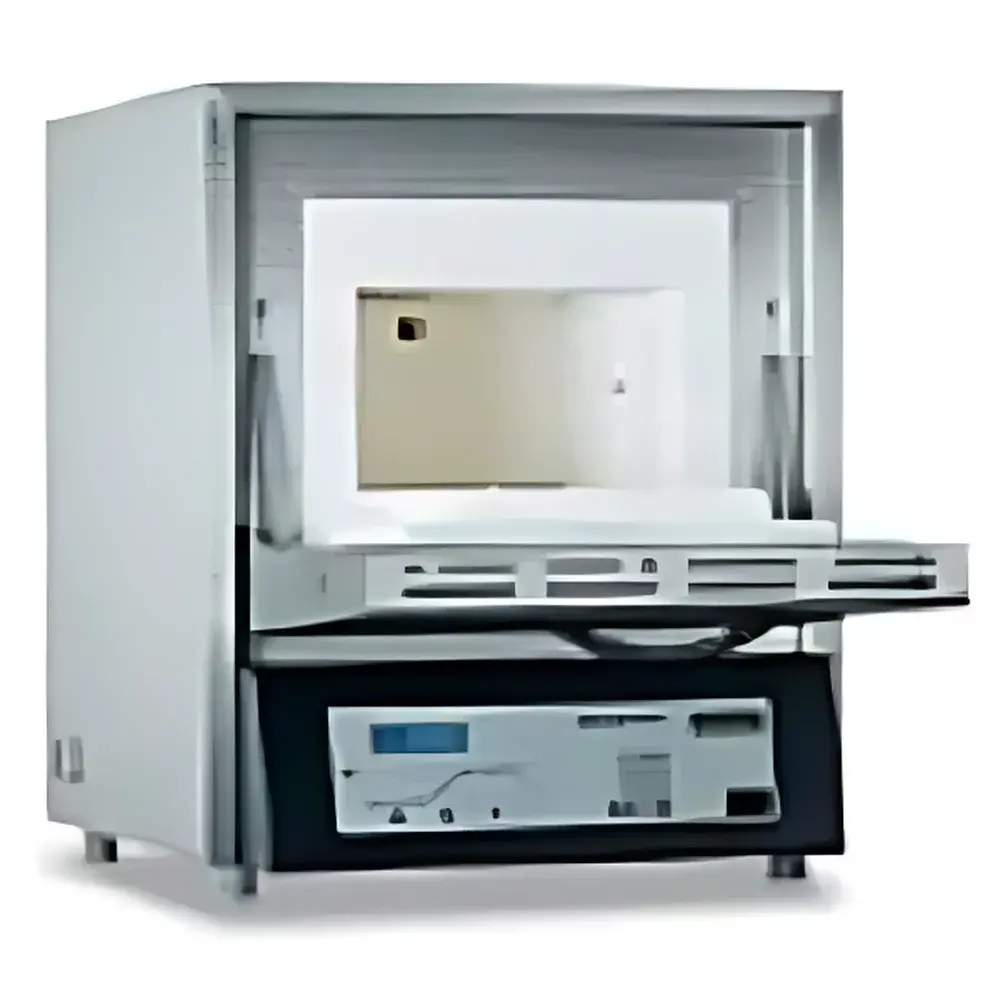
Nabertherm L-Series Laboratory Muffle Furnace
| Brand | Nabertherm |
|---|---|
| Model | L3–L40 |
| Max. Temperature | 1100 °C / 1200 °C |
| Effective Chamber Volume | 3–40 L |
| Voltage | 230 V, 1/N |
| Power Rating | 1.2–6.0 kW |
| Weight | 20–95 kg |
| Construction | Dual-layer stainless steel housing |
| Insulation | Vacuum-formed ceramic fiber modules (standard) |
| Heating Elements | Embedded resistive wire in ceramic heating plates |
| Controller | Standard B170 digital PID (ramp-soak programming) |
| Air Management | Adjustable inlet on door |
| Safety | Low external surface temperature |
Overview
The Nabertherm L-Series Laboratory Muffle Furnace is a precision-engineered, bench- and floor-standing box-type furnace designed for routine thermal processing in academic, industrial, and quality control laboratories. Operating on the principle of resistive heating within an electrically insulated muffle chamber, it delivers stable, uniform temperature distribution across its working volume—critical for applications requiring strict thermal reproducibility, such as ashing, calcination, heat treatment, sintering, and gravimetric analysis. With maximum operating temperatures of either 1100 °C or 1200 °C (model-dependent), the L-Series complies with key thermal testing standards including ASTM E1112 (for furnace calibration), ISO/IEC 17025 requirements for laboratory equipment qualification, and supports GLP/GMP workflows where documented thermal profiles and traceable setpoint stability are mandatory.
Key Features
- Dual-layer stainless steel housing with optimized air gap insulation—ensures external surface temperatures remain below 60 °C at maximum operating temperature, reducing ambient heat load and improving operator safety.
- Vacuum-formed ceramic fiber insulation modules provide high thermal resistance, low thermal mass, and rapid cool-down rates—enabling efficient energy use and shortened cycle times.
- Modular ceramic heating plates with embedded NiCr resistance wire offer uniform radiant heating, extended service life, and straightforward field replacement without specialized tools or downtime.
- Standard B170 digital PID controller supports single-segment ramp-soak operation with real-time temperature display, manual tuning, and alarm thresholds—fully compliant with basic ISO 17025 instrument calibration documentation requirements.
- Optional P320 multi-segment programmable controller enables up to nine independent thermal protocols, each comprising four linear ramp stages and four hold stages—ideal for complex thermal treatments such as controlled oxidation, step-annealing, or pre-sintering cycles.
- Integrated airflow management system includes an adjustable front air inlet and a rear exhaust port—compatible with passive venting, forced-air extraction via optional fan-equipped ducts, or catalytic abatement systems for volatile organic compound (VOC) mitigation during organic sample decomposition.
- Silent solid-state relay switching eliminates mechanical contact wear and acoustic noise—enhancing long-term reliability and suitability for shared laboratory environments where electromagnetic interference or audible disturbance must be minimized.
Sample Compatibility & Compliance
The L-Series accommodates standard crucibles (alumina, porcelain, platinum, graphite), ceramic boats, and refractory trays within its 3–40 L chamber volumes. Its muffle design isolates samples from direct contact with heating elements and combustion by-products—ensuring contamination-free thermal treatment essential for residue analysis (e.g., ASTM D874, ISO 2160), loss-on-ignition (LOI) assays, and catalyst activation. All models meet CE marking requirements under the EU Machinery Directive 2006/42/EC and Electromagnetic Compatibility Directive 2014/30/EU. Optional accessories—including calibrated thermocouple ports (Type S or K), data logging interfaces, and validation kits—support IQ/OQ/PQ execution per FDA 21 CFR Part 11 and Annex 11 guidelines.
Software & Data Management
While the L-Series operates autonomously via its front-panel controllers, the optional P320 unit supports RS485 Modbus RTU communication for integration into centralized lab automation systems. Third-party SCADA or LIMS platforms can read real-time temperature, program status, and alarm events—enabling audit-trail generation, electronic batch records, and automated report export. When paired with Nabertherm’s optional THERMOCOM software (Windows-based), users gain full remote monitoring, graphical profile visualization, and CSV export for post-run statistical process analysis—meeting ALCOA+ data integrity principles.
Applications
- Gravimetric analysis: ash content determination (AOAC 923.03, ISO 1171), moisture-free residue quantification.
- Materials science: sintering of metal oxides, thermal stabilization of battery cathode precursors, phase transformation studies.
- Environmental testing: total suspended solids (TSS) ignition, sludge incineration residue analysis per EPA Method 2540E.
- Pharmaceutical QC: excipient dryness verification, residual solvent removal validation, and tablet coating thermal stability screening.
- Geological and metallurgical labs: LOI testing of ores, clays, and refractories; flux fusion preparation for XRF sample pellets.
FAQ
What temperature uniformity can be expected across the chamber at 1000 °C?
Typical radial and axial uniformity is ±5 °C within the usable zone (defined as 70% of chamber volume), verified per ASTM E220 calibration practices.
Is the furnace suitable for inert or reducing atmospheres?
The standard L-Series is configured for air atmosphere only; optional quartz or alumina tube inserts with gas inlet/outlet ports are available for controlled-atmosphere modifications.
How is temperature calibration performed and documented?
Each unit ships with a factory calibration certificate traceable to national standards (DKD/DAkkS-accredited); users may perform in-house verification using a calibrated reference thermocouple inserted through the optional side port.
Can the L-Series be integrated into a 21 CFR Part 11–compliant workflow?
Yes—when equipped with P320 + THERMOCOM and configured with user access controls, electronic signatures, and audit-log archiving, it satisfies core Part 11 technical requirements for electronic records and signatures.
What maintenance intervals are recommended for the heating elements and insulation?
Ceramic fiber insulation requires no scheduled replacement under normal use; heating plates are rated for ≥5,000 hours at 1100 °C—inspection every 12 months is advised for visual integrity and electrical continuity testing.



