
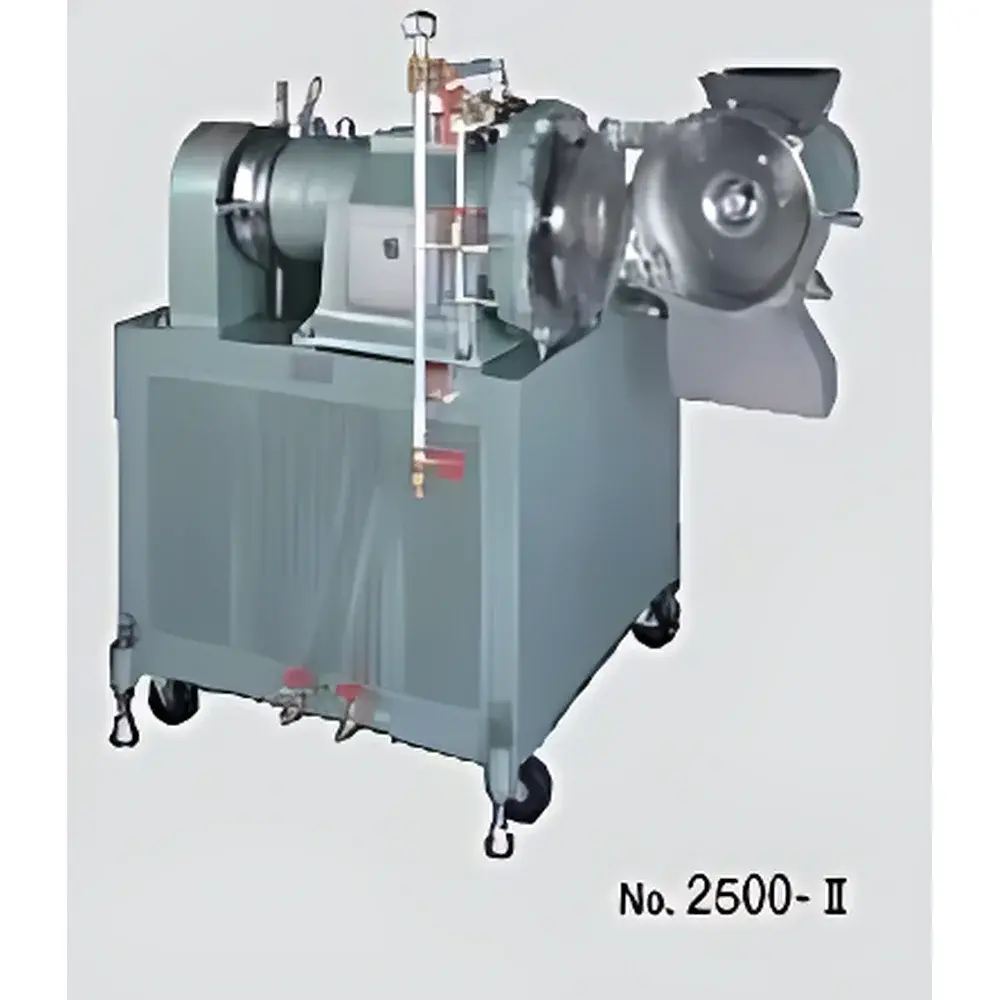
KRK KRK-2500Ⅱ High-Consistency Refiner
| Brand | KRK |
|---|---|
| Origin | Japan |
| Model | KRK-2500Ⅱ |
| Type | Single-Disk Refiner |
| Liquid-Wetted Material | SUS-316 Stainless Steel |
| Disc Diameter | 305 mm |
| Rotor Speed | 3,000 rpm (standard) |
| Motor Power | 22 kW / 30 kW |
| Feed Screw Speed | 30–300 rpm |
| Gap Resolution | 0.01 mm |
| Overall Dimensions | 1030 × 1440 × 1270 mm |
| Weight | 800 kg |
| Electrical Supply | 200/220 V, 3-phase DC, 50/60 Hz, 107 A |
| Cooling Water Required | Yes |
Overview
The KRK KRK-2500Ⅱ High-Consistency Refiner is an engineered pulp refining system designed for continuous, high-efficiency mechanical treatment of fiber suspensions across a broad concentration range—from low-consistency (3% solids) to high-consistency (up to 30% solids). Based on the principle of controlled shear and fibrillation between rotating and stationary refiner plates, this single-disk refiner applies precise mechanical energy to modify fiber morphology, enhancing bonding potential, tensile strength, and sheet formation characteristics in papermaking and fiber-based composite processes. Its compact footprint, rigid three-point support balance system, and modular construction reflect decades of Japanese precision engineering tailored for demanding packaging-grade pulp applications—including recycled fiber (OCC, ONP), chemical pulps (KP, CGP), semi-chemical pulps (RGP), non-wood fibers (wheat straw), and blended streams.
Key Features
- Single-disk configuration with 305 mm diameter stainless steel refiner plates—six replaceable segments per plate face—fabricated from cast SUS-316 for corrosion resistance and dimensional stability under thermal and hydraulic load.
- High-resolution gap adjustment mechanism with 0.01 mm (1/100 mm) incremental readout, enabling reproducible control over refining intensity and fiber development.
- Helical feed system driven by a dedicated 0.2 kW variable-speed motor (30–300 rpm), ensuring uniform, pulse-free slurry delivery independent of consistency fluctuations or fiber entanglement.
- Open-end housing design with internal locking bolts facilitates rapid access to the grinding chamber—reducing downtime during plate replacement, inspection, or cleaning without requiring full disassembly.
- Three-point static balancing system compensates for dynamic torque shifts during lid operation and operational transients, maintaining mechanical alignment and minimizing bearing wear over extended service life.
- Integrated cooling water jacket and dilution water manifold maintain thermal equilibrium in the refining zone, preventing fiber hornification and ensuring consistent rheological behavior of the refined stock.
Sample Compatibility & Compliance
The KRK-2500Ⅱ accommodates diverse fiber sources relevant to sustainable packaging production: virgin hardwood/softwood kraft (KP), chemi-thermomechanical pulp (CTMP), recycled fiber grades (OCC, DIP), agricultural residues (wheat straw), and hybrid blends. All liquid-wetted components conform to ISO 80000-13 standards for material traceability and surface finish (Ra ≤ 0.8 µm). The unit meets CE machinery directive requirements (2006/42/EC) and incorporates grounding provisions compliant with IEC 60204-1. While not intrinsically certified for hazardous locations, its electrical architecture supports integration into ISO 9001- and ISO 14001-aligned manufacturing environments. Optional flanged feed and recirculation modules allow seamless connection to closed-loop pilot systems adhering to TAPPI T 200 cm-18 and ISO 5267-1 test protocols.
Software & Data Management
The KRK-2500Ⅱ operates as a stand-alone mechanical refiner without embedded digital controls; however, its analog interfaces (motor current output, feed screw encoder signal, temperature sensors at inlet/outlet jackets) are compatible with third-party SCADA or PLC-based data acquisition systems. Users commonly integrate it with LabVIEW or Siemens S7 platforms to log real-time parameters—including power draw (kW), specific energy consumption (kWh/ton), feed rate (L/min), and gap position—for correlation with pulp freeness (CSF), drainage time (Schopper-Riegler), and tensile index (ISO 1924-3). Audit trails generated via external controllers may satisfy GLP documentation requirements when paired with electronic lab notebooks (ELNs) supporting 21 CFR Part 11-compliant user authentication and change history.
Applications
This refiner serves critical roles in R&D and pilot-scale development for packaging substrates including corrugating medium, linerboard, folding boxboard, and molded fiber products. It enables systematic investigation of refining intensity versus fiber length distribution (ISO 5267-2), fines generation (ISO 5267-3), and hornification kinetics under elevated consistency—conditions unattainable with conventional low-consistency grinders. Its ability to process high-solid-content OCC suspensions directly supports circular economy initiatives by reducing dewatering energy prior to refining. Additionally, it functions as a benchmark tool for evaluating alternative fiber modifications—e.g., enzymatic pretreatment or nanocellulose dispersion—prior to full-scale mill trials.
FAQ
What types of pulp can be processed in the KRK-2500Ⅱ?
It handles kraft pulp (KP), chemi-groundwood pulp (CGP), refined groundwood pulp (RGP), wheat straw pulp, deinked pulp (DIP), and mixed waste streams—provided feed consistency remains within 3–30% solids.
Is the refiner suitable for GMP-regulated pharmaceutical packaging development?
While not certified for Grade A cleanrooms, its SUS-316 wetted surfaces, cleanable geometry, and traceable gap calibration support qualification under ICH Q5C and USP for non-sterile fiber excipient processing.
Can the unit be integrated into an automated pilot line?
Yes—via 4–20 mA analog outputs and discrete I/O signals, it interfaces with industrial PLCs for synchronized control with upstream dilution valves and downstream consistency meters.
What maintenance intervals are recommended for the refiner plates?
Plate inspection is advised every 200–300 operating hours; replacement frequency depends on feedstock abrasiveness and target refining degree—typically 500–1,200 hours for OCC, 800–2,000 hours for softwood KP.
Does KRK provide validation documentation for IQ/OQ protocols?
KRK supplies mechanical certification documents (dimensional drawings, material certificates, factory acceptance test reports); site-specific IQ/OQ execution requires collaboration with qualified third-party validation partners.






