
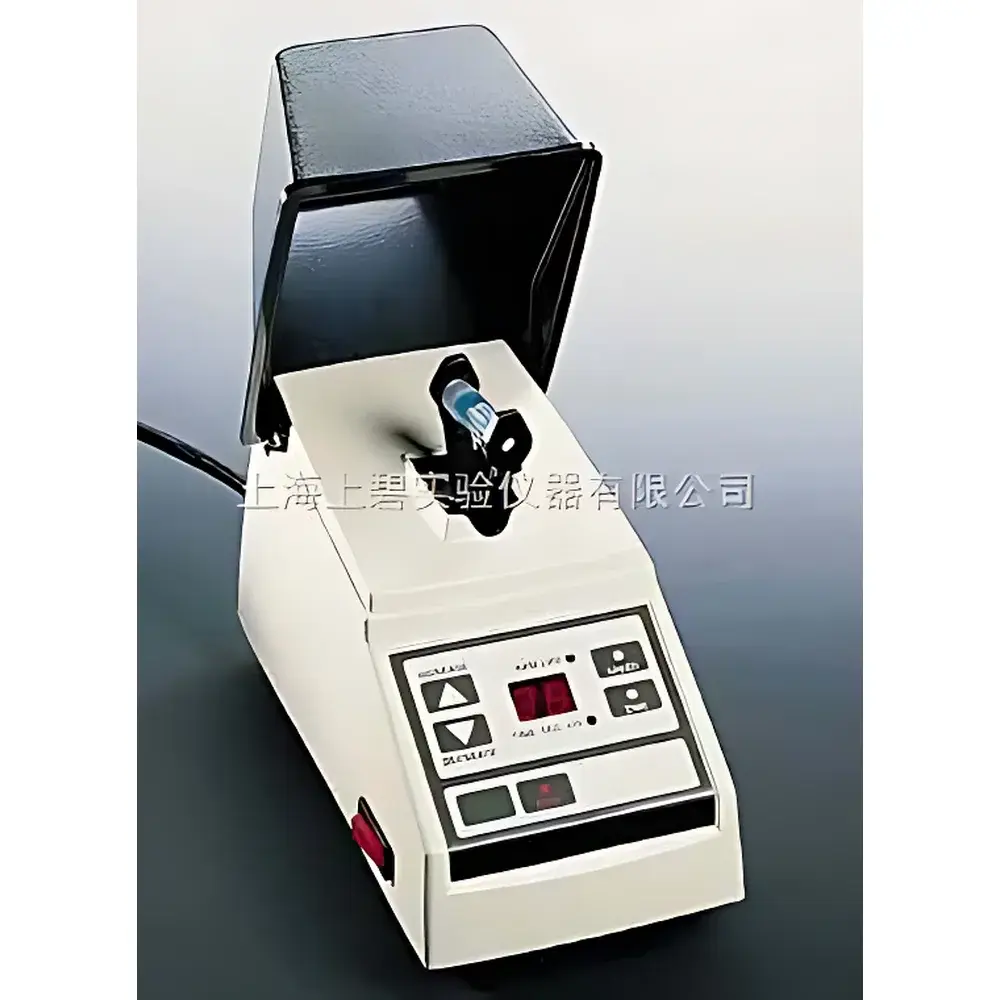
Cole-Parmer Mini BeadBeater-1 Benchtop Bead Mill Homogenizer (Model 3110BXEUR)
| Brand | Cole-Parmer |
|---|---|
| Origin | USA |
| Manufacturer Type | Authorized Distributor |
| Product Category | Imported Instrument |
| Instrument Type | Bead Mill Homogenizer |
| Sample Type | Soft Biological Samples (Cells, Tissues, Microorganisms) |
| Final Particle Size | < 0.01 mm |
| Batch Processing Volume | 0.1–1.5 mL |
| Speed Settings | 2500, 4200, 4600, 5000 rpm |
| Timer Range | 0–5 min (10-sec increments) |
| Power Supply | 220 V, 50 Hz, 0.3 A |
| Dimensions (L×W×H) | 13 × 26 × 18 cm |
| Weight | 5 kg |
| Compatible Bead Materials | Glass, Stainless Steel, Zirconia Silicate |
| Bead Diameters | 0.1 mm, 0.5 mm, 1.0 mm |
| Tube Format | 2 mL Screw-Cap Polypropylene Tubes with Chloroprene O-Rings |
| Throughput | Up to 400 mg Tissue/Cell Mass per Run |
Overview
The Cole-Parmer Mini BeadBeater-1 Benchtop Bead Mill Homogenizer (Model 3110BXEUR) is a compact, high-energy mechanical lysis system engineered for rapid and reproducible disruption of soft biological samples—including mammalian and plant cells, bacterial cultures, yeast, fungal hyphae, spores, and subcellular organelles. Operating on the principle of high-frequency bead impact, the instrument subjects suspended samples to intense kinetic energy transfer via oscillating grinding beads within sealed tubes. This physical shearing mechanism avoids thermal denaturation and chemical contamination, preserving native biomolecular integrity—particularly critical for downstream applications requiring intact nucleic acids, functional enzymes, or unmodified proteins. Unlike rotor-stator or ultrasonic homogenizers, the Mini BeadBeater delivers consistent lysis without aerosol generation, foam formation, or significant heat buildup, making it compliant with biosafety Level 1 (BSL-1) containment requirements and suitable for use in GLP- and GMP-aligned laboratories.
Key Features
- Four programmable speed settings (2500, 4200, 4600, and 5000 rpm) enable precise optimization for diverse sample matrices—from fragile primary neurons to resilient bacterial endospores.
- LED touchscreen interface displays real-time speed and elapsed time; timer resolution is 10 seconds, adjustable from 0 to 5 minutes.
- Benchtop footprint (13 × 26 × 18 cm) and low mass (5 kg) support flexible placement in laminar flow hoods, cold rooms, or shared core facility spaces.
- Sealed 2 mL polypropylene tubes with screw caps and chloroprene o-rings ensure leak-proof containment during high-G acceleration cycles (up to ~3000 × g).
- No moving parts external to the sample chamber—eliminates cross-contamination risk when using single-use tubes and disposable beads.
- Electrical compliance with IEC 61010-1 for laboratory equipment; operates on standard 220 V / 50 Hz mains supply with low current draw (0.3 A).
Sample Compatibility & Compliance
The Mini BeadBeater-1 accommodates a broad spectrum of soft-to-moderately resistant biological materials. For microbial cell lysis (e.g., E. coli, S. cerevisiae), 0.1 mm zirconia silicate beads achieve >95% lysis efficiency within 60–90 s at 4600 rpm. Plant leaf tissue and mammalian cell pellets (up to 400 mg wet weight) are fully homogenized in ≤3 min using 1.0 mm glass beads. Spore-rich samples (e.g., Bacillus or Aspergillus) require 0.1 mm beads and extended cycles (≥2.5 min at 5000 rpm). All protocols are compatible with chaotropic reagents (e.g., guanidinium thiocyanate) and commercial RNA/DNA isolation kits. The system meets ASTM E2694–19 guidelines for mechanical homogenization validation and supports audit-ready documentation under FDA 21 CFR Part 11 when paired with validated electronic lab notebook (ELN) integration.
Software & Data Management
While the Mini BeadBeater-1 operates as a standalone hardware platform without embedded firmware-based data logging, its deterministic operational parameters (speed, duration, tube geometry, bead type/diameter) are fully documentable in standardized SOPs. Users may integrate run metadata into LIMS or ELN systems via manual entry or barcode-scanned tube labels. The absence of proprietary software reduces cybersecurity exposure and simplifies qualification under ISO/IEC 17025:2017 Clause 5.9 (method validation). Optional traceability enhancements include time-stamped video recording of homogenization cycles and digital calibration logs for speed verification using certified tachometers.
Applications
- Routine extraction of high-molecular-weight genomic DNA from fibrous plant tissues for long-read sequencing library prep.
- Preparation of soluble protein lysates from C. elegans or cultured neuronal cells for native PAGE and activity assays.
- High-yield total RNA isolation from Gram-positive bacteria with thick peptidoglycan layers, minimizing RNase release.
- Disruption of biofilm-embedded pathogens for metatranscriptomic profiling.
- Homogenization of frozen tissue biopsies prior to metabolite extraction under cryogenic conditions (−20 °C operation supported with optional chilled adapter block).
FAQ
What bead size should I select for my sample type?
For bacteria and spores: 0.1 mm zirconia silicate beads. For yeast, algae, or cultured mammalian cells: 0.5 mm beads. For plant leaves, animal organs, or fibrous tissues: 1.0 mm glass beads.
Can the Mini BeadBeater-1 be used for cryogenic grinding?
Yes—when equipped with optional pre-chilled aluminum adapters and cryo-compatible tubes, it supports lysis at −20 °C to preserve thermolabile metabolites and inhibit protease activity.
Is the instrument compliant with Good Laboratory Practice (GLP) requirements?
Yes—the deterministic mechanical design, absence of consumable calibration components, and full parameter traceability enable straightforward IQ/OQ/PQ validation per ASTM E2500–13.
How is cross-contamination prevented between runs?
By design: all sample-contacting components (tubes, beads, adapters) are single-use or rigorously autoclavable; no internal fluid pathways exist.
What regulatory standards does this device support?
It aligns with ISO 15195:2018 (reference measurement systems), CLSI EP17-A2 (limit of detection studies), and USP for dissolution testing sample preparation where mechanical homogenization is specified.



