
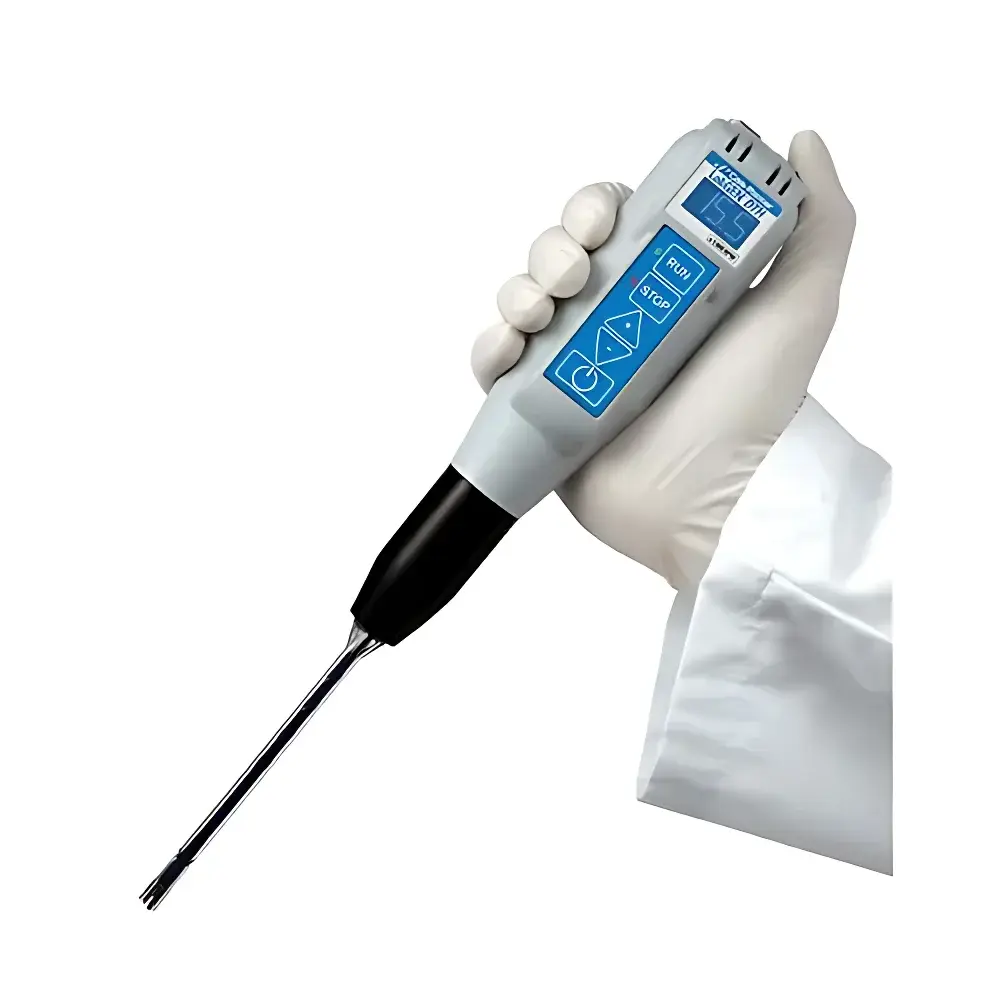
Labgen DTH Handheld Homogenizer
| Origin | USA |
|---|---|
| Manufacturer Type | Authorized Distributor |
| Origin Category | Imported |
| Model No. | 04727-21 |
| Instrument Type | Handheld Homogenizer |
| Instrument Subtype | Tissue Homogenizer |
| Sample Volume Range | 0.03–100 mL |
| Speed Range | 8,000–35,000 rpm |
| Power Input | 220 V, 50/60 Hz, 20 W |
| Standard Accessories | Variable-speed motor unit, adjustable homogenization stand, 12 disposable plastic conical probes (7 mm diameter), tool kit, carrying case |
Overview
The Labgen DTH Handheld Homogenizer is a precision-engineered, high-speed mechanical homogenization system designed for reproducible disruption of biological tissues, cells, and viscous suspensions in research, clinical, and quality control laboratories. Operating on the principle of high-shear rotor-stator interaction, the DTH delivers controlled mechanical energy through rapid rotational motion of interchangeable probes—generating localized turbulence, cavitation, and hydrodynamic shear forces sufficient to lyse mammalian cells, homogenize soft tissues (e.g., liver, brain, muscle), emulsify lipid-based formulations, and disperse nanoparticles in aqueous or organic media. Its compact handheld form factor enables direct immersion into sample vessels ranging from microcentrifuge tubes (0.03 mL) to 50 mL conical tubes, while its integrated stand support ensures ergonomic stability during extended processing or multi-sample workflows. Designed for compliance with routine laboratory safety and operational standards, the DTH meets IEC 61000-4 electromagnetic compatibility requirements and incorporates thermal overload protection to sustain consistent performance across repeated duty cycles.
Key Features
- Digital speed display with last-setting memory function—enables immediate recall and replication of validated homogenization protocols without manual reconfiguration.
- Variable-speed brushless motor delivering precise, stepless control across 8,000–35,000 rpm—optimized for balancing shear intensity against sample integrity across diverse matrices (e.g., fibrous tissue vs. bacterial pellet).
- Modular probe architecture supporting both disposable plastic conical probes (7 mm diameter, pack of 12) and optional stainless-steel probes (flat-tip, serrated-tip; diameters 5–10 mm; lengths up to 110 mm) for applications requiring sterilizability or chemical resistance.
- Ergonomic handheld design with non-slip grip and balanced weight distribution—minimizes operator fatigue during manual operation.
- Integrated homogenization stand with height-adjustable clamp and universal probe holder—facilitates hands-free, vibration-dampened processing ideal for standardized QC testing or GLP-compliant sample preparation.
- Low-power consumption (20 W) and universal 220 V / 50–60 Hz input—compatible with standard laboratory power infrastructure without dedicated circuitry.
Sample Compatibility & Compliance
The Labgen DTH supports a broad spectrum of sample types including but not limited to: soft animal tissues (brain, spleen, kidney), cultured mammalian and insect cells, plant leaf homogenates, bacterial and yeast pellets, emulsions (oil-in-water, water-in-oil), colloidal suspensions, and protein extraction buffers. Its probe geometry and speed range are empirically validated for efficient lysis of HeLa, CHO, and E. coli cells under non-denaturing conditions when paired with appropriate lysis buffers. The system adheres to ISO 13485-aligned handling principles for diagnostic sample prep and supports traceable documentation practices required under FDA 21 CFR Part 11 when used with compliant electronic lab notebooks (ELNs). Disposable probe use eliminates cross-contamination risks—critical for multi-patient clinical specimen processing or regulated bioanalytical workflows.
Software & Data Management
While the DTH operates as a standalone hardware platform without embedded firmware or cloud connectivity, its digital interface supports integration into broader laboratory informatics ecosystems. Speed settings and runtime logs can be manually recorded in LIMS or ELN platforms using standardized templates aligned with ISO/IEC 17025 documentation requirements. For automated data capture, third-party USB-hub-enabled timers or programmable relay controllers may be deployed in conjunction with the DTH’s analog speed control signal output (if equipped with optional analog interface module). All accessories—including probe lot numbers, calibration certificates for stainless-steel variants, and maintenance logs—are traceable via Labgen’s authorized distributor portal, ensuring audit readiness for GLP, GMP, and CAP-accredited facilities.
Applications
- Routine tissue homogenization for RNA/DNA/protein isolation in molecular biology workflows.
- Pre-analytical sample preparation for clinical diagnostics—including homogenization of biopsy specimens prior to PCR or immunoassay analysis.
- Cell lysis optimization studies in bioprocess development labs.
- Emulsion stabilization trials in pharmaceutical formulation R&D.
- Homogenization of environmental samples (soil slurries, wastewater biofilms) for microbial enumeration or metagenomic analysis.
- Dispersion of nanomaterials (e.g., graphene oxide, metal oxides) in polymer matrices for materials science characterization.
FAQ
What is the maximum recommended continuous run time per sample?
For optimal probe longevity and thermal management, continuous operation should not exceed 30 seconds per cycle; allow ≥60 seconds cooling between cycles when processing viscous or high-density samples.
Are stainless-steel probes autoclavable?
Yes—models 04727-22, 04727-23, and 04727-24 are constructed from medical-grade 316 stainless steel and rated for full-cycle autoclaving (121°C, 15 psi, 20 min); verify probe integrity visually before each use.
Can the DTH be used for cryogenic homogenization?
No—the device is not rated for sub-zero ambient or sample temperatures; condensation ingress may compromise motor insulation and electronics reliability.
Is speed calibration traceable to NIST standards?
Calibration certificates issued by Labgen’s authorized service centers include traceability to NIST-traceable tachometer standards, with uncertainty budgets documented per ISO/IEC 17025 Annex A.3.
What maintenance is required for long-term reliability?
Routine inspection of probe threads, O-ring integrity (on motor housing), and cleaning of ventilation grilles every 100 operating hours; annual motor brush inspection recommended for units operating >5 hrs/day.



