
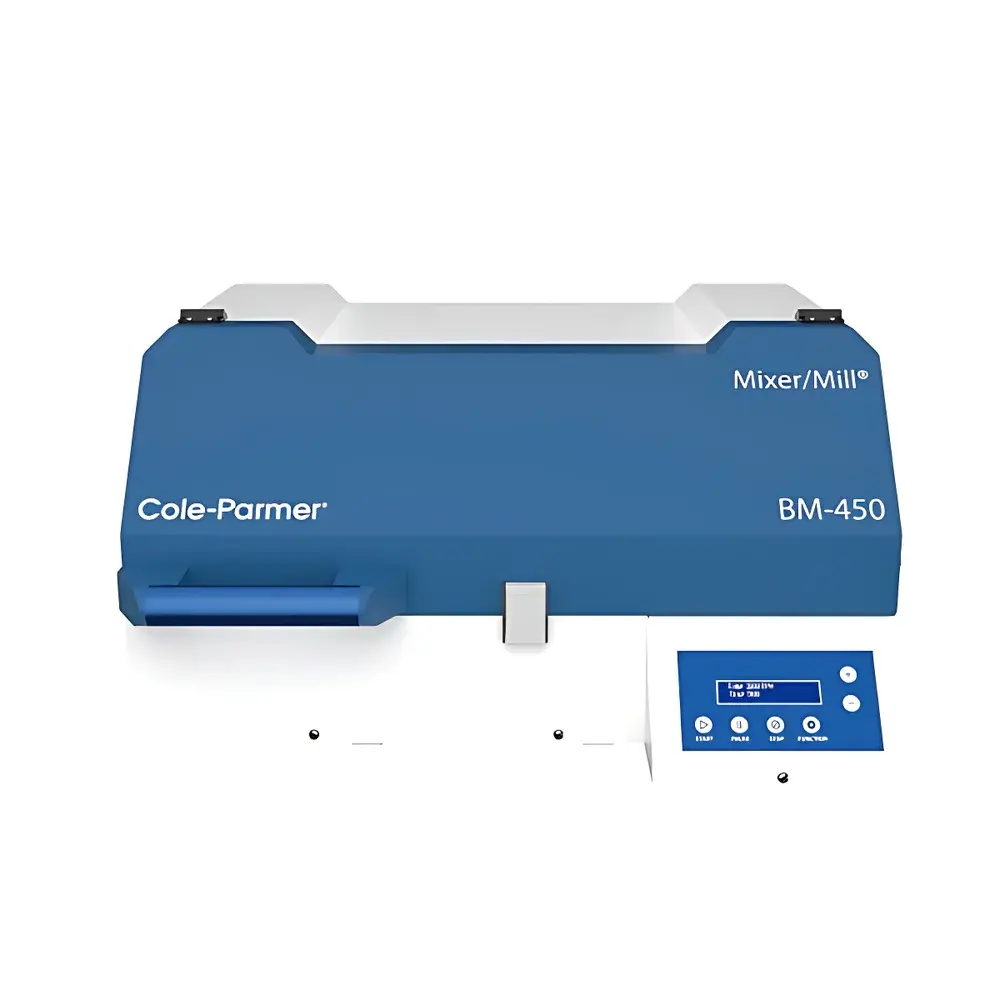
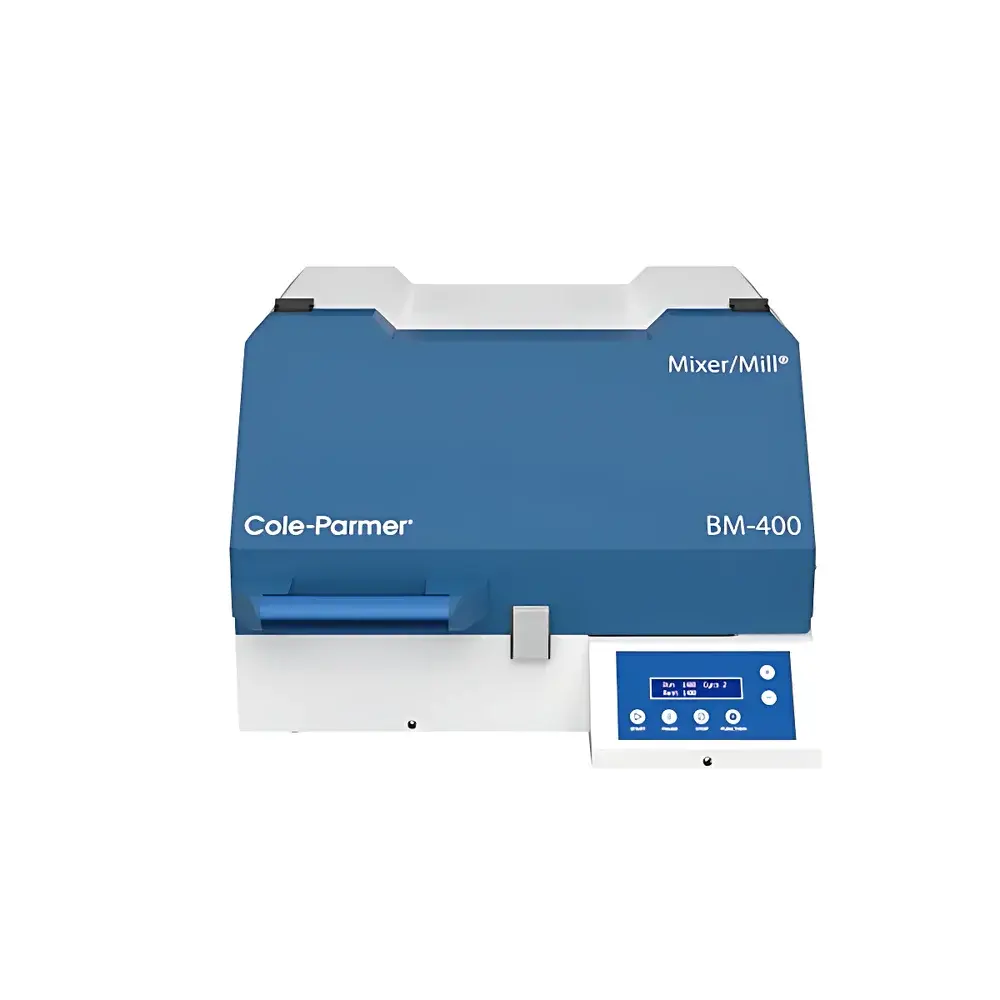
Cole-Parmer BM-400 High-Energy Ball Mill (Formerly SPEX 8000M)
| Brand | Cole-Parmer |
|---|---|
| Origin | USA |
| Manufacturer Type | Authorized Distributor |
| Product Category | Imported Instrument |
| Model | BM-400 |
| Instrument Type | High-Energy Ball Mill |
| Sample Applicability | Hard and Brittle Materials |
| Output Particle Size | 0.01–0.5 mm |
| Input Particle Size | ≤75 nm |
| Grinding Capacity | 0.2–10 g per cycle |
| Mixing Capacity | 60 mL per cycle |
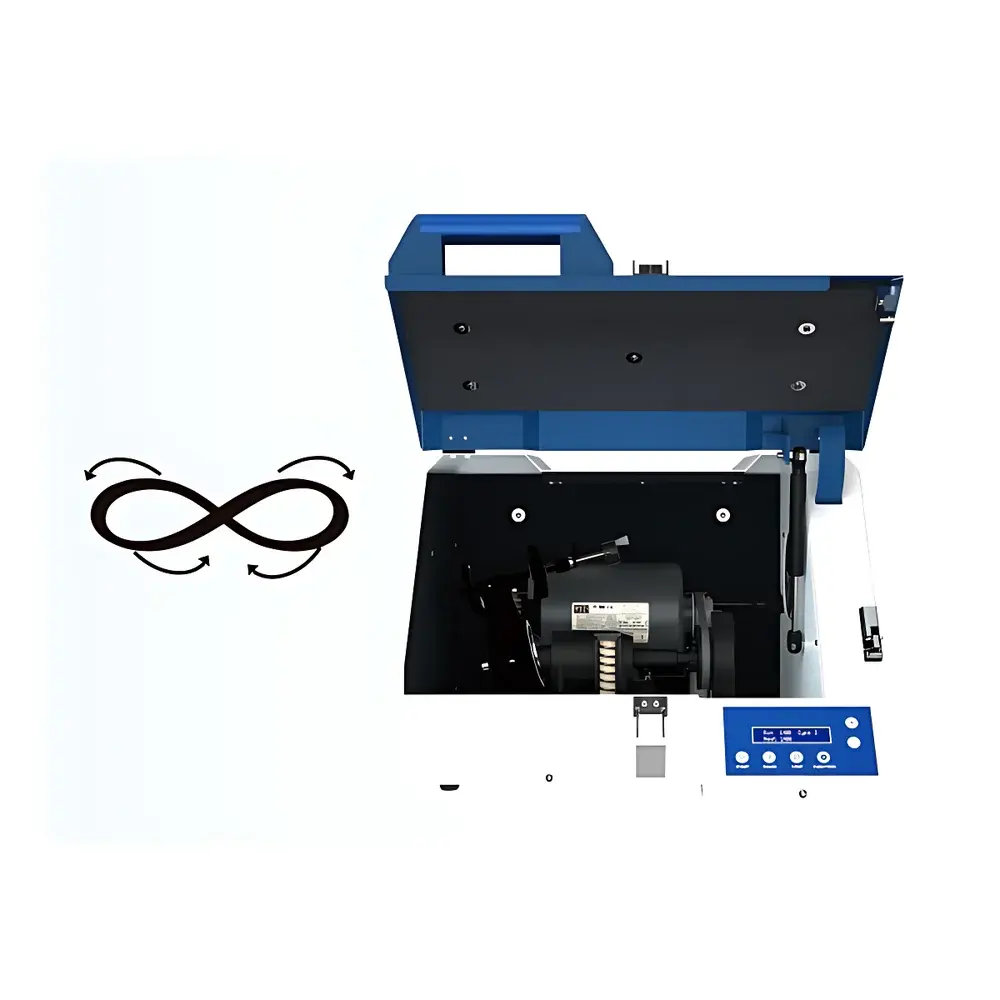
| Clamp Motion Path | 59 mm (front–back), 25 mm (left–right) |
| Clamp Frequency | 1060 cycles/min |
| Standard Timer Range | 0–100 min |
| Extended Timer Range | 0–10500 min |
| Motor Power | 1/3 HP (245 W) |
| Electrical Supply | 230 V / 50 Hz |
| Cooling | Forced-air fan |
| Safety | Dual-interlock lid system, non-slip dual-clamp fixture |
| Construction | High-strength steel housing |
Overview
The Cole-Parmer BM-400 High-Energy Ball Mill (formerly SPEX 8000M) is a laboratory-scale shaker mill engineered for mechanical alloying, nanostructural synthesis, and high-efficiency comminution of hard, brittle, and refractory materials. Unlike planetary or conventional rotary mills, the BM-400 employs a patented three-dimensional ∞-shaped oscillatory motion—comprising simultaneous vertical, horizontal, and rotational displacement—which delivers significantly higher mechanical energy input per unit time. This motion profile has been experimentally validated to generate 6–8× greater specific energy transfer compared to two-axis planetary systems, while maintaining lower thermal generation due to reduced frictional losses and optimized kinetic coupling between grinding media and sample. As a result, the BM-400 achieves rapid particle size reduction to submicron and nanoscale regimes (down to ~75 nm input, routinely producing outputs in the 10–500 nm range under controlled conditions), with exceptional homogeneity and minimal amorphous phase contamination. Developed over nearly seven decades by SPEX CertiPrep and now distributed globally by Cole-Parmer, this instrument serves as a de facto benchmark in high-energy milling for academic research, metallurgical development, and advanced materials synthesis.
Key Features
- Three-dimensional ∞-motion mechanism enabling superior energy transfer efficiency and reproducible mechanical activation
- High-strength steel housing with vibration-dampened motor mount for stable, low-noise operation
- Forced-air cooling system integrated into base enclosure to mitigate thermal accumulation during extended runs (up to 10,500 minutes)
- Dual-safety interlock lid system compliant with IEC 61000-4-2 and ANSI Z244.1 standards for operator protection
- Non-slip dual-clamp fixture ensuring secure retention of vials across all standard SPEX-compatible grinding containers (2.5 mL, 5 mL, 35–135 mL)
- Programmable digital timer with factory-default 100-minute limit and optional extended-range module supporting up to 175 hours of continuous operation
- Fixed-frequency oscillation at 1060 cycles per minute, delivering consistent impact velocity and kinetic energy distribution
Sample Compatibility & Compliance
The BM-400 accommodates a broad spectrum of inorganic and organic solid samples—including metals, oxides, ceramics, minerals, alloys, polymers, pharmaceutical powders, and geological matrices—provided they fall within the defined hardness and brittleness envelope. It is routinely employed for ASTM E290 (tensile testing of metallic materials), ISO 13320 (laser diffraction particle size analysis), and USP (particle size distribution of drug substances) sample preparation workflows. The instrument supports GLP-compliant documentation when paired with external audit-trail-capable data loggers; its mechanical design meets CE marking requirements for electromagnetic compatibility (EMC Directive 2014/30/EU) and low-voltage safety (LVD Directive 2014/35/EU). No software-based regulatory validation package is included, but hardware-level traceability (serial-numbered components, calibrated timer module) enables integration into GMP-aligned laboratories under documented SOPs.
Software & Data Management
The BM-400 operates as a standalone electromechanical device without embedded firmware or digital control interface. All operational parameters—including run duration, start/stop commands, and lid status—are managed via front-panel tactile switches and an analog/digital hybrid timer. For laboratories requiring electronic recordkeeping, third-party USB data loggers or programmable logic controllers (PLCs) may be interfaced via dry-contact relay outputs (optional accessory). While no proprietary software is supplied, the instrument’s deterministic mechanical behavior—fixed frequency, repeatable clamp trajectory, and linear timer response—facilitates full traceability under 21 CFR Part 11 when used in conjunction with validated external logging systems. Calibration certificates for timer accuracy (±0.5% deviation over 100-hour interval) and clamp displacement verification are available upon request.
Applications
- Mechanical alloying of intermetallic compounds (e.g., Mg–Ni–Y systems), enabling metastable phase formation and grain refinement to nanocrystalline domains
- Top-down synthesis of nanomaterials including metal oxides (TiO₂, Fe₃O₄), carbides (SiC), and borides (TiB₂) from coarse precursors
- Homogenization and dispersion of multi-component ceramic composites prior to sintering or hot pressing
- Preparation of spectrometric reference materials (XRF, XRD, SEM-EDS) requiring sub-10 µm particle uniformity and minimized preferential orientation
- Rapid disintegration of cementitious binders, slag, fly ash, and geological aggregates for geochemical assay
- Cell disruption and extraction support for botanical and agricultural samples where thermal degradation must be avoided
FAQ
What types of grinding vials are compatible with the BM-400?
The BM-400 accepts all SPEX-certified stainless steel, tungsten carbide, agate, and hardened chrome steel vials in 2.5 mL, 5 mL, and 35–135 mL volumes. Vial geometry must conform to SPEX Part No. 2001, 2002, or 2003 specifications.
Can the BM-400 achieve true nanoscale particle sizes?
Yes—under optimized conditions (e.g., WC vials, 5 mL volume, 10–30 min runtime, cryogenic pre-cooling), the BM-400 consistently produces median particle diameters below 100 nm for ductile metals and brittle ceramics, as verified by TEM and BET surface area analysis.
Is the BM-400 suitable for moisture-sensitive or air-reactive samples?
Yes—when used with SPEX inert-atmosphere vials (Part No. 2010 series) and appropriate glovebox integration, the BM-400 supports milling under argon or nitrogen environments without modification.
Does the BM-400 require routine calibration?
Timer accuracy should be verified annually using a calibrated stopwatch or frequency counter; mechanical alignment checks (clamp path symmetry, vial seating depth) are recommended after every 500 operating hours or following transport.
How does the BM-400 compare to planetary ball mills in terms of energy efficiency?
Independent studies (e.g., J. Alloys Compd. 2018, 735, 1127–1135) confirm the BM-400 delivers 6.8× higher specific impact energy per minute than comparable 0.2 L planetary mills, with 42% lower average temperature rise under identical load conditions.



