
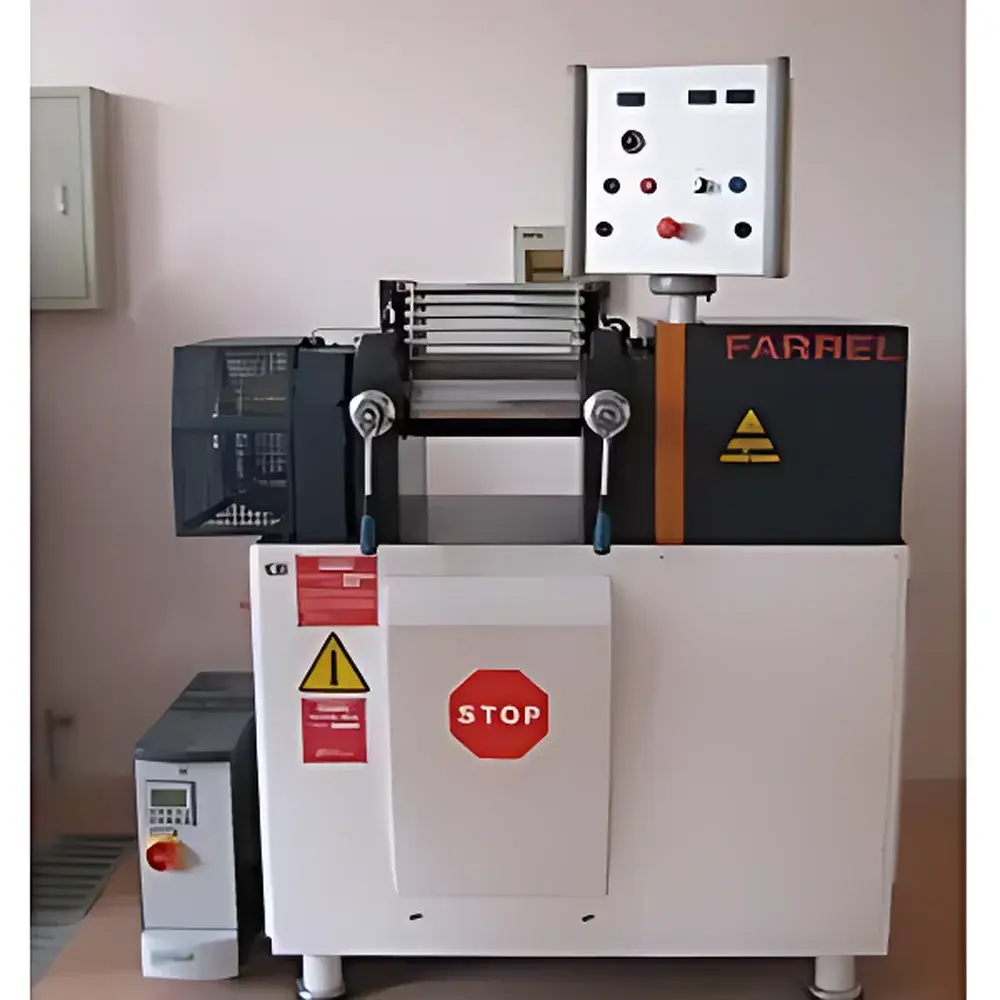
Farrel 150×130 FF Two-Roll Mill / Laboratory Banbury Mixer
| Brand | Farrel |
|---|---|
| Origin | USA |
| Model | 150×130 FF |
| Roller Diameter | 150 mm |
| Roller Length | 330 mm |
| High-Speed Roller Max Speed | 27.4 rpm (GX-2003) / 33.6 rpm (GX-2603) |
| Low-Speed Roller Max Speed | 20 rpm |
| Fixed Friction Ratio | 1:1.4 (GX-2003) / 1.125:1 (BR1600) |
| Motor Power | 5.5 kW × 2 (GX-2603), 22 kW (BR1600) |
| Mixing Chamber Volume | 1.57 L |
| Fill Factor Range | 0.68–0.90 |
| Rotor Speed Range | 25–240 rpm (±1 rpm) |
| Max Operating Temperature | 120 °C |
| Roller Surface Hardness | 60–65 HRC |
| Thermal Control | Drilled Rollers with Rotating Joints |
| Bearing Type | Double-Row Roller Bearings |
| Gap Adjustment | Manual, 0.1 mm Resolution with Overload Protection |
| Drive System | AC Inverter-Controlled Motors with Safety Brake (GX series) |
Overview
The Farrel 150×130 FF Two-Roll Mill and BR1600 Laboratory Banbury Mixer represent a vertically integrated platform for polymer compounding, rubber formulation development, and pre-production process validation. Engineered to replicate industrial-scale mixing dynamics at laboratory scale, the system combines two complementary unit operations: the GX-series two-roll mill—based on Couette flow rheology and shear-dominated material conditioning—and the BR1600 internal mixer, which operates on high-shear dispersive and distributive mixing principles derived from Banbury® architecture. Both units are manufactured in the United States under strict ASME BPE-aligned mechanical integrity protocols and comply with EU Machinery Directive 2006/42/EC for safety integration. The 150 mm roll diameter and 330 mm working length of the GX mills ensure representative residence time distribution and thermal history matching for downstream extrusion or calendering processes. The BR1600’s 1.57 L chamber volume, coupled with its precisely controlled rotor speed range (25–240 rpm ±1 rpm), enables statistically robust DoE studies under GLP-compliant conditions.
Key Features
- Hardened and ground rolls (60–65 HRC) with precision-machined axial cooling channels and rotary unions for closed-loop temperature control (ambient to 120 °C)
- Double-row roller bearings with optional manual or automatic lubrication systems ensuring long-term rotational stability and minimal runout
- Manually adjustable roll gap with 0.1 mm resolution and mechanical overload protection to prevent gear train damage during high-viscosity processing
- Dual bronze material guides to minimize edge build-up and improve sheet uniformity during open-mill operation
- AC inverter-driven motors (5.5 kW × 2 for GX-2603; 22 kW for BR1600) with dynamic braking and torque monitoring for repeatable shear input
- PLC-based control system (BR1600) supporting up to 99 stored mixing cycles, timestamped parameter logging, and password-protected recipe management
- Modular hydraulic power unit with external chiller interface and real-time oil temperature feedback for consistent ram pressure and dump door actuation
Sample Compatibility & Compliance
The 150×130 FF platform accommodates thermoplastics (e.g., PP, PE, PC), elastomers (NR, SBR, EPDM), thermoplastic elastomers (TPEs), filled composites (carbon black-, silica-, or CaCO₃-loaded), and conductive polymer blends. All wetted surfaces conform to FDA 21 CFR 177.2400 for indirect food contact applications where applicable. The BR1600 meets ASTM D3417 (heat of fusion), ASTM D5992 (dynamic mechanical analysis prep), and ISO 289-1 (rubber viscosity) sample preparation requirements. Electrical systems comply with UL 508A and IEC 61800-5-1 for adjustable speed drives. Full traceability documentation—including FAT/SAT reports, material certifications (ASTM A668 Class E steel for rotors), and CE Declaration of Conformity—is provided with each unit.
Software & Data Management
The BR1600 integrates a Siemens S7-1200 PLC with an HMI panel supporting CSV export of full-cycle data: rotor torque (N·m), chamber temperature (°C), energy consumption (kWh), elapsed time (s), and setpoint deviations. Audit trails comply with FDA 21 CFR Part 11 via configurable user roles, electronic signatures, and immutable log files stored on encrypted SD card. Optional OPC UA server enables direct integration into LabVantage or STARLIMS LIMS environments. GX-series mills include analog tachometer outputs and 4–20 mA temperature transmitter interfaces for third-party SCADA linkage.
Applications
- Rubber compound development: scorch time evaluation (ASTM D5289), filler dispersion assessment, and vulcanization kinetics modeling
- Thermoplastic formulation screening: masterbatch dilution, nanofiller exfoliation, and rheological fingerprinting prior to capillary rheometry
- Process scale-up validation: correlation of lab-scale BR1600 energy input (kWh/kg) and specific mechanical energy (SME) with production Banbury® units
- Recycled polymer reprocessing: contaminant dispersion analysis, degradation monitoring via melt flow index (ASTM D1238) correlation
- Academic research: constitutive modeling of viscoelastic melts under transient shear, interfacial adhesion studies in multiphase systems
FAQ
What safety standards does the 150×130 FF system meet?
It complies with EU Machinery Directive 2006/42/EC, including Category 3/PL e stop circuitry, light curtain integration capability, and validated emergency brake response time ≤200 ms.
Can the BR1600 operate under inert atmosphere?
Yes—optional nitrogen purge ports and sealed rotor shafts enable operation under N₂ or argon atmospheres for oxygen-sensitive formulations (e.g., peroxide-cured elastomers).
Is the GX-2603 capable of variable friction ratio operation?
No—the 1:1.4 ratio is mechanically fixed via gear train design to ensure reproducible shear history; variable ratio requires separate drive control not implemented in this model.
What maintenance intervals are recommended for the BR1600 hydraulic system?
Hydraulic oil analysis every 500 operating hours; filter replacement every 1,000 hours; full fluid change and accumulator precharge verification every 2,000 hours.
Does the system support ASTM D3417-compliant DSC sample preparation?
Yes—the BR1600’s controlled cooling ramp (0.5–5 °C/min) and low-oxidation chamber environment produce specimens meeting D3417 specimen geometry and thermal history requirements.





