
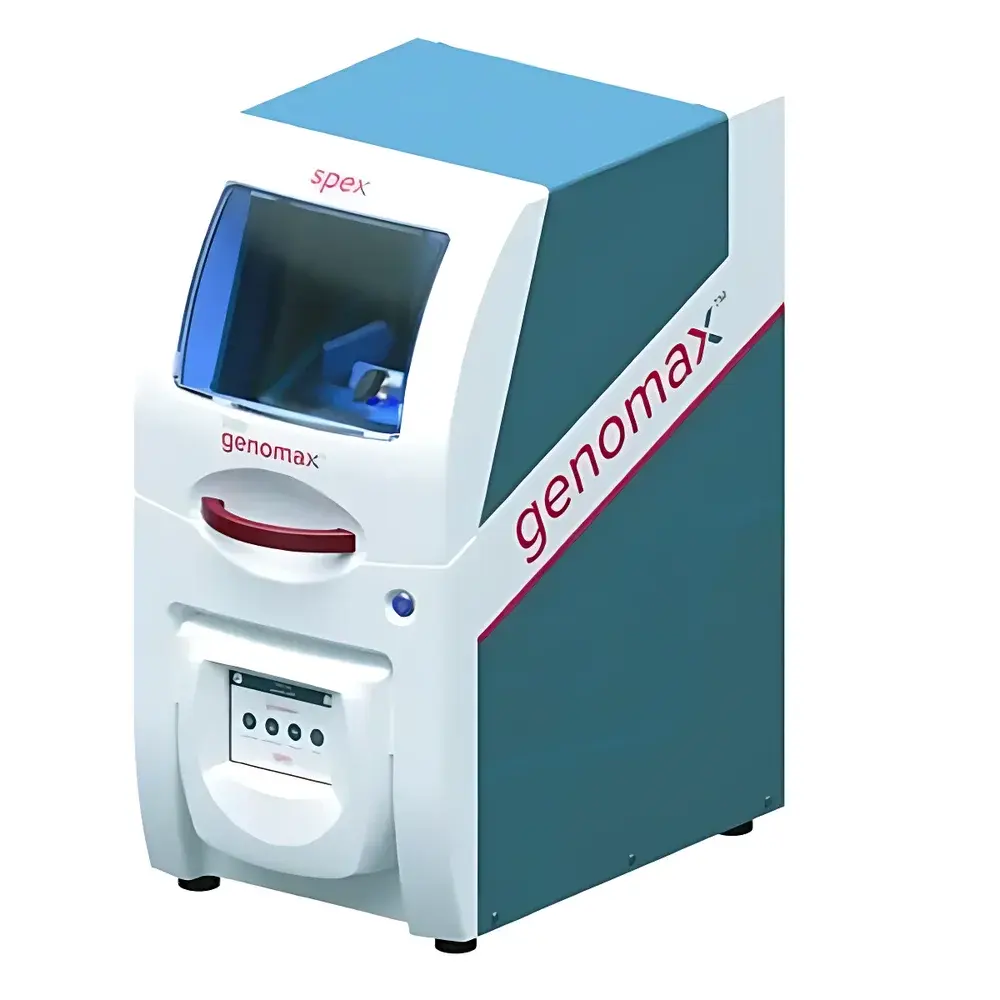
Genomax® 2050 Automated Tissue Homogenizer by Cole-Parmer
| Brand | Cole-Parmer |
|---|---|
| Origin | USA |
| Model | 2050 Genomax |
| Clamp Stroke | 3.2 cm |
| Oscillation Frequency | 500–1750 cycles/min |
| Timer Range | 00:01–20:00 (mm:ss) |
| Power Supply | 230 V / 50 Hz |
| Dimensions (W×D×H) | 135.6 × 57.2 × 71.1 cm |
| Net Weight | 45.5 kg |
| Motor Rating | 0.5 HP |
| Standard Fixture | 2051 Universal Bottle/Tube Clamp |
| Optional Fixture | 2052 Deep-Well Plate Clamp |
Overview
The Genomax® 2050 Automated Tissue Homogenizer is a high-throughput, benchtop mechanical homogenization system engineered for reproducible and scalable lysis of biological tissues and cultured cells via bead-based impact milling. Operating on the principle of high-frequency horizontal oscillation—where sample containers are subjected to rapid, controlled reciprocating motion against grinding beads—the instrument delivers consistent shear and impact forces essential for efficient disruption of cell membranes, extracellular matrices, and resilient plant or animal tissue structures. Designed specifically for molecular biology, pharmaceutical development, and clinical research laboratories, the 2050 platform supports robust nucleic acid (DNA/RNA) and protein extraction workflows while maintaining biomolecular integrity under controlled thermal conditions when paired with Kryo-Tech® cryogenic accessories. Its architecture complies with general laboratory safety standards for rotating/oscillating equipment (IEC 61010-1) and integrates seamlessly into GLP-compliant environments where traceable, auditable processing is required.
Key Features
- Programmable touchscreen interface with password-protected operation and user-defined method storage for up to 20 preconfigured protocols—including one-touch optimized settings for mammalian tissue, plant leaf, bacterial pellet, and frozen samples.
- Adjustable oscillation frequency (500–1750 cycles/min) and precise digital timer (00:01–20:00 mm:ss) enabling fine-tuned control over lysis intensity and duration to match sample type and downstream application requirements.
- Standard 2051 Universal Clamp accommodating vials, tubes, and wide-mouth bottles from 1 mL to 750 mL—compatible with common polypropylene, glass, and stainless-steel containers used in extraction kits.
- Dedicated 2052 Deep-Well Plate Clamp supporting up to six 96-well or 24-well deep-well plates simultaneously; features reinforced retention geometry and integrated sealing alignment to prevent cross-contamination and bead leakage during high-speed homogenization.
- Kryo-Tech® accessory compatibility, including insulated cryo-adapters and pre-chilled plate carriers, ensuring temperature-sensitive analytes remain stabilized at ≤4 °C throughout processing—critical for preserving RNA integrity and native protein conformation.
- USB port for secure export of run logs (timestamp, frequency, duration, operator ID), supporting 21 CFR Part 11–aligned data governance when combined with lab-wide electronic lab notebook (ELN) integration.
Sample Compatibility & Compliance
The Genomax® 2050 accommodates diverse biological matrices without requiring enzymatic pretreatment or manual shearing. Validated sample types include fibrous muscle tissue, lignified plant stems, yeast cell pellets, Gram-positive bacteria, and primary neuronal cultures. All clamps meet ISO 8573-1 purity class 4 for non-oil-lubricated motion systems and are constructed from corrosion-resistant anodized aluminum and FDA-compliant polymers. The instrument’s mechanical design adheres to IEC 61010-1 for electrical safety in laboratory environments, and its operational repeatability has been verified per ASTM E2500-13 (Guide for Specification, Design, and Verification of Pharmaceutical and Biopharmaceutical Manufacturing Systems). When used with certified reagent kits (e.g., Qiagen DNeasy, Thermo Fisher PureLink), the system supports validated workflows aligned with ISO/IEC 17025 quality assurance frameworks.
Software & Data Management
No proprietary software installation is required—the built-in firmware provides full local control and audit-ready logging. Each run record includes date/time stamp, selected protocol name, actual oscillation frequency, elapsed time, and operator login ID (if enabled). Exported .csv files retain ISO 8601 timestamp formatting and are compatible with LIMS platforms such as LabVantage, STARLIMS, and Benchling. For regulated environments, optional firmware upgrades support configurable audit trails, electronic signatures, and role-based access controls—enabling compliance with FDA 21 CFR Part 11 and EU Annex 11 requirements for electronic records and signatures.
Applications
- High-yield genomic DNA isolation from formalin-fixed paraffin-embedded (FFPE) tissue sections prior to NGS library preparation.
- Routine RNA extraction from thermolabile samples (e.g., adipose tissue, brain cortex) using chilled Kryo-Tech® adapters to suppress RNase activity.
- Preparation of whole-cell lysates for Western blotting and mass spectrometry-based proteomics, minimizing proteolytic degradation through rapid, cold homogenization.
- Microbial community disruption for metagenomic DNA recovery from soil, fecal, or biofilm samples—particularly effective for spore-forming or capsule-encased species.
- Batch processing of clinical biopsy specimens under CAP-accredited pathology lab SOPs, ensuring inter-run consistency across diagnostic assay pipelines.
FAQ
What types of grinding beads are compatible with the Genomax® 2050?
The system accepts standard zirconium oxide, stainless steel, and ceramic beads ranging from 0.1 mm to 5.0 mm in diameter; bead selection must be matched to sample volume and hardness per manufacturer-recommended ratios.
Can the 2050 process samples in sealed tubes to prevent aerosol generation?
Yes—when used with screw-cap microcentrifuge tubes, skirted deep-well plates (e.g., 2205-50), or certified leak-proof vials, the 2051 and 2052 clamps maintain positive containment during operation.
Is routine calibration required for regulatory submissions?
While no scheduled calibration is mandated by Cole-Parmer, users performing GxP work should implement periodic verification of oscillation frequency accuracy using a calibrated tachometer and document results per internal SOP.
Does the instrument support remote monitoring or network connectivity?
The base configuration includes only USB data export; Ethernet or Wi-Fi modules are not available, but exported logs can be ingested into centralized lab informatics systems via automated file transfer scripts.
How does the Genomax® 2050 compare to rotor-stator or ultrasonic homogenizers for tough plant tissues?
Unlike probe-based methods that risk localized overheating or inconsistent energy delivery, the 2050’s uniform oscillatory motion ensures homogeneous bead–sample interaction across all vessels—reducing variability in cellulose-rich or waxy samples such as maize kernels or pine needles.



