
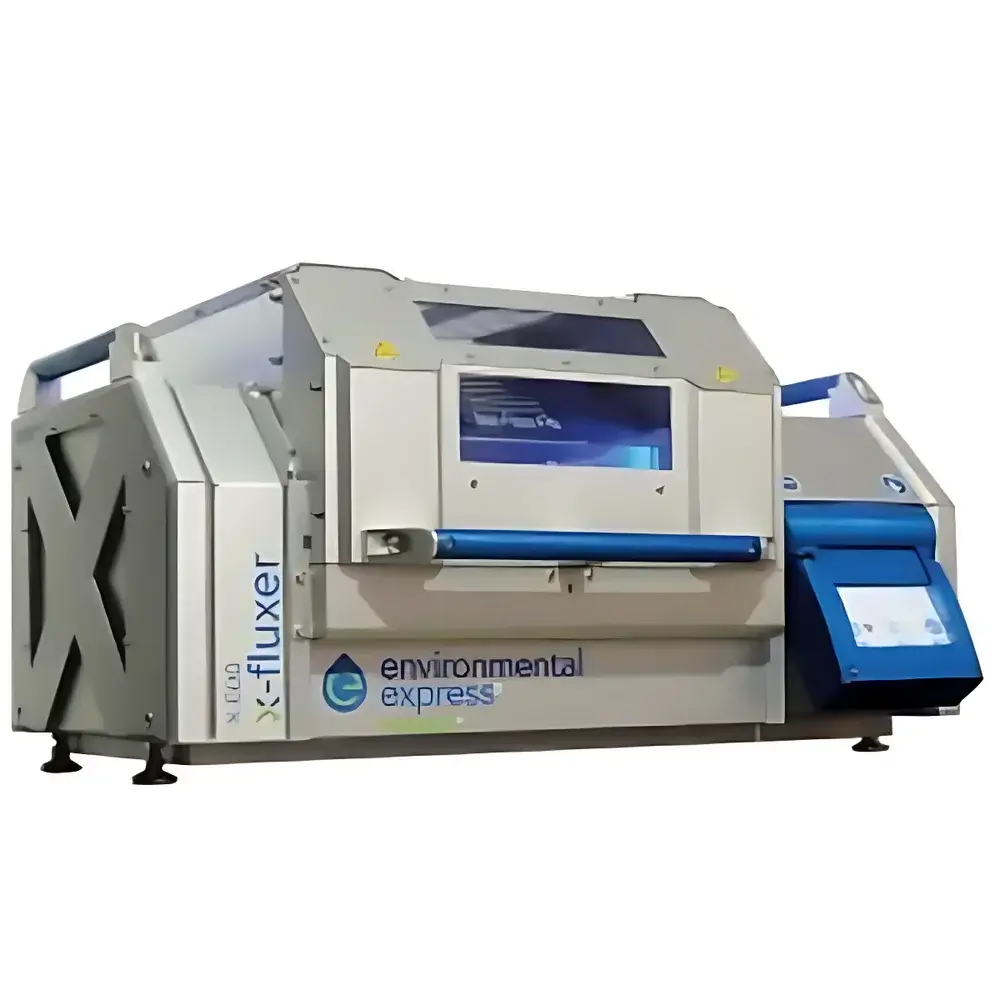
EE-Katanax X-300 Automated Fusion Fluxer for XRF and ICP Sample Preparation
| Brand | Cole-Parmer (Antylia Scientific) |
|---|---|
| Origin | USA |
| Model | X-300 |
| Type | Benchtop Automated Fusion Fluxer |
| Temperature Range | 50–1200 °C |
| Max. Samples per Run | 2 (X-300D) / 3 (X-300T) / 16 (X-300M) |
| Throughput | Up to 30 samples/hour |
| Heating Element | Black-ceramic-coated composite |
| Sample Holders | Crucible-integrated molds |
| Safety | Gas-free, flameless operation |
| Control | Color LCD touchscreen with programmable fusion protocols |
| Data Logging | USB export, barcode support, optional LIMS integration |
| Compliance | Designed for GLP/GMP environments |
Overview
The EE-Katanax X-300 is a benchtop automated fusion fluxer engineered for precise, reproducible preparation of fused beads for wavelength-dispersive (WDXRF) and energy-dispersive (EDXRF) X-ray fluorescence spectrometry, as well as dissolution for ICP-OES and ICP-MS analysis. It operates on the principle of controlled high-temperature flux fusion—melting solid samples with lithium-based fluxes (e.g., Li₂B₄O₇, LiBO₂, or Li₂CO₃) under inert or oxidizing atmospheres to produce homogeneous, glassy discs suitable for quantitative elemental analysis. Unlike traditional gas-fired furnaces, the X-300 employs electrically driven, ceramic-encapsulated heating elements with Dynamic Temperature Profiling (DTP) technology, ensuring ±1.5 °C uniformity across all sample positions within the furnace chamber. This thermal consistency directly translates into improved inter-run precision (<0.5% RSD for major oxides) and eliminates positional bias in calibration curve development—critical for ISO 12847, ASTM E1999, and USP compliance workflows.
Key Features
- Gas-free, flameless operation eliminates explosion hazards, ventilation ducting requirements, and regulatory constraints associated with propane or butane systems.
- Dynamic Temperature Profiling (DTP) with individual element compensation ensures uniform thermal distribution across up to 16 sample positions (X-300M variant), enabling statistically robust multi-sample validation per ISO/IEC 17025 Clause 7.7.
- Modular crucible-integrated mold design maintains identical thermal history for each sample—eliminating post-fusion repositioning errors and preserving stoichiometric integrity during cooling.
- Preloaded, customizable fusion protocols cover oxide fusion, peroxide fusion, sulfate fusion, and compacted bead preparation; all programs support version control, renaming, duplication, and password-protected editing.
- Rugged industrial architecture includes corrosion-resistant ceramic support structures, sealed industrial-grade PCBs, and replaceable heating elements—designed for >10,000 operational cycles under continuous QC laboratory conditions.
- Intuitive color LCD touchscreen interface with tilt adjustment, icon-driven navigation, and multilingual firmware (English, Chinese, Spanish, German, French) reduces operator training time and minimizes protocol deviation risk.
Sample Compatibility & Compliance
The X-300 accommodates standard 35–40 mm platinum-gold or graphite crucibles and corresponding borosilicate or quartz molds. It supports fusion of geological matrices (silicates, carbonates), metallurgical slags, cement clinkers, catalysts, and pharmaceutical excipients containing refractory oxides (Al₂O₃, TiO₂, ZrO₂). All fusion cycles comply with ASTM D5630 (ash content), ISO 9556 (iron and steel), and EN 15309 (waste characterization) sample preparation guidelines. The system’s closed-loop temperature monitoring, real-time power calibration, and non-volatile program storage meet documentation requirements for GLP audits and FDA 21 CFR Part 11 electronic record integrity—particularly when paired with optional barcode scanning and timestamped USB log export.
Software & Data Management
Fusion parameters—including ramp rates, hold times, cooling profiles, and gas purge sequences (if used with optional inert gas module)—are stored as discrete, editable files analogous to OS-level documents. Each run logs timestamp, operator ID (via keypad or barcode), sample ID, protocol name, peak temperature, actual dwell time, and final melt homogeneity index (derived from thermocouple variance). Logs export via USB 2.0 to CSV or XML formats compatible with LIMS platforms including Thermo Fisher SampleManager, LabVantage, and Waters Empower. Remote diagnostics capability allows Antylia Scientific engineers secure, time-limited access for firmware updates or calibration verification—fully auditable under internal SOPs.
Applications
- Preparation of fused beads for major/minor/trace element quantification in mining QA/QC labs (Fe, SiO₂, CaO, MgO, Al₂O₃, P₂O₅).
- Routine dissolution of high-melting-point pharmaceutical intermediates prior to ICP-MS trace metal testing per ICH Q2(R2) validation guidelines.
- Standardized ash fusion testing of coal and biomass per ASTM D1857 and ISO 540.
- High-precision calibration standard production for environmental soil and sediment analysis (EPA Method 6010D).
- Research-scale flux optimization studies requiring systematic variation of Li/B ratio, oxidation state, and quench rate.
FAQ
Does the X-300 require external cooling or compressed air?
No. The system operates with passive convection cooling and requires no auxiliary utilities beyond standard 230 V AC power.
Can fusion protocols be validated for GMP environments?
Yes. Protocol files are digitally signed, version-controlled, and support electronic signatures when integrated with compliant LIMS or ELN systems meeting 21 CFR Part 11 Annex 11 requirements.
Is crucible cleaning automation supported?
Not natively—but the X-300’s programmable cooling profile enables controlled thermal shock cycles that facilitate manual residue removal; third-party ultrasonic cleaning modules can be synchronized via digital I/O.
What maintenance intervals are recommended?
Heating elements and thermocouples should be verified annually using NIST-traceable reference standards; ceramic supports require visual inspection every 500 runs for microfracture or flux adhesion.
How does the X-300 handle volatile analytes like As, Sb, or Hg during fusion?
By default, fusion occurs under ambient atmosphere; optional nitrogen purge kits (sold separately) reduce volatility losses by >40% for semi-volatile elements—validated per ISO 17294-2:2016.







