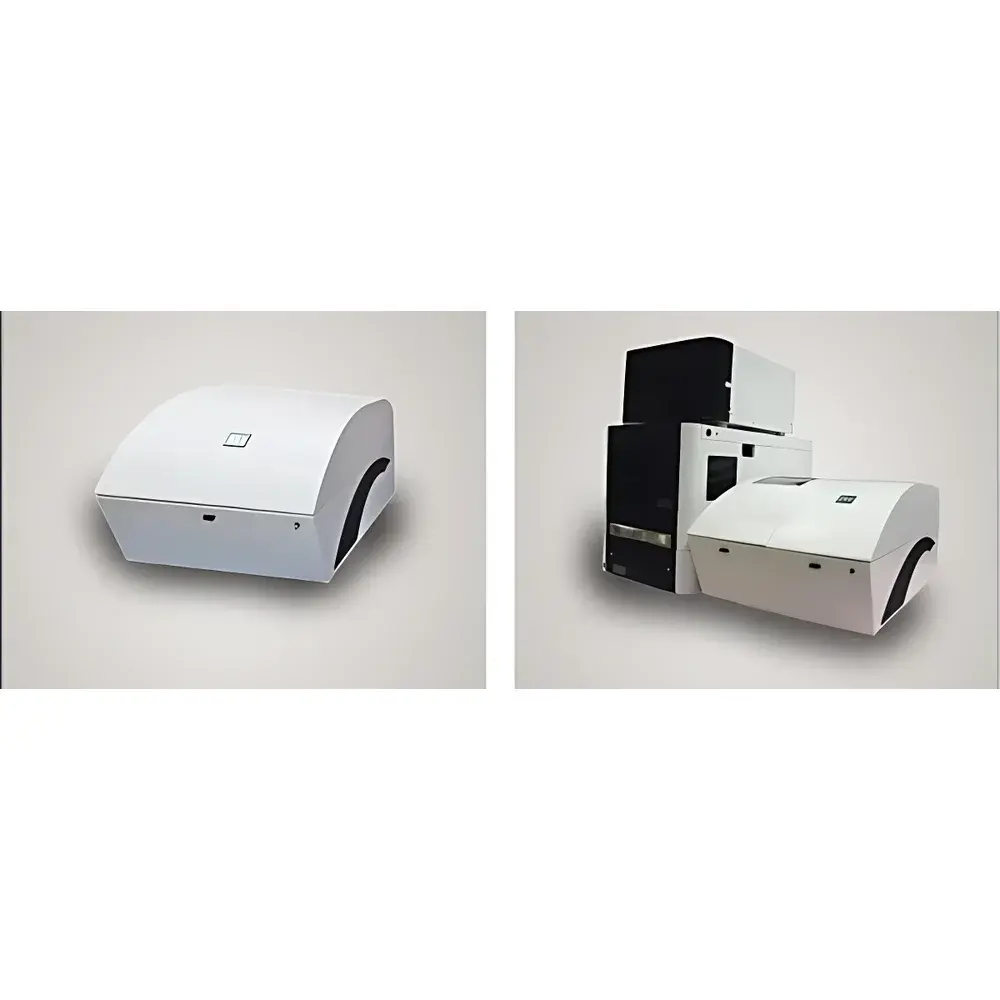
nGauge BI2500 & BI4500 Surface Plasmon Resonance Molecular Interaction Analyzers
| Brand | nGauge |
|---|---|
| Origin | USA |
| Model | BI2500 (3-channel SPR), BI4500 (5-channel modular SPR) |
| Detection Range | <100 Da |
| Sample Volume per Channel | <32 nL |
| Minimum Injection Volume | >50 µL |
| Data Acquisition Rate | 4 ms per point |
| Temperature Control | Ambient (RT only) |
| Configuration | Modular flow-cell architecture with electrochemical, gas-phase, and liquid-phase sensing options |
Overview
The nGauge BI2500 and BI4500 are high-performance, label-free surface plasmon resonance (SPR) molecular interaction analyzers engineered for quantitative real-time analysis of biomolecular binding events. Based on angular interrogation of the Kretschmann configuration, these instruments detect minute changes in the refractive index at a gold-coated sensor chip surface—enabling precise measurement of association/dissociation kinetics, affinity constants (KD), and concentration-dependent binding responses. Unlike conventional SPR platforms constrained by fixed fluidics or limited channel count, the BI series integrates a patented DirectFlow™ microfluidic architecture that minimizes diffusion-induced mass transport artifacts—ensuring kinetic data fidelity even for low-molecular-weight analytes (<100 Da) and low-immobilization-density surfaces. Designed for rigorous academic and industrial R&D environments, the system supports multi-modal operation: standard liquid-phase binding assays, electrochemical SPR (EC-SPR), gas-phase adsorption studies, and hybrid electrochemical–optical correlative measurements—all within a single instrument platform.
Key Features
- Multi-channel SPR Architecture: BI2500 offers three independent flow channels for parallel reference-subtraction or comparative kinetics; BI4500 expands to five channels with fully independent fluidic control and modular sensor cartridge compatibility.
- Ultra-low Sample Consumption: Each detection channel requires less than 32 nL of sample volume per injection—critical for precious recombinant proteins, synthetic peptides, or metabolite standards.
- Sub-millisecond Temporal Resolution: 4-ms data acquisition interval enables accurate capture of rapid on-rates (kon > 1 × 10⁶ M⁻¹s⁻¹) and transient conformational intermediates.
- Modular Sensing Capabilities: Interchangeable flow cells support electrochemical biasing (±2 V range), controlled gas-phase exposure (N₂, O₂, NO, NH₃), and high-sensitivity liquid-phase detection with integrated temperature-stabilized cuvette mounts.
- DirectFlow™ Microfluidics: Laminar, diffusion-minimized flow ensures true solution-phase binding conditions—eliminating convective artifacts and enabling reliable koff determination for tight-binding interactions (KD < 10 pM).
Sample Compatibility & Compliance
The BI2500/BI4500 platform is validated for use with native and engineered proteins (including membrane proteins reconstituted in nanodiscs), oligonucleotides, glycans, small-molecule inhibitors (<100 Da), and volatile organic compounds. Sensor chips employ standardized Au(111) surfaces functionalized via thiol-based self-assembled monolayers (e.g., 3-mercaptopropionic acid for cytochrome c immobilization) or carboxymethyl dextran matrices. All hardware and firmware comply with IEC 61010-1 (electrical safety) and ISO 13485-aligned manufacturing controls. While not FDA-cleared as an IVD device, the system supports GLP-compliant workflows through audit-trail-enabled software logging, user-access controls, and electronic signature capability per 21 CFR Part 11 when operated with validated SOPs.
Software & Data Management
BIControl™ software provides instrument control, real-time sensorgram visualization, global fitting of kinetic models (1:1 Langmuir, bivalent analyte, heterogeneous ligand), and thermodynamic parameter extraction (ΔH, ΔS). Raw data are stored in vendor-neutral HDF5 format with embedded metadata (flow rate, temperature, buffer composition, cell ID). Batch processing supports automated referencing, double-referencing (buffer + surface), and outlier rejection based on chi-square residuals. Export modules generate CSV, Excel, and GraphPad Prism-compatible files. Software validation documentation—including IQ/OQ protocols and traceability matrices—is available upon request for regulated laboratories.
Applications
- Redox-Driven Conformational Analysis: Simultaneous electrochemical polarization and SPR angle tracking enable direct correlation between redox state (e.g., Fe²⁺/Fe³⁺ in cytochrome c) and structural rearrangement—quantified via shift in resonance minimum angle (Δθ) during cyclic voltammetry sweeps.
- Gas-Phase Sensor Calibration: Adsorption isotherms of volatile organics (e.g., formaldehyde, acetone) on functionalized Au surfaces yield sub-monolayer sensitivity (detection limit ~10 pptv), serving as primary calibration references for chemiresistive or QCM biosensors.
- Food Contaminant Screening: Detection of melamine in skim milk matrix demonstrates LOD of 0.5 µM—over 18× lower than WHO’s tolerable daily intake threshold (9 µM)—with <5% cross-reactivity against common dairy proteins.
- Electrodeposited Metal Thickness Quantification: In situ EC-SPR monitoring of Cu electrodeposition from acidic sulfate electrolyte achieves thickness resolution of ±0.1 nm, enabling real-time validation of nucleation overpotential and growth mode transitions.
- Low-MW Drug–Target Kinetics: High signal-to-noise ratio at sub-100-Da scale permits robust kon/koff determination for fragment-sized inhibitors binding to kinases or GPCRs without signal amplification.
FAQ
Does the BI4500 support simultaneous electrochemical and SPR measurements?
Yes—the BI4500’s modular flow cell includes integrated working/reference/counter electrode contacts co-located with the SPR sensing area, enabling true concurrent potentiostatic control and optical readout.
Can the system be used for kinetic analysis of membrane proteins?
Yes—when coupled with nanodisc- or liposome-embedded targets immobilized on hydrophobic SPR chips, the BI series maintains stable baseline and low non-specific binding across extended assay durations (>2 h).
Is temperature regulation available beyond ambient?
No—the current platform operates exclusively at ambient (RT) conditions; active Peltier-based thermal control is not included but can be implemented externally via custom flow-cell jackets.
What data formats are supported for third-party analysis?
All raw sensorgrams export as HDF5 with embedded timestamps, flow-cell identifiers, and experimental parameters; processed fits export to CSV and .prism formats compatible with GraphPad, Origin, and MATLAB.
Are service contracts and application support available internationally?
Yes—nGauge provides remote diagnostics, on-site service (via authorized regional partners), and application-specific method development support under annual maintenance agreements.