
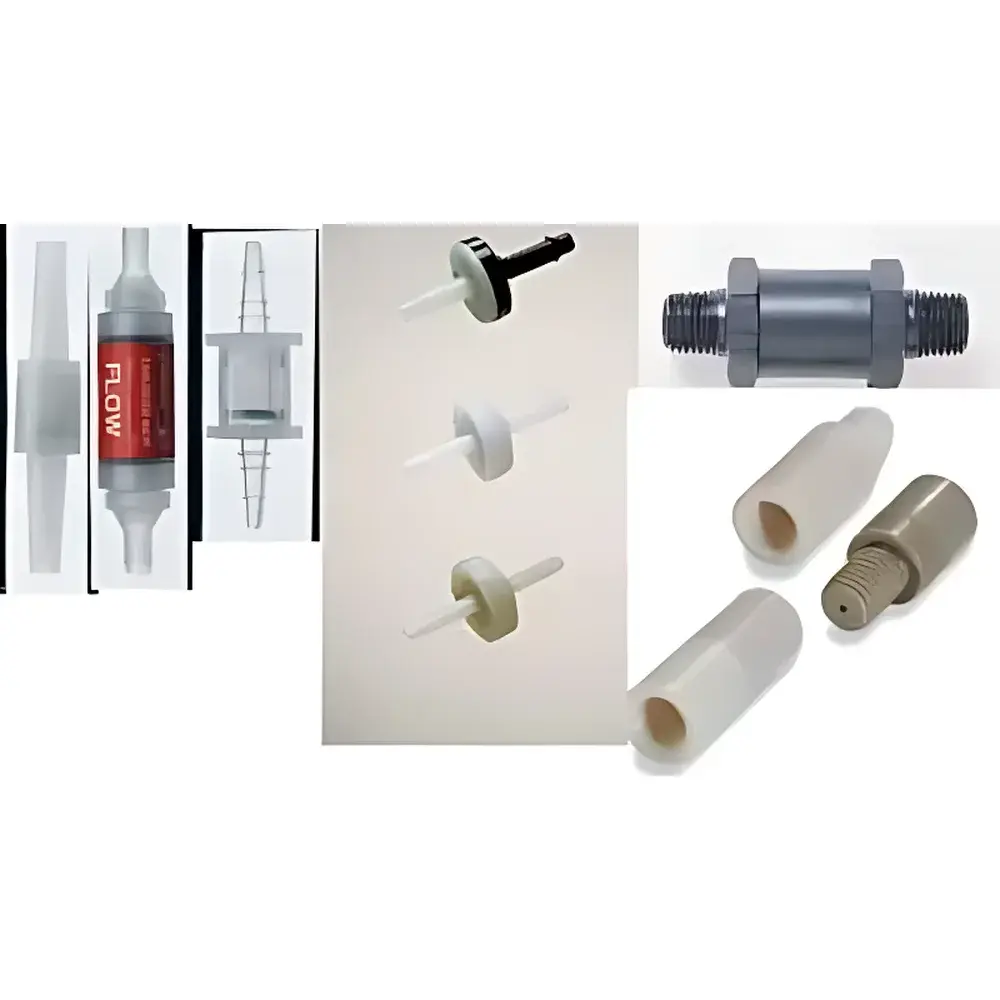
Cole-Parmer 98553-10 Non-Return Valve for Peristaltic Pump Systems
| Brand | Cole-Parmer |
|---|---|
| Origin | USA |
| Model | 98553-10 |
| Type | Inline Spring-Loaded Check Valve |
| Material | FDA-Compliant EPDM Elastomer with Polypropylene Housing |
| Max Operating Pressure | 100 psi (6.9 bar) |
| Max Flow Rate | 2.5 L/min |
| Connection | 1/4" ID Tubing (6.4 mm) Compression Fitting |
| Temperature Range | 0–80 °C |
| Sterilization | Autoclavable (121 °C, 20 min, max 3 cycles) |
| Compliance | FDA 21 CFR Part 177.2600, USP Class VI |
Overview
The Cole-Parmer 98553-10 Non-Return Valve is an engineered inline check valve designed specifically for integration into peristaltic pump fluid paths in analytical, bioprocessing, and laboratory automation applications. It operates on a spring-loaded poppet mechanism to ensure unidirectional flow control—preventing backflow, siphoning, and sample carryover during pump stoppages or pressure transients. Its compact, low-dead-volume design minimizes fluid retention and supports rapid system priming and washout, critical for high-integrity liquid handling workflows. Unlike gravity-dependent flap valves, this unit maintains consistent cracking pressure (typically 1.5–3 psi) across variable flow rates and orientations, enabling reliable performance in horizontal, vertical, or inverted installations.
Key Features
- FDA-compliant EPDM elastomer sealing element ensures chemical resistance to common aqueous buffers, alcohols, and mild organic solvents—validated per USP Class VI biological reactivity standards.
- Polypropylene housing provides structural rigidity, thermal stability up to 80 °C, and compatibility with autoclave sterilization (121 °C, 20 minutes; maximum 3 cycles), supporting GLP/GMP-critical environments.
- 1/4″ internal diameter compression fitting enables secure, leak-free connection to standard peristaltic pump tubing without adhesives or clamps—reducing assembly time and eliminating torque-sensitive fasteners.
- Low-pressure-drop design (< 2.5 psi at 2.5 L/min water @ 25 °C) preserves pump efficiency and avoids unintended flow restriction in multi-valve manifolds.
- Fixed cracking pressure threshold prevents premature opening under low-flow conditions while ensuring immediate closure upon pump deactivation—critical for metering accuracy in dosing and titration systems.
Sample Compatibility & Compliance
The 98553-10 valve is validated for use with non-corrosive, non-particulate liquids including saline solutions, cell culture media, HPLC mobile phases (aqueous/organic blends ≤ 30% acetonitrile), and buffered reagents. It is not rated for use with strong oxidizers (e.g., concentrated HNO₃, H₂O₂ > 10%), halogenated hydrocarbons, or slurries containing particles > 50 µm. Regulatory documentation includes full material traceability (lot-specific CoA), FDA 21 CFR Part 177.2600 compliance for indirect food contact, and ISO 10993-5 cytotoxicity test reports. The valve meets mechanical requirements of ASTM F2391 for check valve leakage rate (< 0.1 mL/min at 100 psi), and its design supports audit-ready validation protocols for IQ/OQ/PQ execution.
Software & Data Management
As a passive mechanical component, the 98553-10 requires no firmware, drivers, or software integration. However, its predictable failure mode (gradual increase in back-leakage > 0.05 mL/min at rated pressure) enables straightforward condition monitoring when paired with upstream flow sensors or pressure transducers in automated pump control architectures. Maintenance logs—including installation date, sterilization cycles, and functional verification results—can be incorporated into electronic lab notebook (ELN) systems or LIMS via standardized CSV import templates aligned with ASTM E1578-22 metadata conventions.
Applications
- Preventing reverse flow in peristaltic pump-driven reagent dispensing modules for automated analyzers and ELISA workstations.
- Isolating downstream detection cells from upstream buffer reservoirs in continuous-flow UV-Vis spectrophotometry setups.
- Securing fill lines in single-use bioreactor feed systems to avoid cross-contamination during media exchange.
- Enabling fail-safe operation in environmental monitoring samplers where pump power interruption must not compromise sample integrity.
- Supporting closed-loop calibration workflows in conductivity or pH meter verification rigs by eliminating drift-inducing back-diffusion.
FAQ
Can this valve be used with silicone tubing?
Yes—its compression fitting is dimensionally compatible with standard 1/4″ ID silicone tubing (e.g., Tygon® LFL, PharMed® BPT); however, repeated autoclaving may accelerate silicone degradation; EPDM or Viton® alternatives are recommended for steam-exposed configurations.
What is the maximum allowable pulsation frequency when used with high-speed peristaltic pumps?
The valve remains stable under pulsation frequencies up to 300 rpm (5 Hz) with peak-to-peak pressure amplitudes ≤ 15 psi—exceeding typical operating envelopes of Masterflex® and Watson-Marlow® pump heads.
Is replacement of the internal spring possible in the field?
No—the 98553-10 is supplied as a sealed, non-serviceable assembly; end users must replace the entire unit after exceeding three autoclave cycles or observing measurable backflow during functional testing.
Does this valve meet USP particulate matter requirements?
While the valve itself is not tested per USP , its materials and manufacturing process are certified particulate-free per ISO 14644-1 Class 7 cleanroom assembly, and extractables profiling confirms < 10 ppb total organic carbon (TOC) leachables under simulated use conditions.
Can it be installed in vacuum service?
No—it is rated for positive-pressure applications only; vacuum exposure may cause seal extrusion or housing deformation due to lack of internal support structure.



