
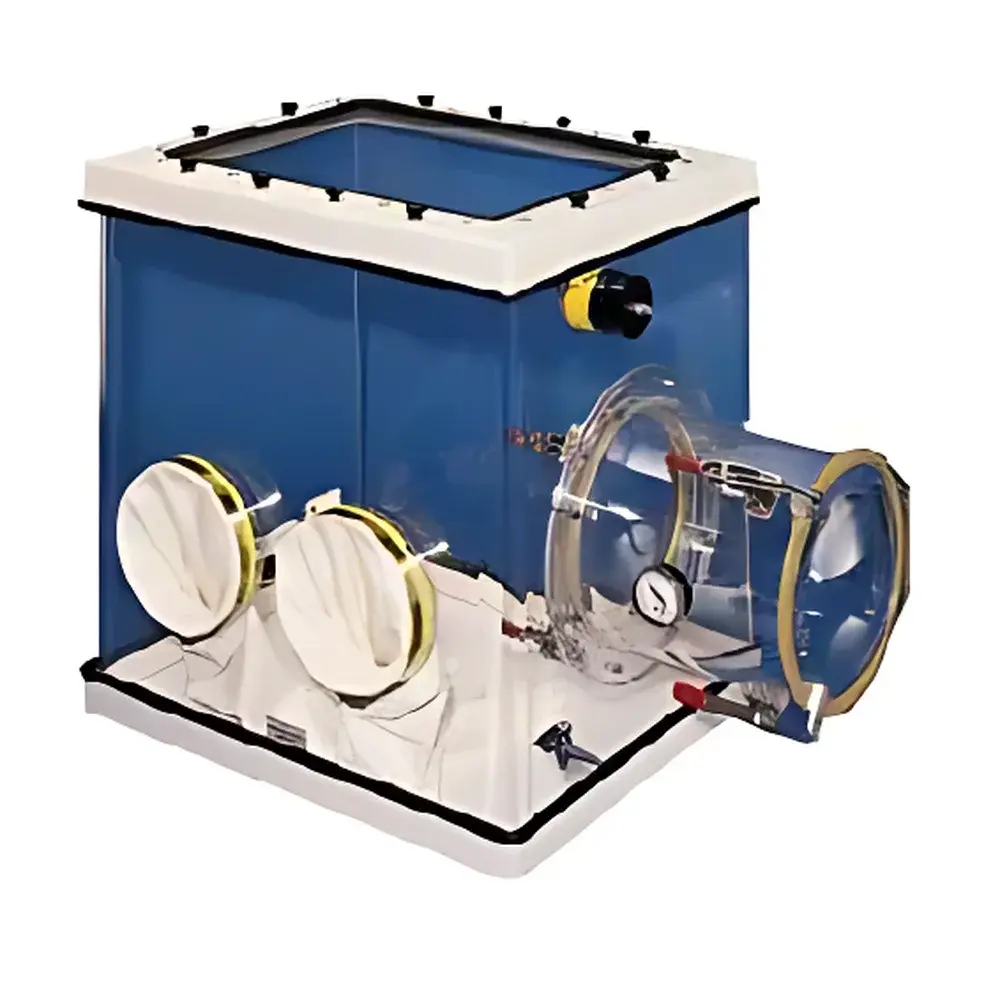
Plas-labs 830-ABC Hazardous Materials Glove Box
| Origin | USA |
|---|---|
| Manufacturer Type | Authorized Distributor |
| Origin Category | Imported |
| Model | 830-ABC |
| Application | Research-Grade Glove Box |
| Chamber Material | Acrylic (PMMA) |
| Chamber Volume | 317 L |
| Transfer Chamber Volume | Not Specified |
| Number of Gloves | 2 |
| Internal Dimensions (L×W×H) | 71 × 58 × 74 cm |
| External Dimensions (L×W×H) | 110 × 61 × 79 cm |
| Glove Port Diameter | 22.2 cm |
| Glove Length | 81 cm |
| Weight | 104 kg |
| HEPA Filter | 8" (203 mm) H14 |
| Pre-filter | 4 µm Organic Vapor & Particulate |
| Operating Pressure | Negative Pressure Mode |
| Leak Rate | Not Specified |
| Temperature Range | Ambient |
| Humidity Control | Not Integrated |
| Oxygen/Water Content Monitoring | Requires Optional Sensors |
| Vacuum Gauge Included | Yes, 28 cm Dial |
| Top Access Hatch | Yes |
| Internal Power Outlets | Yes (220 V, 60 Hz) |
| Sealing Mechanism | Stainless Steel Clamp Locks (4 valves) |
Overview
The Plas-labs 830-ABC Hazardous Materials Glove Box is an engineered containment solution designed for safe, reproducible handling of toxic, pyrophoric, moisture-sensitive, or biologically hazardous substances in research and development laboratories. Built to ANSI Z9.5 and ISO 14644-1 Class 5 cleanroom-compatible standards, this negative-pressure glove box operates under controlled atmospheric isolation—maintaining a consistent sub-ambient pressure differential relative to the surrounding lab environment to prevent uncontrolled egress of contaminants. Its primary engineering principle relies on continuous volumetric air exchange through a dual-stage filtration system: a high-efficiency 8″ H14 HEPA filter (≥99.995% @ 0.3 µm) paired with a 4 µm pre-filter optimized for organic vapors and coarse particulates. This architecture ensures operator protection during manipulation of pharmaceutical intermediates, cytotoxic compounds, asbestos fibers, radioactive isotopes (low-energy β/γ emitters), and volatile chemical agents—without requiring external exhaust ducting in many installations.
Key Features
- Negative-pressure containment system with four stainless steel clamp-lock isolation valves for independent control of inlet, exhaust, purge, and vacuum lines
- Acrylic (PMMA) chamber construction offering optical clarity, chemical resistance to non-halogenated solvents, and impact resilience per ASTM D543
- Two integrated 22.2 cm-diameter glove ports fitted with O-ring sealed hypalon gloves (81 cm length), certified to ASTM F739 for permeation resistance against Class A–C hazardous agents
- Dedicated cylindrical transfer chamber (317 L total chamber volume; dimensions: 71 × 58 × 74 cm internal) enabling sequential airlock-style sample introduction without breaching main chamber integrity
- Top-mounted access hatch (43 × 58 cm) facilitating integration of analytical instruments such as microbalances, Karl Fischer titrators, or humidity analyzers
- Built-in 220 V / 60 Hz power outlets and analog vacuum gauge (28 cm dial face) for real-time pressure monitoring during purging or evacuation cycles
- Modular design compliant with IEC 61000-6-3 EMC requirements and UL 61010-1 safety certification for laboratory electrical equipment
Sample Compatibility & Compliance
The 830-ABC accommodates solid, liquid, and semi-solid samples including cytostatic drug formulations, lyophilized biologics, nanomaterial slurries, low-level radioactive tracers (e.g., 3H, 14C), and industrial toxins such as organophosphates or heavy metal salts. It meets functional equivalency to OSHA 1910.120 (HAZWOPER) engineering controls for Level B PPE substitution and supports GLP-compliant workflows when paired with validated environmental monitoring systems. While the base unit does not include integrated oxygen or moisture sensors, its chamber wall ports and electrical feedthroughs permit retrofitting of third-party analyzers compliant with ASTM E2027 (moisture measurement) and ISO 8573-3 (compressed air purity). All materials contacting the interior atmosphere conform to USP Class VI biocompatibility testing protocols.
Software & Data Management
This is a hardware-only containment platform with no embedded microprocessor or digital control interface. Environmental parameters—including pressure differential, flow rate, and filter service life—are monitored manually via analog gauges and scheduled maintenance logs. For regulated environments (e.g., FDA-regulated QC labs), users may integrate external data acquisition systems connected through NEMA 12-rated feedthroughs. Audit trail generation, electronic signatures, and 21 CFR Part 11 compliance are achieved exclusively at the peripheral instrumentation level (e.g., balance software, gas analyzer firmware), not by the glove box itself. Documentation packages include Factory Acceptance Test (FAT) reports, material certifications (RoHS/REACH), and ISO 9001-certified assembly records.
Applications
- Handling of potent pharmaceutical compounds during formulation screening and stability testing (ICH Q5C)
- Encapsulated synthesis of air-sensitive catalysts (e.g., Grignard reagents, alkali metal hydrides)
- Preparation and analysis of asbestos-containing building material (ACBM) samples per EPA Method 600/R-93/116
- Decontamination and weighing of low-activity radiopharmaceuticals in nuclear medicine R&D
- Controlled drying and moisture content determination of hygroscopic APIs using integrated microbalances
- Safe manipulation of neurotoxic agents (e.g., VX simulants) in defense-related countermeasure research
FAQ
Does the 830-ABC include built-in oxygen or moisture sensors?
No—oxygen and humidity monitoring require optional third-party sensor modules mounted externally or via chamber port adapters.
Can the glove box be connected to a central exhaust system?
Yes—exhaust lines may be plumbed via the rear-mounted 1/2″ NPT valve; static pressure drop must remain below 1.5 kPa to maintain specified leak integrity.
What glove replacement options are certified for use with this model?
Only Plas-labs OEM hypalon, butyl rubber, or Viton®-lined gloves with 22.2 cm flange diameter and ASTM F739 Class C permeation ratings are supported.
Is the acrylic chamber resistant to chlorinated solvents?
No—acrylic exhibits stress cracking in contact with chlorinated hydrocarbons (e.g., chloroform, methylene chloride); alternative chamber materials (e.g., stainless steel) are available under custom configuration.
What maintenance intervals are recommended for the HEPA and pre-filters?
HEPA filter replacement is advised every 12–18 months under continuous operation; pre-filter replacement every 3–6 months, depending on airborne particulate load and organic vapor concentration.



