
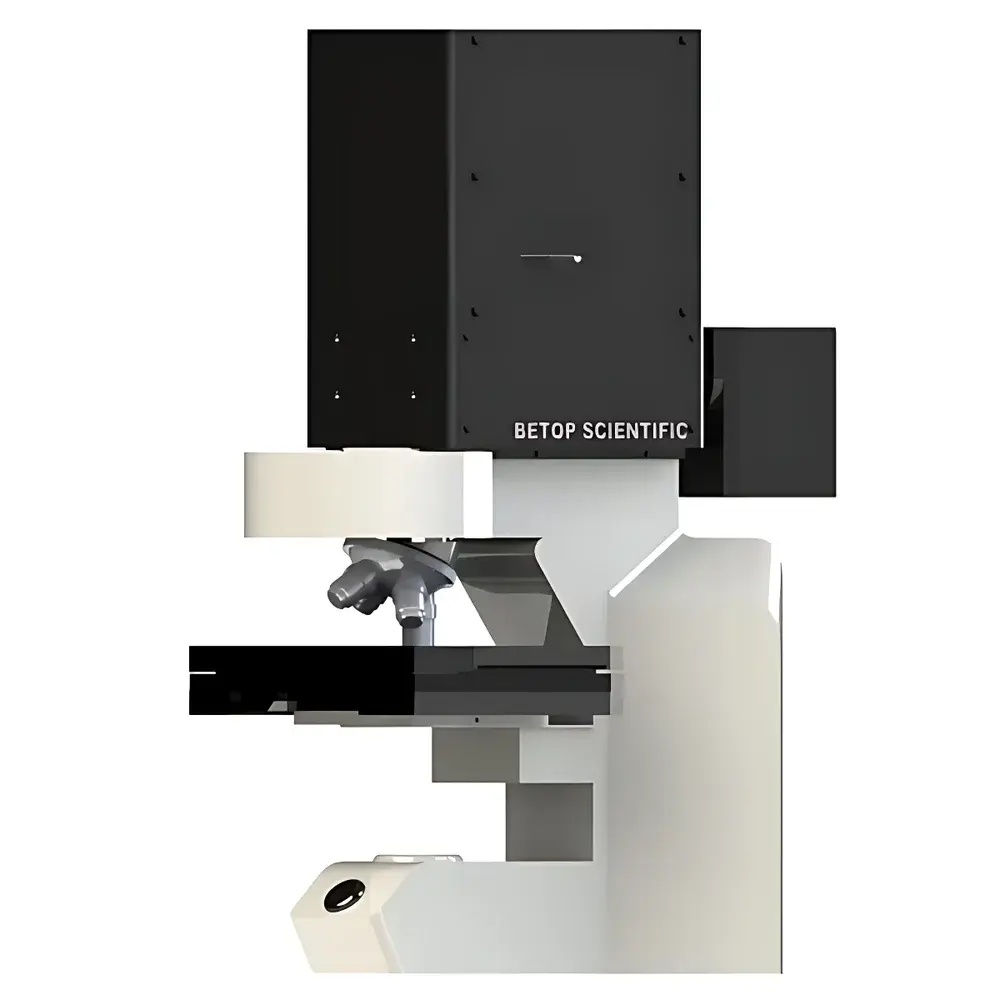
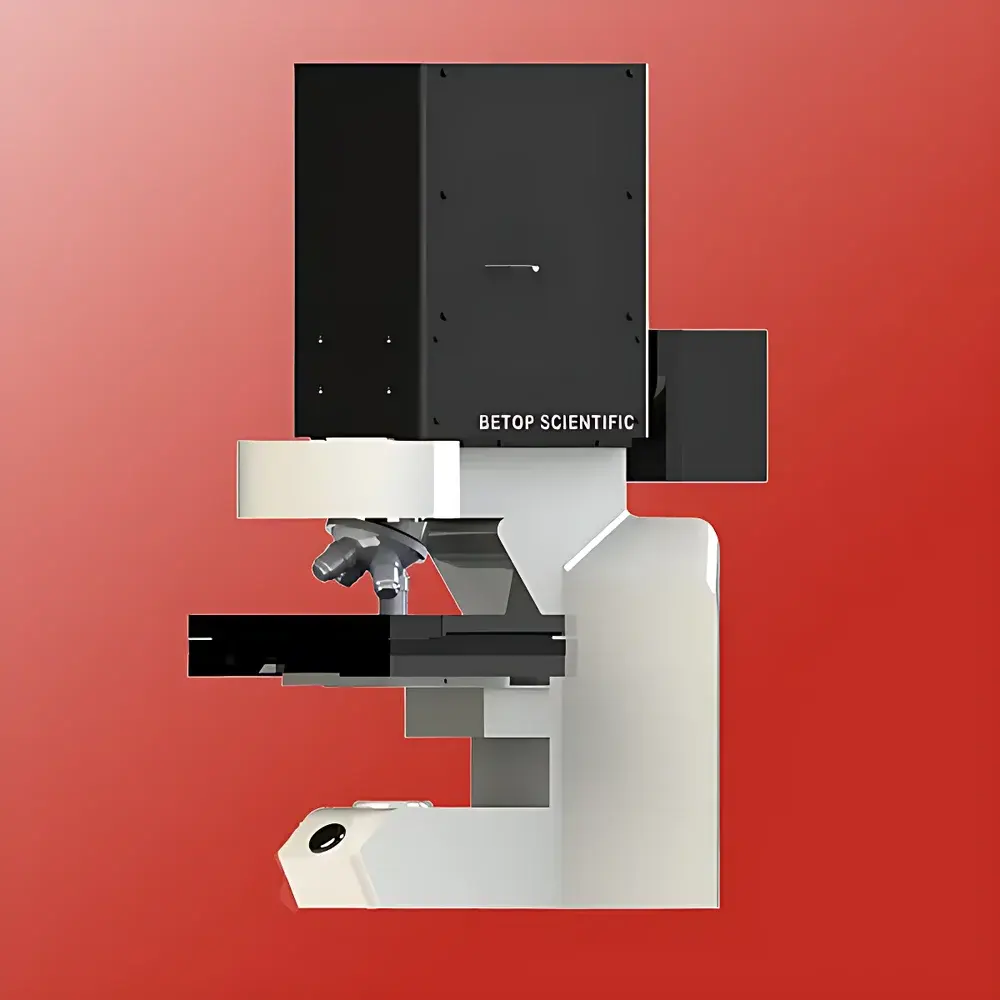
Betop Scientific MARS1000 Microscopic Angle-Resolved Spectrometer
| Brand | Betop Scientific |
|---|---|
| Origin | Guangdong, China |
| Manufacturer Type | Direct Manufacturer |
| Country of Origin | China |
| Model | MARS1000 |
| Pricing | Upon Request |
Overview
The Betop Scientific MARS1000 Microscopic Angle-Resolved Spectrometer is an advanced optical characterization platform engineered for quantitative mapping of electromagnetic mode dispersion in micro- and nanoscale materials. It operates on the principle of conjugate-plane imaging—precisely aligning the back focal plane (BFP) of the objective lens, the total internal reflection (TIR) plane, and the angle-resolved detection plane—to enable spatially localized, momentum-resolved spectroscopic measurements. By coupling a single-mode optical fiber as both excitation source and collection probe, the system delivers collimated illumination at defined in-plane wavevectors (k∥) and records spectrally resolved emission or scattering as a function of emission angle. This architecture satisfies rigorous requirements for k-space spectroscopy in low-dimensional photonic systems, supporting fundamental studies of polaritons, Bloch modes, and guided resonances with sub-micron spatial registration.
Key Features
- Integrated microscope-spectrometer architecture enabling simultaneous high-magnification structural imaging and angle-resolved spectral acquisition
- Conjugate-plane optical design ensuring precise k∥-space calibration across the full angular range (±75° relative to surface normal)
- Fiber-coupled excitation and collection path for stable, alignment-insensitive angular scanning without mechanical goniometer movement
- Motorized XYZ translation stage with sub-micron positioning repeatability for automated real-space raster scanning of microstructures
- Modular spectral detection options: CCD-based visible-NIR spectrometers (350–1100 nm) or InGaAs array detectors (900–1700 nm), configurable per application
- Optical polarization control via motorized half-wave and quarter-wave plates for full Stokes parameter acquisition
Sample Compatibility & Compliance
The MARS1000 accommodates planar and quasi-planar samples up to 50 mm × 50 mm, including dielectric metasurfaces, plasmonic nanostructures, 2D material heterostructures (e.g., MoS2, hBN), photonic crystal slabs, and semiconductor microcavities. Sample mounting uses vacuum chucks or kinematic stages compatible with cryogenic (4 K–300 K) and environmental (controlled N2/vacuum) chambers. The system supports traceable calibration using NIST-traceable spectral standards and angular reference gratings. All optical components comply with ISO 10110 surface quality specifications, and mechanical stages meet ISO 230-2 positional accuracy standards. Data acquisition workflows are compatible with GLP-compliant documentation protocols, including timestamped metadata embedding and audit-ready log export.
Software & Data Management
Control and analysis are performed through Betop’s proprietary MARS Control Suite v3.x, a Windows-based application supporting real-time spectral preview, automated k-space grid acquisition, and polarization-resolved data stitching. Raw datasets are saved in HDF5 format with embedded metadata (wavelength, angle, polarization state, stage coordinates, integration time). Built-in processing modules include dispersion curve extraction via 2D Fourier transform, Lorentzian/Fano line-shape fitting, and band-edge identification algorithms. Export options include CSV, MATLAB .mat, and standardized JCAMP-DX files for interoperability with third-party modeling tools (Lumerical FDTD, COMSOL, Python-based k-space libraries). Software architecture adheres to FDA 21 CFR Part 11 principles for electronic records, featuring user role management, electronic signatures, and immutable audit trails for regulated environments.
Applications
- Metasurface & flat optics validation: Quantitative verification of theoretical dispersion relations for Huygens’ metasurfaces and achromatic metalenses under variable-angle illumination
- Polaritonics research: Mapping of exciton-polariton dispersion in TMDC-based microcavities and observation of topological edge states
- Photonic crystal light extraction: Angular-resolved fluorescence mapping to identify leaky radiation channels and quantify Purcell enhancement factors
- Nanofabrication process control: Non-destructive, wafer-scale angular spectral metrology for grating pitch uniformity and sidewall angle assessment
- Display technology R&D: Characterization of viewing-angle-dependent color gamut and luminance in quantum-dot patterned films and micro-LED arrays
FAQ
What is the minimum resolvable angular step size?
The system achieves ≤0.1° angular resolution in k-space through sub-pixel fiber positioning and calibrated BFP mapping.
Can the MARS1000 be integrated with a cryostat?
Yes—standard configurations support integration with closed-cycle cryostats (4 K–300 K) via vacuum-compatible optical feedthroughs and low-vibration mounting interfaces.
Does the system support time-resolved angle-resolved measurements?
When coupled with a pulsed laser source and time-correlated single-photon counting module (TCSPC), the platform enables picosecond-resolved k-space dynamics tracking.
Is spectral calibration traceable to national standards?
Yes—factory calibration includes NIST-traceable tungsten-halogen and mercury-argon lamp references, with certificate of calibration provided upon delivery.
What sample preparation is required?
No special coating or metallization is needed; native substrates (SiO2/Si, sapphire, quartz) and air-bridged structures are fully compatible. Substrate thickness should be ≥100 µm for TIR coupling efficiency.




