
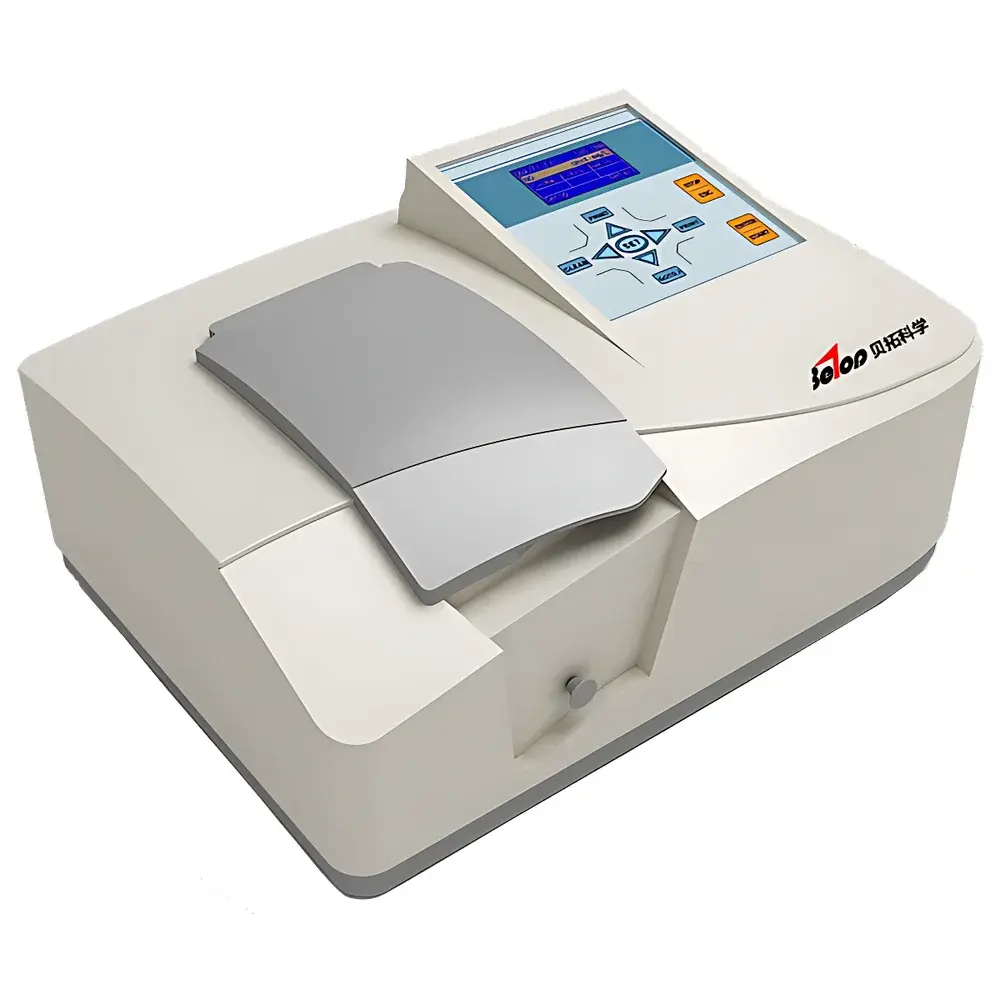
Betop Scientific Lambda-220 Single-Beam Ultraviolet-Visible Spectrophotometer
| Brand | Betop Scientific |
|---|---|
| Origin | Guangdong, China |
| Manufacturer Type | Original Equipment Manufacturer (OEM) |
| Product Origin | Domestic (China) |
| Model | Lambda-220 |
| Instrument Architecture | Single-Beam |
| Detector Type | Photodiode Array (PDA) |
| Wavelength Range | 190–1100 nm |
| Automation Level | Automatic Wavelength Scanning |
| Spectral Bandwidth | 4 nm |
| Wavelength Accuracy | ±0.8 nm |
| Wavelength Repeatability | ≤0.2 nm |
| Stray Light | ≤0.1% T at 220 nm and 360 nm |
Overview
The Betop Scientific Lambda-220 is a single-beam ultraviolet-visible (UV-Vis) spectrophotometer engineered for precision absorbance and transmittance measurements across a broad spectral range (190–1100 nm). Based on classical Beer–Lambert law principles, the instrument employs a fixed optical path with a deuterium lamp (UV) and tungsten-halogen lamp (visible/NIR), automatically switched via internal optics to ensure optimal signal-to-noise ratio across the full range. Its single-beam architecture—combined with real-time dark-current correction, auto-zeroing, and integrated wavelength calibration—delivers high reproducibility in routine quantitative analysis without requiring reference beam stabilization. Designed for educational laboratories, QC environments, and applied research settings where robustness, ease of operation, and regulatory-compliant data handling are prioritized over ultra-high-resolution scanning, the Lambda-220 balances performance, reliability, and cost-effectiveness.
Key Features
- Photodiode array (PDA) detector enabling rapid spectral acquisition and stable baseline response
- Automatic wavelength scanning and calibration; no manual alignment required
- Integrated dual-lamp system (long-life socket-type deuterium lamp + tungsten-halogen lamp) with automatic source switching
- Optical design optimized for low stray light (≤0.1% T at 220 nm and 360 nm), critical for accurate low-transmittance measurements
- High-contrast dot-matrix LCD display with intuitive menu navigation and tactile membrane keypad
- Wide sample compartment accommodating cuvettes from 5 mm to 100 mm pathlength, compatible with standard and custom accessories (e.g., multi-cell holders, temperature-controlled cells)
- Onboard data storage with power-loss retention: spectra and measurement results persist through shutdown
- Internal firmware supports dark-current correction, blank subtraction, and wavelength validation routines per ISO 17025-relevant operational checks
- Modular hardware architecture with imported precision optical components and rigid aluminum optical bench for long-term mechanical stability
Sample Compatibility & Compliance
The Lambda-220 accommodates standard quartz, glass, and plastic cuvettes (10 mm default; optional 5/20/50/100 mm), supporting liquid, solution-based, and suspended particulate samples within defined absorbance limits (0–3.0 Abs). It meets fundamental performance criteria outlined in ASTM E275, ISO 6223, and Chinese national standard JJG 178–2015 for UV-Vis spectrophotometers. While not pre-certified for GMP or FDA 21 CFR Part 11 out-of-the-box, its audit-ready data logging (time-stamped measurements, operator ID fields in PC software mode), electronic signature support via optional software modules, and traceable calibration protocols enable straightforward qualification under GLP and internal quality management systems.
Software & Data Management
The optional PC-based Quantitative Analysis Software extends functionality beyond standalone operation: enabling kinetic (time-scan) studies, multi-point standard curve generation (linear, quadratic, cubic), batch concentration calculation, derivative spectroscopy, and customizable report export (PDF, CSV, Excel). All raw absorbance/transmittance data are timestamped and stored with metadata (wavelength, slit width, date/time, user ID if configured). The software supports audit trail configuration, user access levels, and encrypted local database storage—facilitating compliance with ISO/IEC 17025 documentation requirements. Data can be exported without proprietary format lock-in, ensuring interoperability with LIMS and statistical analysis platforms.
Applications
The Lambda-220 serves core analytical workflows across academic, industrial, and public health laboratories. Typical use cases include: quantification of nucleic acids and proteins (A260/A280 ratios); assay development for enzyme kinetics and inhibitor screening; active pharmaceutical ingredient (API) assay per USP ; colorimetric determination of heavy metals (e.g., Fe2+, Cu2+) in environmental water samples; nutritional component analysis (e.g., vitamin C, nitrate) in food matrices; and dye concentration monitoring in textile effluent treatment. Its reliability in daily teaching labs—supporting student experiments in analytical chemistry, biochemistry, and pharmacology—is reinforced by guided calibration workflows and context-sensitive help prompts.
FAQ
What is the maximum pathlength supported by the sample compartment?
The instrument accepts cuvettes with optical path lengths from 5 mm to 100 mm, including standard 10 mm square cells and specialized long-path flow cells.
Does the Lambda-220 support GLP-compliant data integrity practices?
Yes—when used with the optional PC software, it provides time-stamped records, user authentication, electronic signatures, and immutable audit trails suitable for GLP audits.
Can the instrument perform kinetic measurements without PC connection?
No—time-scan (kinetic) mode requires PC linkage via USB; onboard functions are limited to single-wavelength or full-spectrum static measurements.
Is wavelength calibration traceable to NIST standards?
The internal calibration uses certified holmium oxide and didymium filters; users may perform verification using NIST-traceable standards such as SRM 2034 or SRM 930e.
What maintenance is required for the deuterium lamp?
The socket-mounted deuterium lamp is rated for ≥2,000 hours; replacement requires no optical realignment—lamp position is mechanically fixed and factory-optimized.




