
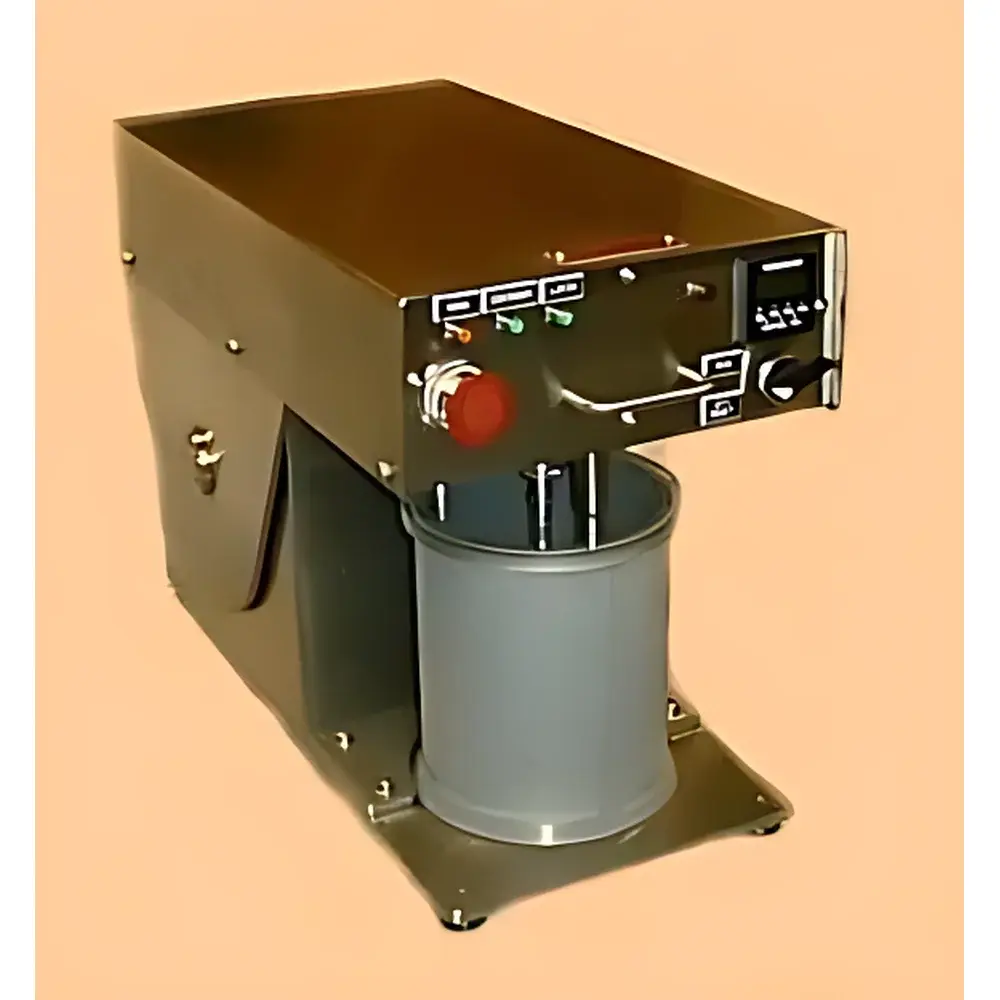
FORMAX T-100 Standard Pulp Disintegrator
| Brand | AMC |
|---|---|
| Origin | USA |
| Manufacturer Type | Authorized Distributor |
| Origin Category | Imported |
| Model | T-100 |
| Motor | 1/3 HP, gear-driven with pulley transmission |
| Power Supply | 220 V, single-phase, 50/60 Hz, max. 3.5 A |
| Dimensions | 28 cm (W) × 56 cm (L) × 43 cm (H) |
| Weight | 45 kg (100 lbs) |
| Construction | 316 stainless steel frame, shaft, and beater roll |
| Disintegration Vessel | CPVC plastic pot |
| Safety | Dual interlock system + transparent polyester splash guard |
| Control | Digital revolution counter with preset stop function |
| Compliance | TAPPI T-205, ISO 5263 |
Overview
The FORMAX T-100 Standard Pulp Disintegrator is an engineered laboratory instrument designed for controlled, reproducible wet disintegration of pulp samples in accordance with internationally recognized standard test methods. It operates on the principle of mechanical shear dispersion—utilizing a precisely balanced beater roll rotating within a fixed vessel to subject fiber suspensions to defined hydrodynamic stress without inducing artificial fiber cutting, fibrillation, or hornification. This ensures that the intrinsic morphological and dimensional characteristics of fibers—including virgin, chemi-thermomechanical (CTMP), and recycled grades—are preserved throughout the disintegration process. As a core tool in pulp and paper quality control laboratories, the T-100 delivers consistent sample preparation for subsequent testing in freeness (e.g., Canadian Standard Freeness, CSF), fiber length analysis (e.g., Kajaani or FiberLab systems), brightness, ash content, and handsheet formation per TAPPI T-205 and ISO 5263 protocols.
Key Features
- Full compliance with TAPPI T-205 “Standard Mechanical Pulping of Laboratory Samples” and ISO 5263-1:2015 “Pulps — Laboratory Wet Disintegration” for method traceability and audit readiness.
- Robust 316 stainless steel construction of the main frame, drive shaft, and beater roll—resistant to corrosion from acidic or alkaline pulp slurries and compatible with routine cleaning agents used in GLP environments.
- Digital revolution counter with programmable stop functionality: users set exact rotation counts (e.g., 30,000 rev for standard TAPPI disintegration) and the unit halts automatically upon completion—eliminating operator variability and ensuring inter-laboratory repeatability.
- Dual safety interlock system: power is cut immediately if the transparent polyester splash guard is lifted or if the vessel lid is not fully secured—meeting OSHA-aligned machine safeguarding requirements for benchtop lab equipment.
- CPVC plastic disintegration pot provides chemical resistance to common pulp processing reagents while maintaining dimensional stability under continuous agitation; optional stainless steel heated pot available for temperature-controlled disintegration studies (e.g., simulating hot dispersing conditions).
- Compact footprint (28 × 56 × 43 cm) and 45 kg mass enable stable operation on standard lab benches without anchoring; 1/3 HP gear-and-pulley drive delivers high-torque, low-speed rotation (typically 5,000–6,000 rpm at motor, reduced to ~1,200 rpm at beater roll) for uniform energy input.
Sample Compatibility & Compliance
The T-100 accommodates pulp consistencies ranging from 0.5% to 4.0% (w/w) and batch volumes up to 2 L, supporting hardwood, softwood, non-wood (e.g., bamboo, bagasse), deinked recycled fiber (DRF), and mechanical pulp types. Its standardized geometry and rotational dynamics ensure equivalence across labs participating in round-robin testing programs coordinated by TAPPI, ISO/TC 6, or SCAN. Documentation includes factory calibration records, material certificates for 316 SS components, and conformity statements referencing IEC 61000-6-2 (EMC immunity) and IEC 61000-6-3 (EMC emission) standards. The unit is suitable for use in FDA-regulated environments where raw material qualification follows 21 CFR Part 11-compliant SOPs—though the base model does not include electronic audit trail capability (available via third-party LIMS integration).
Software & Data Management
The T-100 operates as a standalone electromechanical device with no embedded firmware or network interface. All operational parameters—including preset revolutions, actual run count, and elapsed time—are displayed on the front-panel LED counter. For digital data capture and traceability, laboratories commonly integrate the unit into validated LIMS or ELN platforms using external USB or RS-232 data loggers (sold separately). AMC provides technical documentation packages—including full electrical schematics, maintenance logs, and preventive service checklists—that support ISO/IEC 17025 accreditation and internal GLP/GMP audits. Optional OEM firmware upgrades are not offered; however, AMC maintains archived service bulletins and revision-controlled mechanical drawings for legacy support.
Applications
- Preparation of representative pulp dispersions for freeness testing (TAPPI T-227, ISO 5267-1)
- Standardized fiber liberation prior to optical fiber analysis (e.g., Fiber Quality Analyzer, MorFi)
- Disintegration of recovered paperboard or OCC samples for contaminant screening and sorting validation
- Method development for alternative fiber sources (e.g., agricultural residues) requiring gentle yet complete dispersion
- QC release testing in tissue, packaging, and specialty paper mills adhering to ISO 9001-certified processes
FAQ
Does the T-100 meet FDA or pharmaceutical-grade material handling requirements?
The unit’s 316 stainless steel wetted parts and CPVC vessel comply with USP Class VI biocompatibility for non-implantable contact; however, it is not certified for direct use in sterile API manufacturing environments without additional containment validation.
Can the disintegration speed or torque be adjusted during operation?
No—the T-100 operates at a fixed rotational speed determined by its gear-and-pulley ratio; variable speed control is not supported to maintain strict adherence to TAPPI/ISO-defined energy input profiles.
Is calibration required before first use or after maintenance?
While no periodic metrological calibration is mandated, AMC recommends verifying revolution counter accuracy annually using a handheld tachometer and documenting results per ISO/IEC 17025 Clause 6.5.
What maintenance intervals are recommended for the gear train and bearings?
AMC specifies lubrication of the gearbox every 500 operating hours and inspection of belt tension and bearing play every 1,000 hours—log entries must be retained for audit purposes.
Is the CPVC pot autoclavable?
No—CPVC is not rated for steam sterilization; cleaning is performed with mild detergent and water or 70% ethanol; autoclave-compatible stainless steel pots are available as accessories.






