
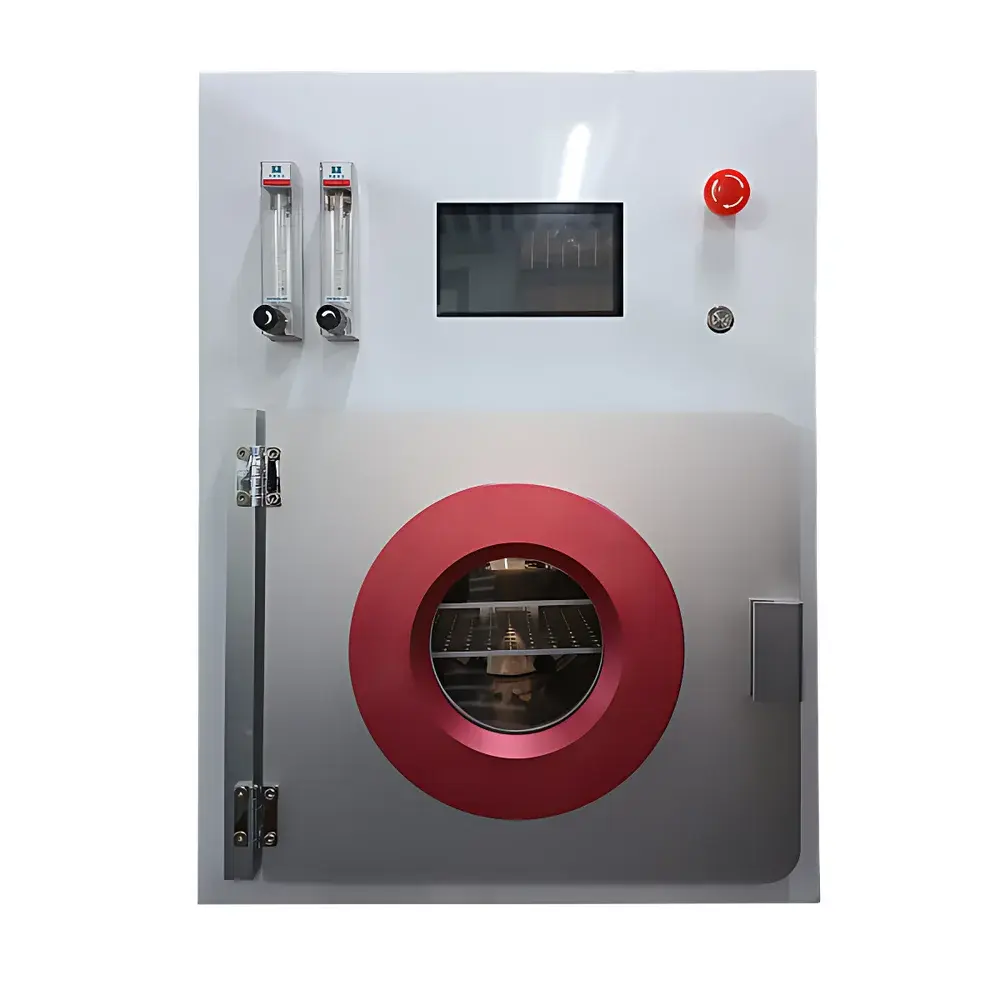
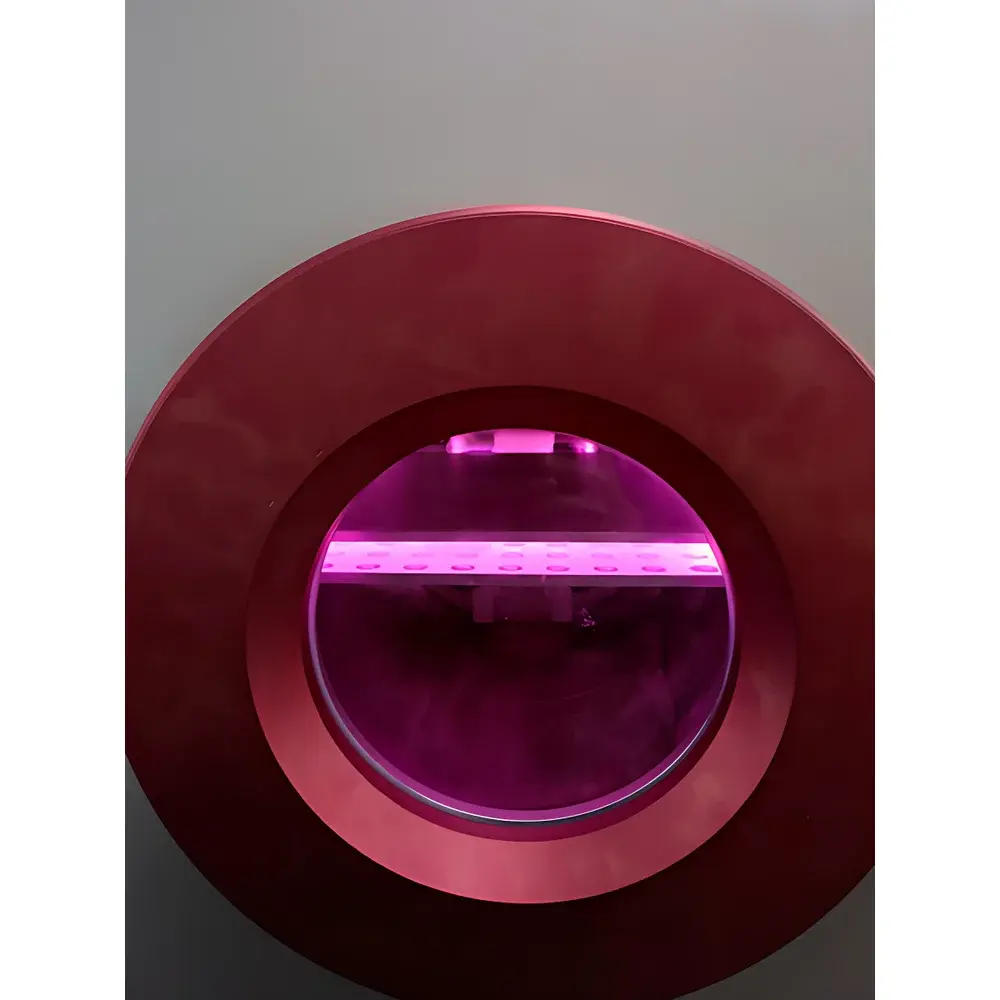
Betop Scientific VPC100M Plasma Surface Treater
| Brand | Betop Scientific |
|---|---|
| Origin | Guangdong, China |
| Manufacturer Type | Direct Manufacturer |
| Country of Origin | China |
| Model | VPC100M |
| RF Frequency | 13.56 MHz |
| Power Range | 0–300 W (adjustable) |
| Chamber Volume | 10 L |
| Chamber Material | Stainless Steel (304) |
| Dimensions (W×D×H) | 76 × 55 × 82 cm |
| Gas Inlets | 2 independent mass flow-controlled channels |
| Control Mode | Manual operation with tactile keypad and LCD interface |
| Plasma Type | Radiofrequency (RF) Capacitively Coupled Plasma (CCP), not microwave plasma — clarification per technical specification |
| Vacuum Base Pressure | ≤0.5 Pa (no-load) |
| Operating Pressure Range | 20–60 Pa |
| Pump-Down Time | ≤40 s (no-load) |
| Venting Time | ≤20 s |
| Electrode Configuration | Dual horizontal adjustable aluminum electrodes |
| Gas Flow Range | 0.3–3.0 L/min per channel (dual float-type flowmeters) |
| Input Power | AC 220 V, 1 kW |
| Net Weight | ~75 kg |
| Compliance | Designed for laboratory-scale surface functionalization under controlled vacuum conditions |
Overview
The Betop Scientific VPC100M Plasma Surface Treater is a benchtop radiofrequency (RF) capacitively coupled plasma (CCP) system engineered for precise, non-thermal surface modification of solid substrates under low-pressure vacuum conditions. Operating at the industrial standard frequency of 13.56 MHz, the VPC100M generates stable, uniform plasma discharges in inert or reactive gas environments—primarily argon, oxygen, nitrogen, or forming gas mixtures—to perform dry, solvent-free surface treatments. Unlike thermal or wet chemical methods, this system achieves molecular-level cleaning, activation, and functionalization through energetic ion bombardment, radical-induced oxidation, and UV photon interaction—without altering bulk material properties or introducing particulate contamination. Its 10-liter stainless steel (AISI 304) vacuum chamber, dual adjustable aluminum electrodes, and robust RF impedance-matching architecture ensure reproducible treatment uniformity across substrates up to 150 mm in diameter, making it suitable for R&D labs requiring GLP-aligned process documentation and repeatable surface engineering outcomes.
Key Features
- Stainless steel (304) vacuum chamber with high-integrity O-ring sealing and leak-tight construction—rated for continuous operation at 20–60 Pa working pressure and ≤0.5 Pa base pressure.
- Dual horizontally mounted, height-adjustable aluminum electrodes—enabling optimal gap tuning (15–50 mm) for uniform plasma distribution across diverse sample geometries including wafers, films, fibers, and irregular 3D components.
- Modular 13.56 MHz RF generator with 0–300 W power regulation and integrated automatic impedance matching—minimizing reflected power and ensuring stable plasma ignition and sustainment.
- Manual control interface featuring backlit LCD display, tactile membrane keypad, and dual analog float-type flowmeters—providing real-time monitoring of gas flow rates (0.3–3.0 L/min per line) without reliance on proprietary software.
- Rapid vacuum cycling: ≤40 s pump-down and ≤20 s venting times (no-load), supporting high-throughput iterative experiments in academic and industrial QC settings.
- No consumables or hazardous chemicals required—eliminating secondary contamination risks associated with solvents, acids, or abrasive media; fully compliant with ISO 14001 environmental management principles.
Sample Compatibility & Compliance
The VPC100M accommodates a broad range of substrate materials—including silicon wafers (up to 6-inch), glass slides, polymer films (PET, PI, PC), metal foils (Al, Cu, Ti), ceramics, and biomedical implants—without thermal damage or dimensional distortion. Its low-power RF plasma regime preserves delicate surface topographies while enabling controlled hydrophilicity enhancement (e.g., water contact angle reduction from >90° to <10° on PDMS), amine-group grafting for bioconjugation, or oxide layer removal prior to thin-film deposition. The system meets fundamental safety requirements per IEC 61010-1 (Electrical Equipment for Laboratory Use) and supports traceable operation under GLP-compliant workflows when paired with external logbooks or electronic lab notebooks (ELNs). Though not FDA 21 CFR Part 11-certified out-of-the-box, its manual operation mode facilitates audit-ready procedural documentation for ISO 9001 or ISO/IEC 17025-accredited laboratories.
Software & Data Management
The VPC100M operates via embedded firmware with no bundled PC software—ensuring long-term operational continuity and minimizing cybersecurity exposure vectors common in connected instrumentation. All process parameters (RF power, gas flow, chamber pressure, treatment duration) are manually set and recorded externally by the user. This design aligns with laboratories prioritizing data sovereignty, regulatory simplicity, and hardware longevity over cloud-based telemetry. For integration into automated workflows, optional analog/digital I/O ports (available upon request) support external PLC-triggered start/stop signals and analog voltage output for power or pressure logging. Raw parameter logs can be imported into LIMS or statistical analysis platforms (e.g., JMP, Python Pandas) for DOE-driven optimization of surface energy, adhesion strength, or bonding yield.
Applications
- Surface Cleaning: Removal of adventitious hydrocarbons, mold release agents, and processing residues from optical lenses, MEMS devices, and microfluidic chips—achieving sub-monolayer cleanliness verified by XPS or contact angle analysis.
- Plasma Activation: Introduction of polar functional groups (–OH, –COOH, –NH₂) onto polyolefin surfaces (PP, PE) to enable subsequent inkjet printing, adhesive bonding, or cell seeding in tissue engineering scaffolds.
- Photoresist Stripping: Low-damage ashing of organic photoresists from semiconductor wafers and PCB substrates—reducing undercut and metal line erosion compared to wet etch alternatives.
- Pre-Deposition Treatment: In-situ chamber conditioning and substrate pretreatment prior to PVD, CVD, or ALD processes—enhancing film nucleation density and interfacial adhesion.
- Biofunctionalization: Covalent immobilization of peptides or antibodies onto sensor surfaces (e.g., SPR chips, QCM-D crystals) via amine-reactive plasma-generated carboxyl sites.
- Medical Device Sterilization Support: Reduction of bioburden and endotoxin levels on stainless steel surgical tools and polymer catheters—used as a complementary step before terminal ethylene oxide or gamma sterilization.
FAQ
Is the VPC100M capable of generating microwave plasma?
No—the VPC100M utilizes 13.56 MHz radiofrequency (RF) capacitive coupling, not microwave (2.45 GHz) excitation. The term “microwave plasma” in legacy marketing materials is technically inaccurate and has been corrected in current technical documentation.
Can the system operate with reactive gases such as O₂ or CF₄?
Yes—dual independently regulated gas inlets support any combination of inert (Ar, He) and reactive (O₂, N₂, NH₃, CF₄, SF₆) gases, enabling both oxidative cleaning and fluorocarbon-based etching protocols.
What vacuum pump is recommended for optimal performance?
A two-stage rotary vane pump with ≤0.5 Pa ultimate vacuum rating and ≥10 m³/h pumping speed is recommended; turbomolecular pumps are unnecessary for standard surface activation applications.
Does the VPC100M include process recipe storage or automated sequencing?
No—it is a manually operated system designed for flexibility and transparency in method development; automation requires external PLC integration.
Is stainless steel chamber passivation required before first use?
Yes—initial chamber conditioning using pure oxygen plasma (100 W, 5 min) is advised to remove residual machining oils and establish a stable oxide surface, improving plasma stability and repeatability.



