
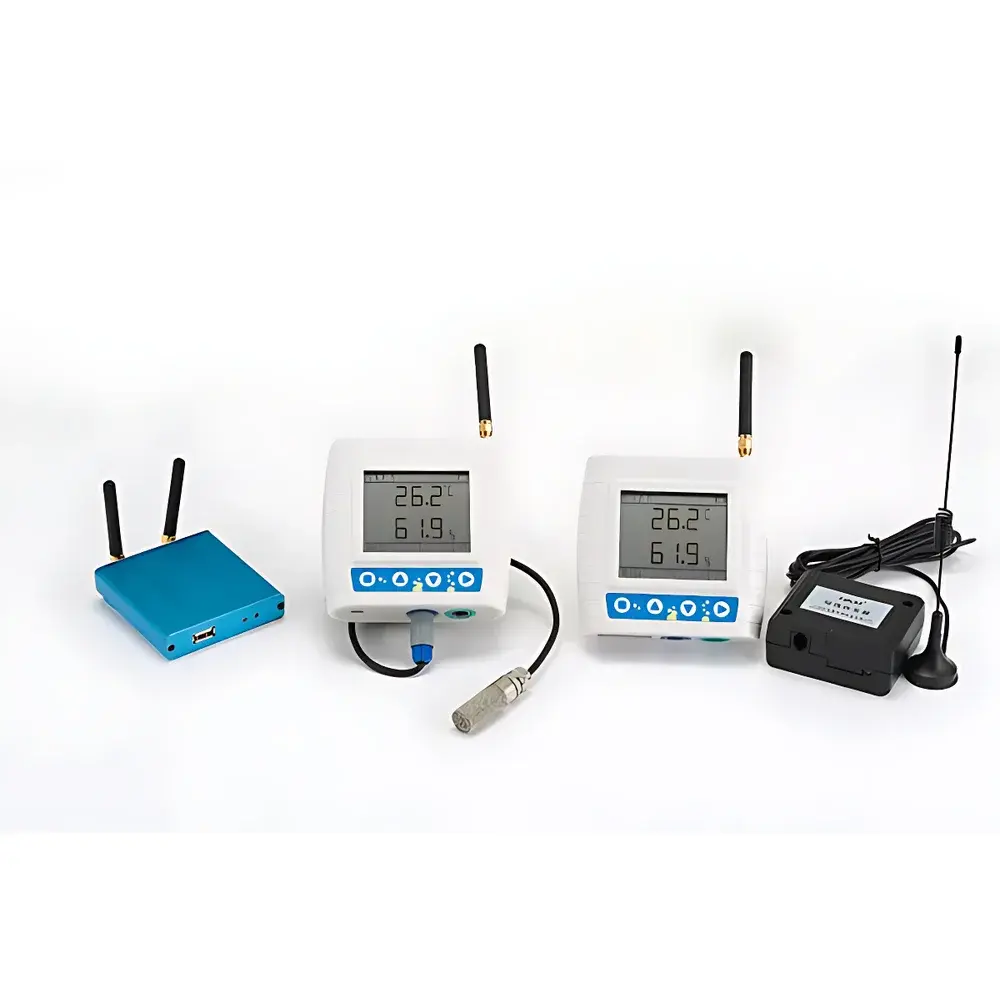
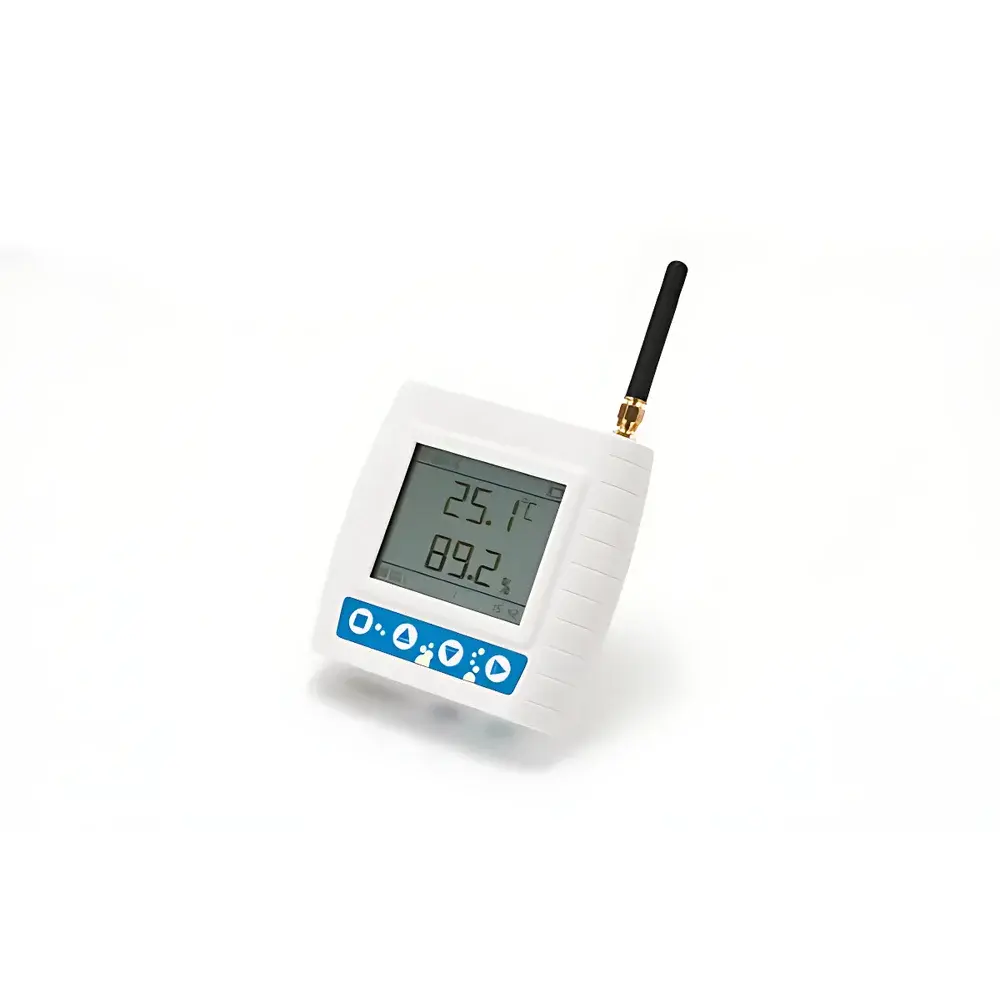
HKM HGS-W21 / HGS-R5 Environmental Monitoring System
| Brand | HKM |
|---|---|
| Origin | Guangdong, China |
| Model | HGS-W21 (Wireless Indoor Temp/RH Logger), HGS-R5 (433 MHz Wireless Data Concentrator) |
| Communication | 433 MHz ISM-band RF (licensed by China NRR) |
| Storage | Onboard non-volatile memory (≥32,000 records per unit) |
| Alarm | Configurable high/low thresholds with local buzzer |
| Compliance | Designed to support GSP (China Good Supply Practice), GLP (Good Laboratory Practice), and archival environmental control per DA-001–2021 (National Archives Administration of China) |
| Connectivity | Up to 250 wireless sensors per concentrator (HGS-R5) |
| Software | Windows-compatible (Win7–11), real-time graphing, statistical reporting (min/max/avg), audit trail export (CSV/PDF), alarm log with timestamp and event annotation |
Overview
The HKM HGS-W21 / HGS-R5 Environmental Monitoring System is a validated, multi-point, continuous monitoring solution engineered for regulatory-grade temperature and relative humidity (RH) surveillance in controlled environments. Built upon IEEE 802.15.4–compliant 433 MHz RF communication architecture—operating within the National Radio Regulation (NRR)-authorized industrial band—the system delivers interference-resistant, low-power wireless telemetry between distributed sensor nodes and centralized data concentrators. Each HGS-W21 logger integrates a factory-calibrated capacitive RH sensor (±3% RH accuracy, 10–90% RH range) and a precision thermistor (±0.3°C accuracy, 0–50°C range), conforming to IEC 60751 Class B tolerances. The HGS-R5 concentrator serves as the secure network hub, aggregating time-synchronized data from up to 250 endpoints, buffering locally during network outages, and forwarding encrypted payloads to host software via USB 2.0 or 10/100BASE-T Ethernet. This architecture satisfies core requirements of pharmaceutical cold chain validation (GSP Annex III), nonclinical study documentation (GLP Principle 5), and long-term archival preservation (DA-001–2021 Section 4.2.1), ensuring traceable, tamper-evident, and auditable environmental records.
Key Features
- Regulatory-ready data integrity: Onboard non-volatile memory retains ≥32,000 timestamped readings per logger—even during PC shutdown or software downtime—eliminating data gaps.
- Flexible deployment topology: Supports star (HGS-R5 direct), repeater-assisted (HGS-F8 + HGS-R5), and hybrid wired/wireless configurations to accommodate complex facility layouts without structural modification.
- Configurable alarm hierarchy: User-defined upper/lower limits per channel trigger local audible alerts (integrated buzzer), visual indicators, and optionally SMS/email notifications via HK-B11 or HK-B3 gateways—fully compliant with GSP §107(3) escalation protocols.
- Secure software audit trail: HKM MonitorPro v4.x enforces role-based access control, generates immutable CSV/PDF reports with digital signatures, and maintains full change history per parameter (e.g., alarm thresholds, calibration dates), satisfying FDA 21 CFR Part 11 Annex A “audit trail” criteria.
- Scalable sensor ecosystem: Compatible with 30+ probe variants—including single/dual temperature, high/low-temperature, and ambient/cryogenic RH models (HAS-Wxx, HAS-WSxx, HGPRS-WSxx)—enabling application-specific validation across cold rooms, incubators, greenhouses, and archival vaults.
Sample Compatibility & Compliance
The HGS-W21/R5 system is validated for continuous monitoring of air-phase environmental conditions in static and dynamic enclosures. It does not measure surface temperature, dew point directly, or vapor pressure—those parameters are derived mathematically from RH and dry-bulb temperature inputs using Magnus formula approximations per ISO 11117:2019 Annex C. Sensor placement follows ISO 14644-3:2019 guidance for cleanroom mapping and WHO TRS 961 Annex 9 for pharmaceutical storage zones. All hardware components meet GB/T 2423.1–2008 (cold), GB/T 2423.2–2008 (dry heat), and GB/T 2423.3–2016 (damp heat) environmental stress testing standards. Firmware and software undergo annual verification per GLP SOP-EM-002 to ensure continued conformance with original performance specifications.
Software & Data Management
MonitorPro v4.x operates natively on Windows 7 through Windows 11 (64-bit), requiring no runtime dependencies. Its database engine stores all raw sensor values with millisecond timestamps, sensor ID, battery status, and CRC-16 checksums. Real-time visualization includes overlayable trend curves, color-coded zone maps, and deviation heatmaps. Historical analysis tools compute rolling averages, standard deviations, and excursion durations per ISO 14644-3 compliance reports. Export modules generate FDA 21 CFR Part 11–compliant audit logs (including user login/logout, configuration changes, and manual data edits), plus GMP-aligned CSV files for LIMS integration. Backup archives are AES-256 encrypted and support automated offsite replication via SMB or SFTP.
Applications
- Pharmaceutical logistics: Continuous validation of warehouse zones, refrigerated trucks (GSP §104), and stability chambers per ICH Q5C.
- Biorepository & GLP labs: Archival compliance for specimen freezers, biosafety cabinets, and animal housing per OECD GLP Principles §5.2.1.
- Fresh produce & dairy supply chains: End-to-end temperature logging for raw milk transport (GB 19301–2010 §4.2) and chilled warehouse operations.
- Clean manufacturing: Humidity control in semiconductor fabrication areas to mitigate electrostatic discharge (ESD) per ANSI/ESD S20.20–2021.
- Cultural heritage preservation: Long-term microclimate monitoring in national archives, museums, and library stacks per DA-001–2021 §5.3.2.
- Agricultural technology: Precision climate feedback for hydroponic facilities and post-harvest storage silos per ISO 22000:2018 Clause 8.5.1.
FAQ
Does the system support FDA 21 CFR Part 11 compliance?
Yes—MonitorPro v4.x implements electronic signatures, audit trails, and role-based permissions aligned with Part 11 Subpart B requirements. Full validation documentation (IQ/OQ/PQ protocols) is available under NDA.
What is the maximum distance between an HGS-W21 logger and the HGS-R5 concentrator?
In open-field conditions: ≤300 m line-of-sight. Indoors with standard drywall/concrete obstructions: 30–80 m, extendable via HGS-F8 repeaters (up to 3 hops).
Can historical data be exported in machine-readable format for LIMS integration?
Yes—CSV exports include all raw sensor values, timestamps, metadata, and calculated metrics (e.g., excursions, averages), with configurable delimiter and time-zone formatting.
Is calibration traceable to national standards?
Each sensor module ships with a UKAS-accredited calibration certificate (ISO/IEC 17025) referencing NIM (China National Institute of Metrology) standards. Field recalibration is supported via HKM-certified service centers.
How is cybersecurity addressed in the wireless protocol?
The 433 MHz RF layer uses proprietary packet framing with rolling sequence numbers and CRC-16 error detection. No encryption is applied at the radio layer; data confidentiality is enforced at the application level via TLS 1.2 during Ethernet transmission and encrypted local database storage.



