
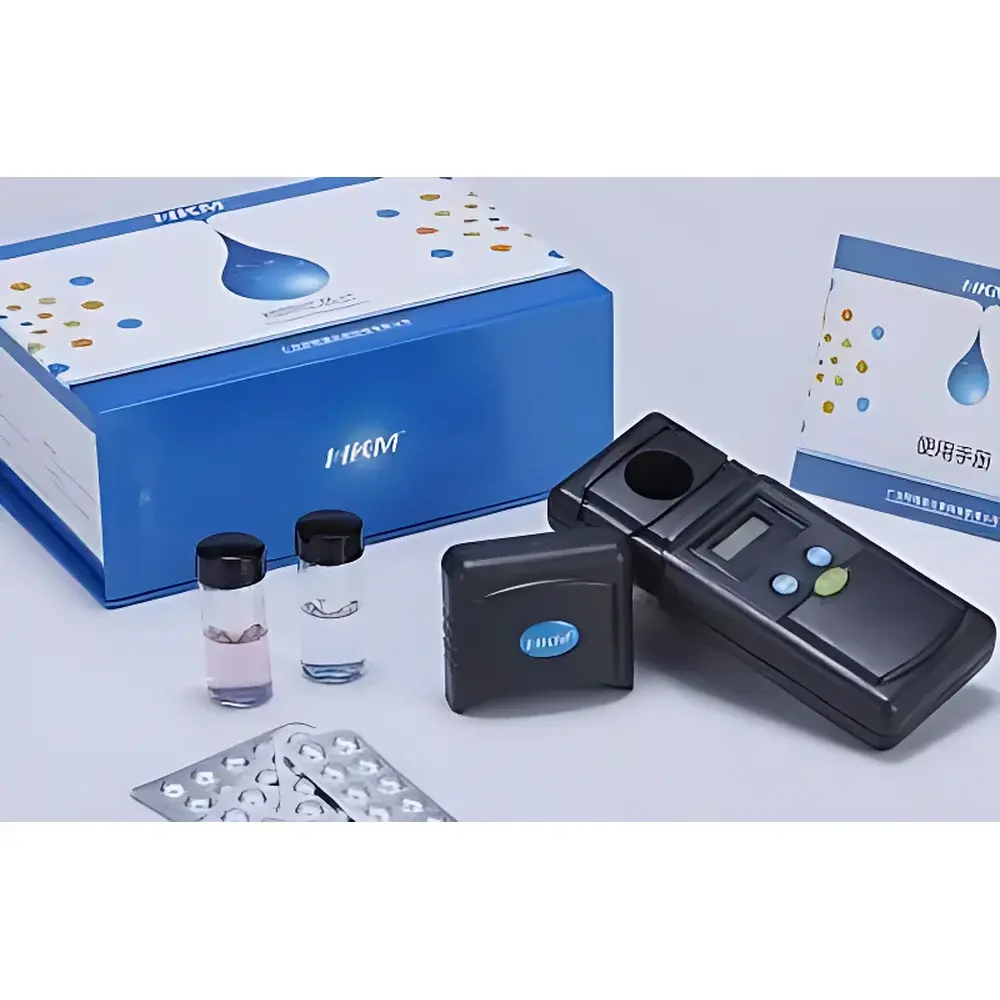
HKM S-102 Chlorine (Free/Total) Pocket Colorimeter
| Brand | HKM |
|---|---|
| Model | S-102 |
| Measurement Range | 0.00–3.00 mg/L (as Cl₂) |
| Wavelength | 510 nm |
| Light Source | Silicon Photodiode |
| Accuracy | ±0.05 mg/L (for readings < 1.00 mg/L) |
| Method | DPD (N,N-Diethyl-p-phenylenediamine) Colorimetric Reaction |
| Operating Temperature | 0–40 °C |
| Relative Humidity | 0–90% RH (non-condensing) |
| Power Supply | 1 × 9 V alkaline battery (≥40 h continuous operation) |
| Dimensions | 170 × 70 × 30 mm |
| Weight | 200 g (including battery) |
| Standard Kit Includes | 1 instrument unit, 2 matched cuvettes, 200 total test cycles (100 free chlorine + 100 total chlorine), reagent packs available separately (100 tests/pack) |
Overview
The HKM S-102 Chlorine (Free/Total) Pocket Colorimeter is a compact, field-deployable photometric analyzer engineered for rapid, on-site quantification of free residual chlorine and total chlorine in drinking water, wastewater effluent, swimming pools, cooling towers, and disinfection validation systems. It operates on the internationally standardized DPD (N,N-Diethyl-p-phenylenediamine) colorimetric method—where free chlorine or total chlorine oxidizes DPD to form a stable magenta-colored complex proportional to concentration. Absorbance is measured at 510 nm using a precision silicon photodiode detector and calibrated optical path, enabling direct concentration readout in mg/L (as Cl₂) on a high-contrast LCD display. Designed for routine compliance monitoring rather than laboratory-grade trace analysis, the S-102 delivers robust performance under variable ambient conditions while maintaining metrological traceability to NIST-traceable DPD reference standards.
Key Features
- Portable handheld design (200 g, including battery) with ergonomic form factor optimized for glove-compatible operation in field or plant environments.
- Dual-mode measurement capability: switchable between free chlorine and total chlorine protocols via dedicated reagent addition sequence—no hardware modification required.
- Integrated optical system featuring fixed-wavelength 510 nm LED excitation and temperature-compensated silicon photodiode detection, minimizing drift across operating temperature range (0–40 °C).
- Pre-programmed calibration curve compliant with APHA Standard Methods 4500-Cl G and ISO 7393-2, supporting both single-point verification and multi-point calibration using certified DPD standard solutions.
- Auto-zero function with cuvette recognition ensures baseline stability; built-in timer synchronizes reaction development (exactly 2 minutes post-reagent addition) prior to measurement.
- Low-power architecture enables >40 hours of continuous use on a single 9 V alkaline battery; automatic shutdown after 5 minutes of inactivity conserves energy without compromising startup readiness.
Sample Compatibility & Compliance
The S-102 accepts clear, non-turbid aqueous samples with turbidity < 5 NTU—samples exceeding this threshold require pre-filtration (e.g., 0.45 µm membrane) to avoid scattering artifacts. It is validated for use with potable water, chlorinated secondary effluent, recirculating pool water, and low-organic-content industrial process streams. The DPD methodology conforms to U.S. EPA Method 334.0, ASTM D1253, and WHO Guidelines for Drinking-water Quality (4th ed.). While not 21 CFR Part 11–compliant as a standalone device, its measurement records—when manually transcribed into LIMS or electronic lab notebooks—support GLP/GMP documentation requirements for routine operational monitoring where audit trails are maintained externally.
Software & Data Management
The S-102 operates as a self-contained, firmware-driven instrument with no onboard data logging or USB/Bluetooth connectivity. All measurements are displayed in real time and intended for immediate manual recording. For regulated environments requiring electronic record retention, users integrate the S-102 into broader QA/QC workflows by pairing it with validated mobile applications (e.g., LabArchives Field Capture or Paperless Lab Notebook modules) that capture timestamped operator ID, location metadata, and photo documentation of the LCD readout. Reagent lot traceability is maintained via printed batch numbers on included DPD tablet packaging—critical for internal quality audits per ISO/IEC 17025 Clause 5.6.
Applications
- Routine verification of chlorine residual at water treatment plant endpoints and distribution system sampling points.
- Swimming pool and spa facility daily compliance checks per CDC Model Aquatic Health Code (MAHC) Section 4.3.2.1.
- Validation of chlorine contact time (CT) calculations in disinfection efficacy studies.
- Emergency response screening during boil-water advisories or post-flooding infrastructure assessments.
- Educational laboratory instruction for environmental chemistry courses covering redox titrimetry and spectrophotometric principles.
- Preventive maintenance monitoring of chlorine dosing systems in HVAC cooling water circuits.
FAQ
What is the difference between free chlorine and total chlorine measurements?
Free chlorine refers to hypochlorous acid (HOCl) and hypochlorite ion (OCl⁻), the active disinfecting species. Total chlorine includes free chlorine plus combined chlorine (chloramines). The S-102 measures free chlorine using DPD-1 reagent alone; total chlorine requires addition of potassium iodide (DPD-3) to liberate combined chlorine before DPD-1 oxidation.
Can the S-102 be used for wastewater with high organic load?
High levels of oxidant-demanding organics or manganese may interfere with DPD response. For such matrices, confirm method applicability per APHA 4500-Cl G Section 7.2 (interference testing) and consider sample dilution or alternative methods like amperometric titration.
How often should calibration verification be performed?
Perform zero and span verification before each sampling shift using deionized water and a mid-range DPD standard (e.g., 1.00 mg/L Cl₂). Full recalibration is recommended quarterly or after reagent lot changes.
Are replacement reagents supplied with NIST-traceable certificates of analysis?
Yes—HKM provides CoA documentation for all DPD reagent batches, including certified concentration uncertainty (k=2) and expiration dating aligned with ISO 17034 requirements.
Is the instrument suitable for ISO 17025-accredited laboratories?
As a Class II portable photometer, the S-102 may be used within accredited scopes for non-critical monitoring when supported by documented uncertainty budgets, annual third-party verification, and full reagent traceability—subject to laboratory-specific method validation per ISO/IEC 17025 Clause 7.2.2.
Related Products







