
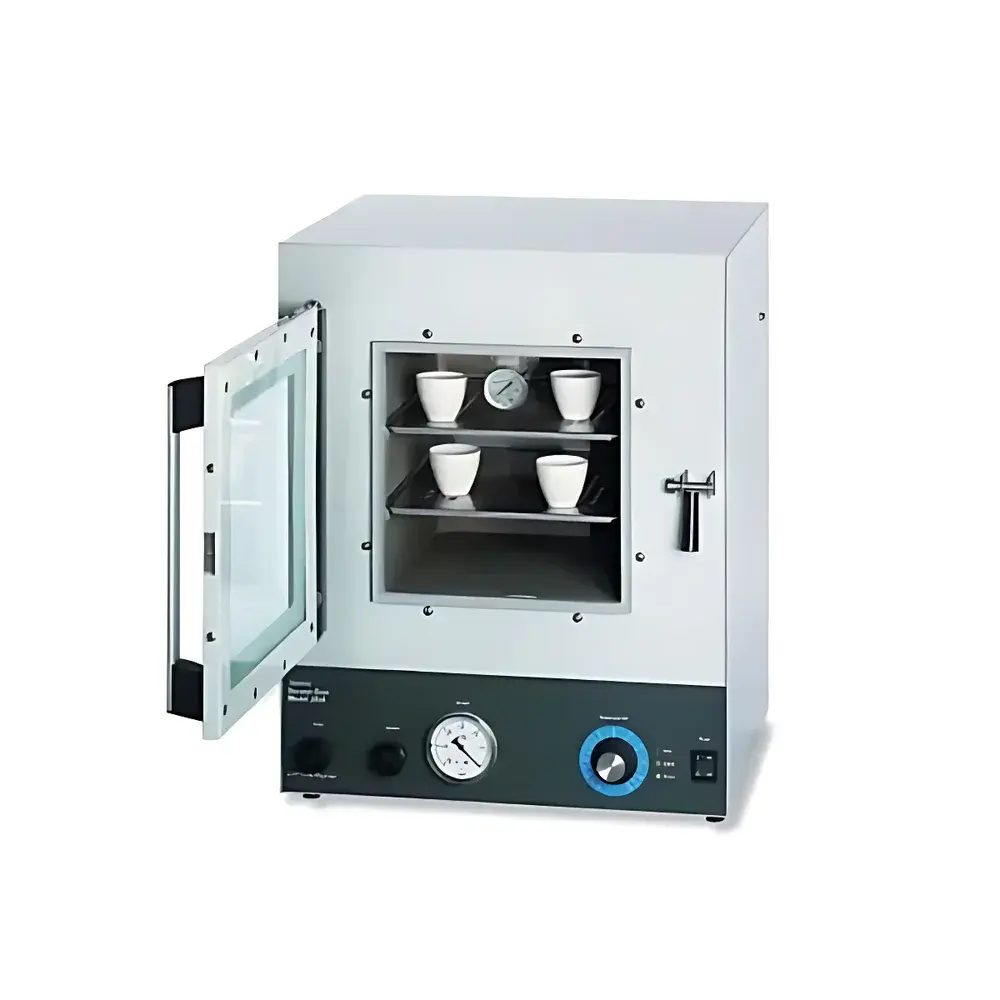
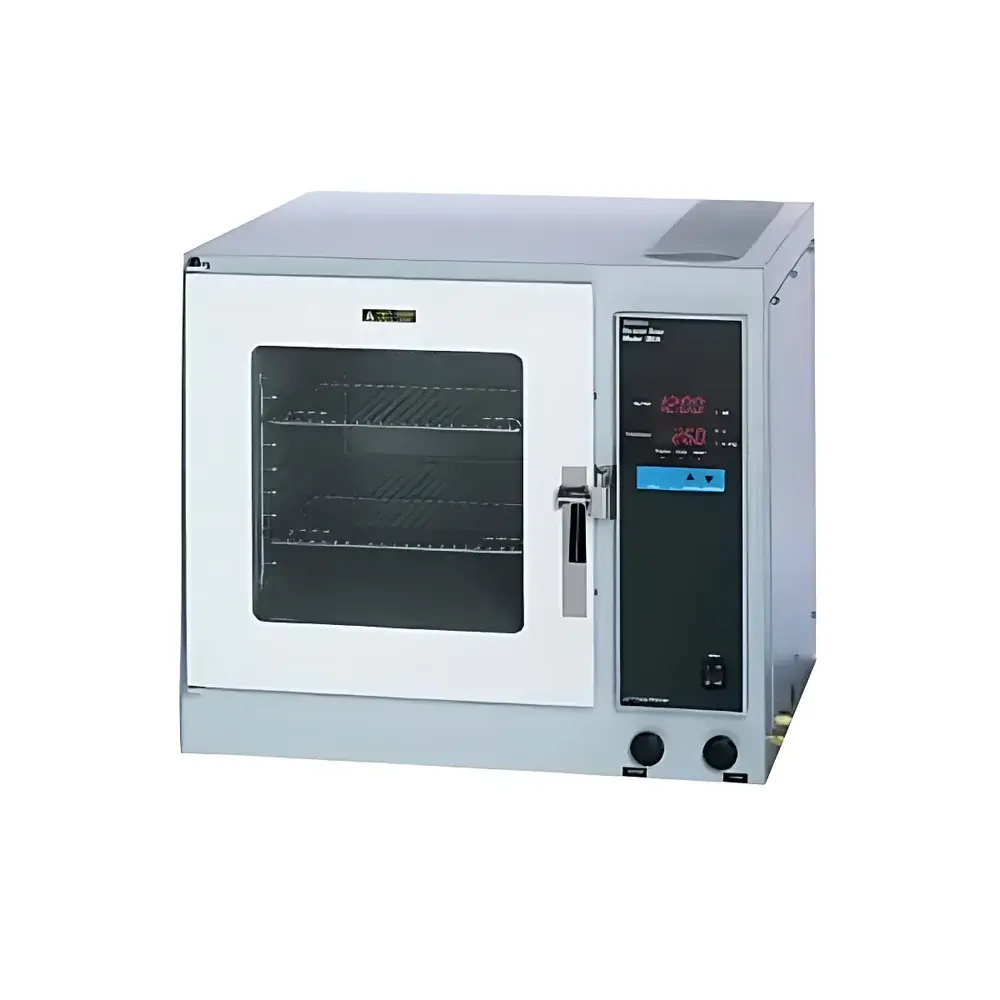
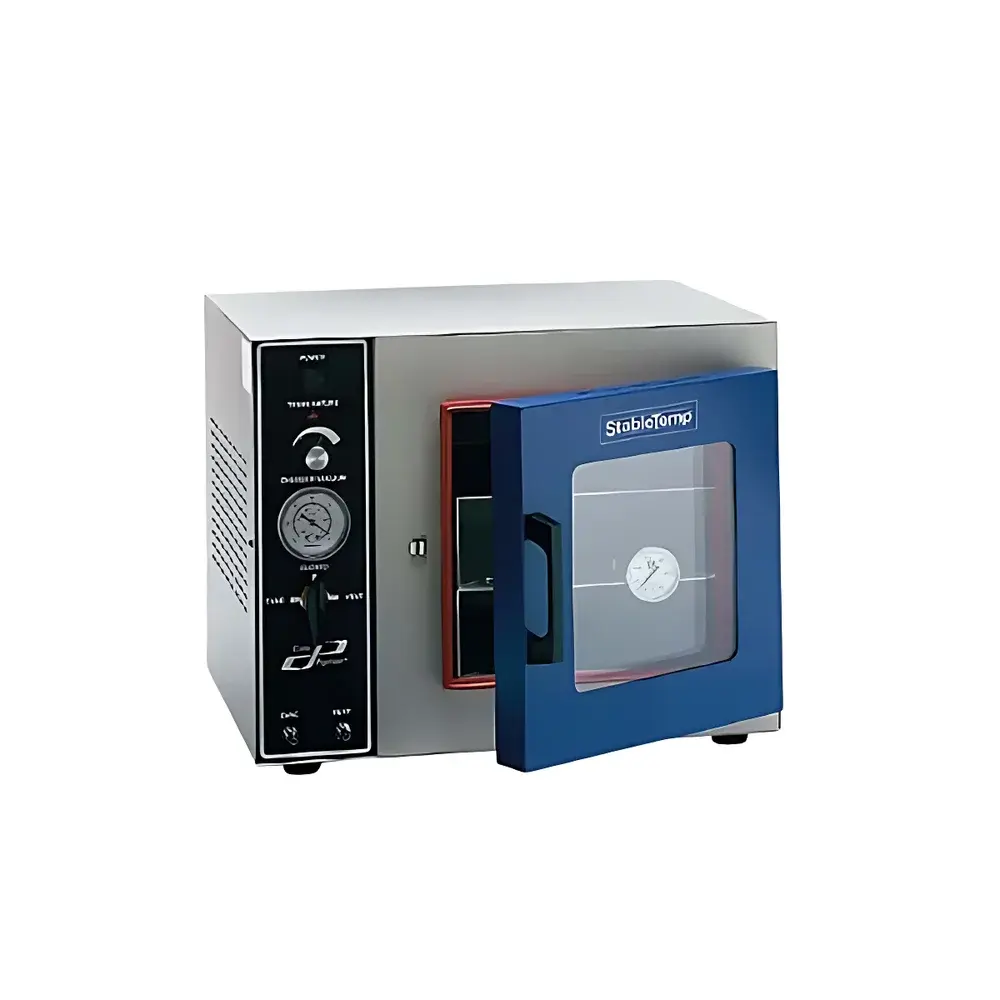
StableTemp Vacuum Oven Model 05053-12
| Origin | USA |
|---|---|
| Manufacturer Type | Authorized Distributor |
| Origin Category | Imported |
| Model | 05053-12 |
| Voltage | 230 V, 50/60 Hz |
| Power | 1800 W (2.5 A) |
| Chamber Volume | 19.8 L |
| Temperature Range | Ambient to 200 °C |
| Temperature Uniformity | ±5 °C |
| Vacuum Range | 0–30 inHg |
| Chamber Dimensions (L×W×H) | 25 × 25 × 30 cm |
| External Dimensions (L×W×H) | 51 × 41 × 41 cm |
| Net Weight | 59 kg |
| Shelving | 2 stainless steel shelves |
| Heating Method | Surround-type electric heating with mechanical thermostatic control |
| Vacuum Interface | 1/4" ID vacuum port on front panel |
| Gas Purge Capability | Compatible with inert gas (N₂, Ar) via three-way valve |
| Construction | Full 304 stainless steel interior and exterior |
| Sealing | High-integrity silicone gasket |
| Safety | Built-in over-temperature protection |
| Vacuum Gauge | Analog Bourdon-tube pressure gauge |
Overview
The StableTemp Vacuum Oven Model 05053-12 is an industrial-grade benchtop vacuum drying system engineered for precision thermal processing under reduced-pressure environments. Designed and assembled in the United States, this oven operates on the fundamental principle of lowering the boiling point of solvents and moisture through controlled vacuum application—enabling gentle, uniform drying of heat-sensitive materials without oxidative degradation or thermal stress. Its all-stainless-steel construction (304 grade), combined with a high-fidelity silicone sealing gasket and integrated three-way valve manifold, ensures long-term vacuum integrity and compatibility with inert gas purging (e.g., nitrogen or argon). The unit is widely deployed in semiconductor fabrication cleanrooms, failure analysis labs, metallurgical sample preparation workflows, vacuum impregnation processes, and vacuum-assisted resin embedding—where reproducible thermal profiles and contamination-free chamber environments are non-negotiable.
Key Features
- Full 304 stainless steel chamber and outer casing for corrosion resistance, cleanability, and compliance with ISO 14644-1 Class 5–7 cleanroom requirements
- Triple-function three-way valve enabling sequential evacuation, inert gas backfilling, and atmospheric venting—critical for oxygen-sensitive processes such as thin-film deposition or electroplating pre-treatment
- Mechanically regulated temperature control (knob-based) with calibrated range from ambient to 200 °C; no digital display but compatible with external traceable monitoring via OKATON Temp10 digital thermometer and gas-phase probe (sold separately)
- Two removable, load-rated stainless steel shelves supporting up to 10 kg per shelf; optimized airflow geometry ensures ±5 °C temperature uniformity across the 19.8 L working volume at steady state
- Dual safety architecture: independent over-temperature cutoff device plus thermal fuse—meeting UL 61010-1 and IEC 61010-1 functional safety requirements for laboratory equipment
- Front-panel 1/4″ ID vacuum port with NPT threading; includes integral vacuum gauge (0–30 inHg analog Bourdon tube) for real-time pressure verification during process validation
Sample Compatibility & Compliance
The 05053-12 accommodates a broad spectrum of sample formats—including wafers, PCBs, ceramic substrates, metallographic mounts, polymer films, and coated optical components—without risk of warping or outgassing-induced contamination. Its inert-gas-compatible design supports ASTM F2476 (Standard Guide for Vacuum Processing of Semiconductor Devices) and IPC-TM-650 2.6.25 (Vacuum Bake Test for Moisture Sensitivity Level Evaluation). The chamber’s smooth-welded interior and absence of painted surfaces eliminate particulate shedding, satisfying SEMI S2/S8 environmental health & safety criteria. While not certified for GMP manufacturing use out-of-the-box, the oven’s repeatable thermal performance and documented calibration pathways enable qualification per IQ/OQ protocols under FDA 21 CFR Part 11-compliant data management systems when paired with validated external sensors.
Software & Data Management
This model does not incorporate embedded firmware or network connectivity. However, it is fully compatible with third-party data acquisition ecosystems. When used with the OKATON Temp10 digital thermometer (Cat. No. 91427-10) and its gas-phase temperature probe (Cat. No. 08500-75), users achieve NIST-traceable, time-stamped thermal logging with ≤0.1 °C resolution. Data export is supported via USB or RS-232 interfaces into compliant LIMS or ELN platforms. For audit readiness, temperature and vacuum logs can be archived with electronic signatures, meeting GLP documentation standards for R&D and QA/QC laboratories.
Applications
- Vacuum desiccation of hygroscopic compounds and pharmaceutical intermediates prior to lyophilization or analytical weighing
- Outgassing of epoxy resins and encapsulants before die-attach or wire-bonding in microelectronics packaging
- Thermal stabilization of MEMS devices and piezoelectric ceramics under inert atmosphere
- Removal of residual solvents from spin-coated photoresists and ALD precursors
- Pre-baking of solder paste stencils and flux residues in PCB assembly lines
- Controlled dehydration of biological tissue blocks prior to paraffin embedding
FAQ
Does the 05053-12 include a digital temperature display?
No—it uses a manual thermostatic knob for setpoint adjustment and relies on external instrumentation for temperature verification. This design enhances electromagnetic immunity in RF-dense environments such as semiconductor fabs.
Can this oven be used for vacuum annealing?
Yes, provided the target temperature remains within the 200 °C upper limit and the material’s outgassing profile is compatible with the chamber’s base vacuum level (~30 inHg, equivalent to ~100 mbar).
Is the vacuum pump included?
No. A separate vacuum pump (e.g., two-stage rotary vane or dry scroll type rated for ≤0.1 mbar ultimate pressure) must be selected based on chamber volume and required evacuation rate.
What inert gases are compatible with the three-way valve?
Nitrogen (N₂), argon (Ar), and helium (He) are routinely used. Ensure gas supply pressure does not exceed 100 psi and that inline filtration (0.01 µm) is installed upstream.
How often should the silicone gasket be replaced?
Under normal operation (≤5 cycles/day), inspect annually and replace every 24 months or after exposure to aggressive solvents (e.g., chlorinated hydrocarbons) or temperatures >180 °C for >100 hours cumulative.



