
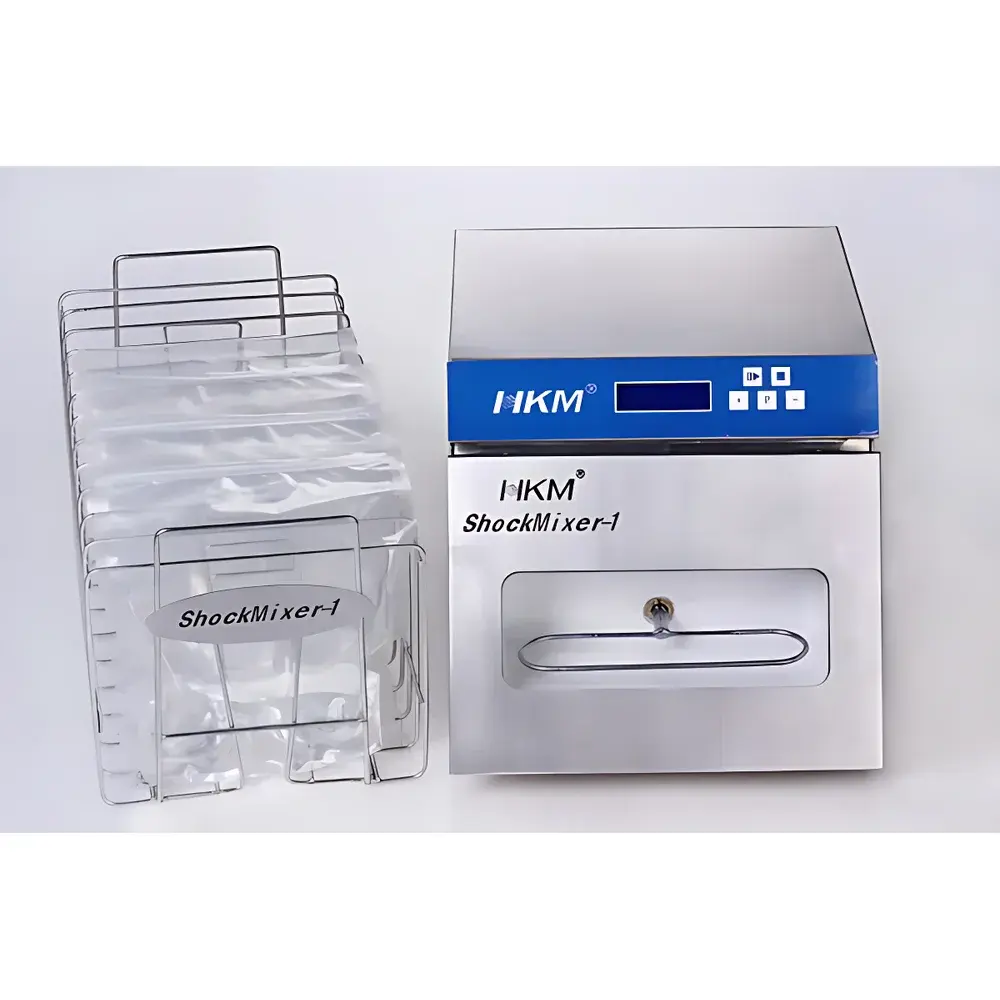

HKM ShockMixer-1 Pulse Oscillation Sample Preprocessor
| Brand | HKM (Guangdong Huankai Microbial Technology Co., Ltd.) |
|---|---|
| Origin | Guangdong, China |
| Model | ShockMixer-1 |
| Dimensions (W×D×H) | 315 × 275 × 254 mm |
| Weight | 11.5 kg |
| Power Input | 220 V, 50 Hz |
| Output Power | 60 W |
| Oscillation Frequency | 93 cycles/sec |
| Maximum Sample Volume | 250 mL |
| Sample Bag Compatibility | Sterile, single-use polyethylene homogenization bags (250 mL capacity) |
| Compliance | ISO 7218:2007 Annex B (Microbiology of food and animal feeding stuffs — General requirements and guidance for microbiological examinations) |
Overview
The HKM ShockMixer-1 Pulse Oscillation Sample Preprocessor is an engineered solution for standardized, non-destructive sample homogenization in microbiological analysis. Unlike mechanical disruption methods such as stomaching or bead-beating, the ShockMixer-1 employs controlled high-frequency oscillation (93 Hz) applied directly to sealed sterile homogenization bags. This induces transient hydrodynamic shear forces and inertial shock waves within the liquid phase, enabling efficient detachment and suspension of microorganisms—including tightly adherent spores, yeasts, and bacteria—from complex solid matrices without thermal or mechanical lethality. Its operational principle aligns with the Couette–Taylor flow regime under pulsed boundary conditions, ensuring reproducible dispersion while preserving microbial viability. Designed specifically for compliance-driven laboratories, it fulfills the sample preparation requirements outlined in ISO 7218:2007 Annex B as a validated alternative to stomacher-based protocols—making it suitable for GLP- and GMP-aligned food safety, pharmaceutical, clinical diagnostics, and veterinary testing environments.
Key Features
- ISO 7218:2007-compliant sample homogenization method, recognized as a standard technique for microbiological sample preparation in food and feed testing.
- Non-lethal pulse oscillation at 93 cycles per second—significantly higher than conventional stomachers (typically ≤9 Hz)—enhancing recovery of stress-resistant microorganisms such as fungal spores and biofilm-associated bacteria.
- Zero cross-contamination risk: uses disposable, gamma-irradiated sterile homogenization bags; no internal chamber cleaning or instrument sterilization required between samples.
- Low sample fragmentation: minimizes particulate debris generation, yielding clarified suspensions ideal for downstream filtration, ATP bioluminescence assays, membrane filtration, and automated colony counting systems.
- Robust mechanical architecture: all-metal housing with vibration-damping base; operates silently compared to percussive homogenizers and eliminates bag rupture risks associated with high-impact stomaching.
- Dual functionality: provides effective mixing of powders, viscous liquids, and semi-solids—supporting applications beyond microbiology, including tissue homogenization (e.g., tumor biopsies), cosmetic formulation QC, and nutraceutical stability testing.
Sample Compatibility & Compliance
The ShockMixer-1 accommodates heterogeneous sample types ranging from soft dairy products and fresh produce to rigid materials such as hard candies, compressed tablets, fish bones, and shelled nuts—without requiring pre-grinding or dilution adjustments. Its compatibility with standard 250 mL polyethylene homogenization bags ensures seamless integration into existing ISO/EN/USP-compliant workflows. The device meets essential regulatory expectations for traceability and data integrity when paired with compliant documentation practices. While not inherently 21 CFR Part 11-certified, its operation supports audit-ready processes when used within laboratory information management systems (LIMS) that enforce electronic record retention, user access controls, and activity logging for sample preparation steps.
Software & Data Management
The ShockMixer-1 is a standalone electromechanical instrument with no embedded firmware or digital interface. It operates via manual start/stop control and does not generate electronic data logs. For laboratories requiring full traceability, integration is achieved through external procedural documentation: homogenization time, bag lot number, operator ID, and sample identification must be recorded manually or via LIMS-linked worksheets. This design prioritizes reliability, ease of maintenance, and regulatory transparency—avoiding software validation burdens often associated with “smart” homogenizers. Optional accessories—including sterile bag openers and stainless-steel 12-compartment bag racks—facilitate ergonomic workflow organization and reduce handling errors during high-throughput operations.
Applications
- Microbiological testing of foods (ready-to-eat meals, confectionery, fermented products), animal feeds, and environmental swabs per ISO 6887-1, ISO 6579-1, and FDA BAM Chapter 3 protocols.
- Preparation of suspensions for rapid detection platforms: ATP bioluminescence, PCR-based pathogen screening, immunoassays, and flow cytometry.
- Homogenization of clinical specimens (e.g., wound swabs, sputum, fecal samples) prior to culture or molecular analysis.
- Pharmaceutical quality control: microbial limit testing of non-sterile dosage forms (USP ) and environmental monitoring samples.
- Research applications involving delicate biological tissues (e.g., murine tumor homogenates, plant root microbiomes) where cell lysis must be minimized to preserve viable subpopulations.
FAQ
Is the ShockMixer-1 validated for use in accredited food testing laboratories?
Yes—its methodology is explicitly referenced in ISO 7218:2007 Annex B as an acceptable alternative to stomaching for initial sample suspension. Many CNAS-accredited labs in Asia and Europe have incorporated it into their scope of accreditation for routine microbiological testing.
Can it replace a stomacher in all applications?
It is functionally equivalent for most food, feed, and environmental samples but is not intended for highly fibrous or cellulose-rich matrices where mechanical shearing remains necessary.
Does it require calibration or periodic verification?
No formal calibration is specified; however, users should verify oscillation frequency annually using a calibrated tachometer or laser vibrometer per internal SOPs, especially in regulated environments.
Are replacement parts and consumables readily available internationally?
Sterile 250 mL homogenization bags are globally distributed through major lab supply channels; OEM spare parts (motor assembly, control board) are available directly from HKM with lead times of 4–6 weeks.
What safety certifications does the device hold?
It complies with GB 4793.1-2019 (Chinese equivalent of IEC 61010-1) for electrical safety and EMC requirements, and carries CCC marking for domestic market use. CE marking is not applicable as it is not CE-declared for EU placement.



