
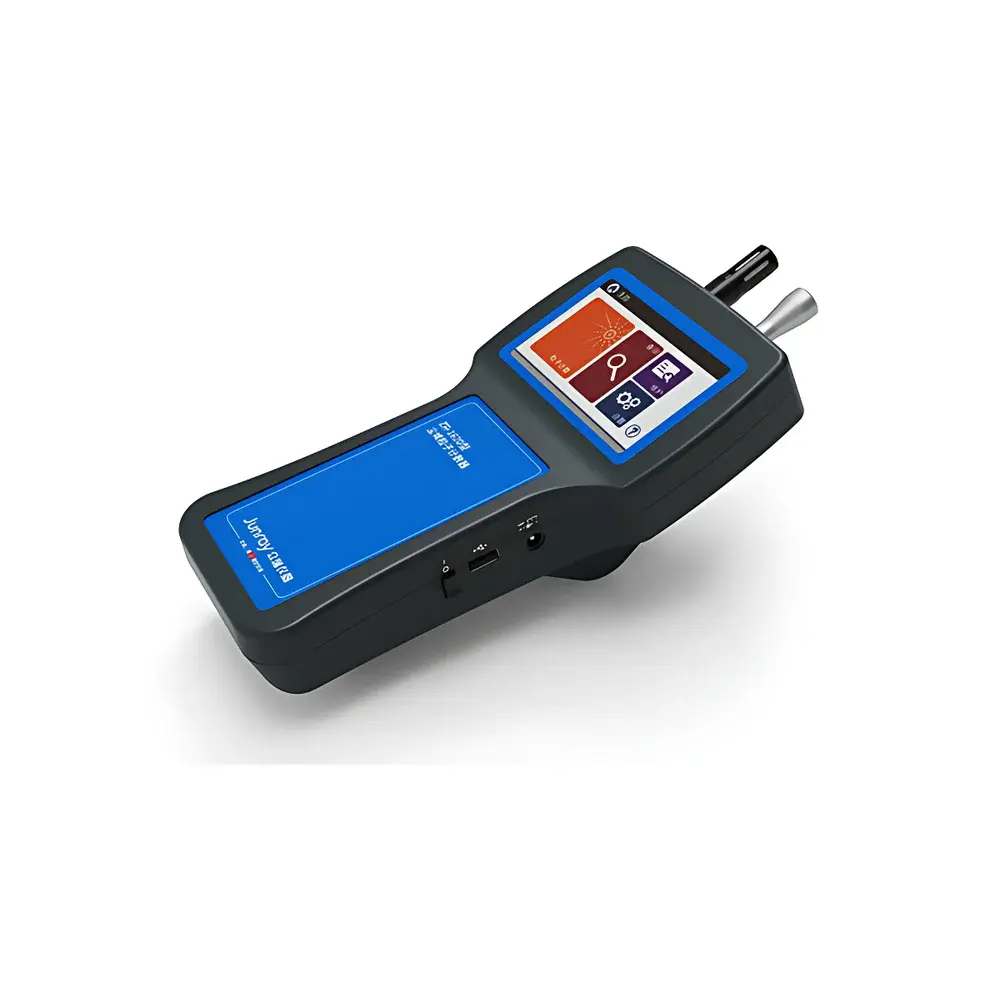


Junray ZR-1620 Handheld Laser Particle Counter (2.83 L/min)
| Brand | Junray |
|---|---|
| Origin | Shandong, China |
| Manufacturer Type | OEM/ODM Manufacturer |
| Instrument Type | Handheld Particle Counter |
| Flow Rate | 2.83 L/min |
| Flow Accuracy | ≤ ±2% |
| Timing Accuracy | ≤ 1 s deviation over 600 s sampling |
| Repeatability | ≤ ±2% FS |
| Particle Size Distribution Error | ≤ ±3% |
| Indication Error | ≤ ±2% FS |
| Detectable Particle Sizes | 0.3, 0.5, 1.0, 3.0, 5.0, 10.0 µm |
| Counting Efficiency | 50% at 0.3 µm |
| Maximum Concentration | 3.5×10⁶ particles/m³ (with <10% coincidence loss) |
| Light Source | Laser Diode |
| Zero Count | <1 count/5 min |
| Self-Cleaning Time | <5 min |
| Data Export | USB flash drive & Bluetooth thermal printer support |
| Display | 3.5-inch capacitive touch color LCD |
| Environmental Sensors | Integrated temperature, humidity, and atmospheric pressure measurement |
| Power | Rechargeable Li-ion battery (7.4 V, 1.5 Ah) |
| Dimensions | 240 × 120 × 110 mm |
| Weight | ~1.0 kg |
| Noise Level | <60 dB(A) |
| Exhaust Filtration | Built-in HEPA filter (>99.97% @ 0.3 µm) |
| Operating Environment | –20 °C to +50 °C, ≤85% RH |
Overview
The Junray ZR-1620 Handheld Laser Particle Counter is a compact, field-deployable optical particle counter engineered for real-time quantification of airborne particulate contamination in controlled environments. It operates on the principle of single-particle light scattering—where a collimated laser beam illuminates individual particles drawn through the sensing volume at a precisely regulated flow rate of 2.83 L/min. Scattered light intensity is detected by a photodiode sensor and classified into six discrete size channels (0.3, 0.5, 1.0, 3.0, 5.0, and 10.0 µm), enabling simultaneous differential and cumulative counting per ISO 21501-4 and GB/T 6167–2007 compliant methodology. Designed for portability without compromising metrological integrity, the ZR-1620 meets core performance criteria outlined in JJF 1190–2008 for calibration verification, including flow stability, timing accuracy (<1 s drift over 10 min), repeatability (≤±2% FS), and size-class resolution (≤±3% distribution error). Its integrated vacuum pump, HEPA-filtered exhaust, and sealed optical path ensure stable operation across variable ambient conditions—from cleanroom classification audits to HVAC filter integrity checks.
Key Features
- Simultaneous six-channel particle sizing and counting (0.3–10.0 µm) with NIST-traceable calibration alignment.
- Integrated environmental sensors measuring ambient temperature, relative humidity, and atmospheric pressure—automatically logged with each sample record.
- Self-cleaning cycle completed in under 5 minutes, minimizing carryover between sequential measurements.
- Real-time audible and visual alarm triggers when user-defined concentration thresholds are exceeded per channel.
- Built-in high-efficiency HEPA exhaust filtration (>99.97% @ 0.3 µm) ensuring operator safety and preventing cross-contamination during field use.
- Rechargeable lithium-ion battery (7.4 V / 1.5 Ah) supporting up to 3 hours of continuous sampling; full recharge in approximately 2 hours.
- 3.5-inch capacitive touch color display with intuitive Chinese/English bilingual UI and graphical histogram visualization.
- Onboard data storage with USB mass-storage mode for direct export to flash drives; optional Bluetooth pairing with certified thermal printers for on-site reporting.
- Automatic fault detection and protective shutdown logic safeguarding optical components and flow control electronics.
Sample Compatibility & Compliance
The ZR-1620 is validated for sampling non-hazardous, non-corrosive, and non-oily aerosols in indoor air, cleanrooms (ISO Class 5–8), pharmaceutical manufacturing suites, hospital isolation rooms, and laboratory HVAC ducts. It complies with national and international standards governing particle counter performance evaluation—including GB/T 6167–2007 (Performance Test Methods for Airborne Particle Counters), JJF 1190–2008 (Calibration Specification), and ISO 21501–4:2018 (Determination of particle size distribution—Light scattering methods). While not intrinsically rated for explosive atmospheres or conductive particulates, its design supports routine GLP-aligned workflows, with timestamped, parameter-stamped records suitable for internal audit trails. Optional traceable calibration certificates (NIST or CNAS-accredited) may be provided upon request for regulatory submissions.
Software & Data Management
Data acquisition is managed via embedded firmware supporting automatic time-stamped logging of all six size channels, environmental parameters, and instrument status flags. Each record includes sampling duration, start/stop timestamps, flow rate confirmation, and self-test results. Files are saved in CSV format compatible with common statistical analysis platforms (e.g., Excel, JMP, Python pandas). No proprietary software installation is required for basic data retrieval; however, Junray provides optional PC-based configuration utilities for advanced protocol setup (e.g., scheduled sampling, multi-point mapping, custom alarm thresholds). All stored data retains immutable metadata—supporting traceability requirements under FDA 21 CFR Part 11 when deployed with appropriate organizational controls (e.g., user access logs, electronic signature validation).
Applications
- Cleanroom certification and routine monitoring per ISO 14644–1 and EU GMP Annex 1.
- HEPA and ULPA filter leak testing using upstream challenge aerosols (e.g., PAO, DOP).
- Pharmaceutical facility environmental monitoring (EM) programs for sterile manufacturing zones.
- Validation of laminar airflow workstations, isolators, and RABS systems.
- Field assessment of indoor air quality (IAQ) in hospitals, data centers, and semiconductor fabrication facilities.
- Educational and research applications requiring portable, quantitative aerosol characterization.
FAQ
What standards does the ZR-1620 comply with for calibration and performance verification?
It conforms to JJF 1190–2008 (China’s national calibration specification) and GB/T 6167–2007 (performance test methods), and aligns with ISO 21501–4:2018 for light-scattering particle counters.
Can the ZR-1620 be used in classified cleanrooms during active production?
Yes—its low noise emission (<60 dB[A]), compact footprint, and battery-powered operation make it suitable for unobtrusive, real-time monitoring without disrupting ISO Class 5–8 operations.
Is the instrument capable of meeting FDA or EMA regulatory submission requirements?
When operated within documented SOPs—including periodic calibration, preventive maintenance, and secure data handling—the ZR-1620 generates auditable records compatible with FDA 21 CFR Part 11 and EU GMP Annex 11 expectations.
Does the device support external probe integration beyond the standard isokinetic sampler?
The ZR-1620 features a standardized 1/4″–28 UNF threaded inlet port, permitting mechanical adaptation to third-party isokinetic probes or tubing manifolds for duct or glovebox sampling.
How is zero-count performance verified, and what is the typical background level?
Zero-count testing follows ISO 21501–4 procedure: instrument is purged with HEPA-filtered air for ≥10 minutes, then counts recorded over five consecutive 5-minute intervals; acceptable result is <1 count per interval.
Related Products







