
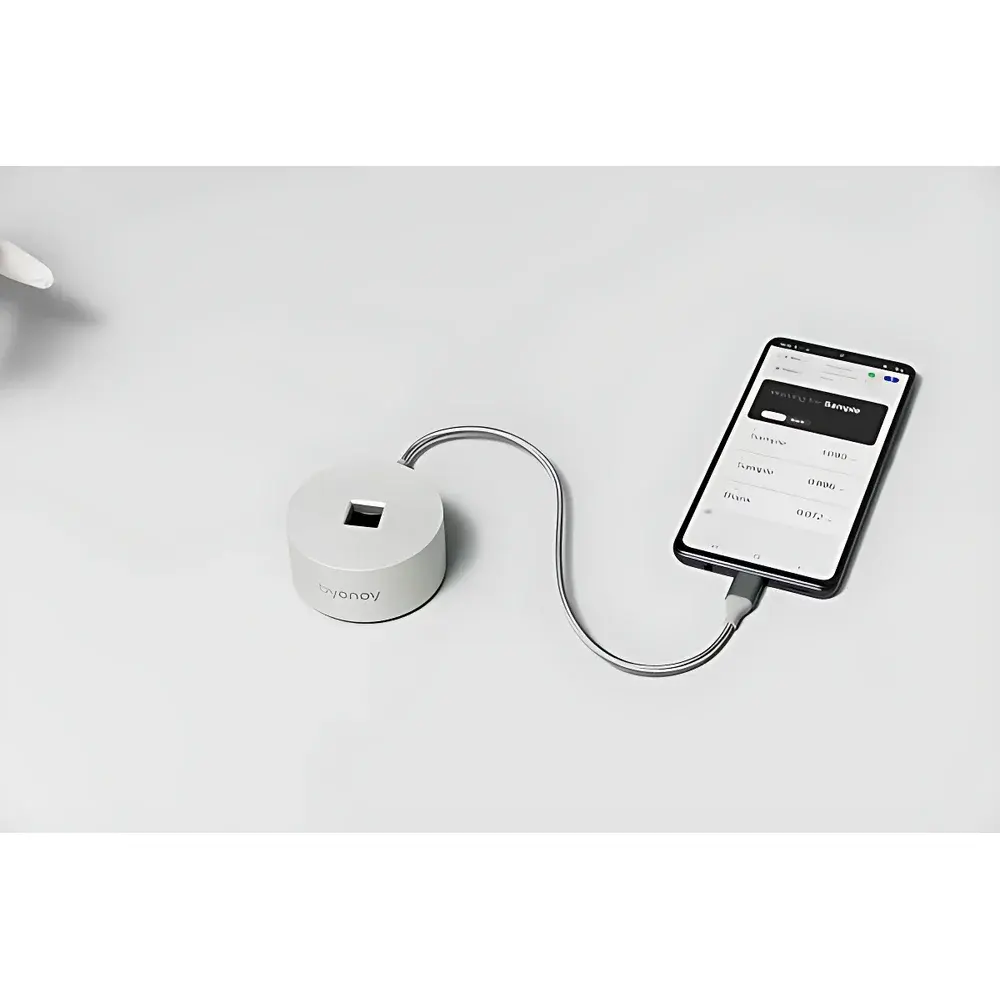
Byonoy Absorbance One Portable UV-Vis Spectrophotometer
| Brand | Byonoy |
|---|---|
| Origin | Germany |
| Model | Absorbance One |
| Wavelength Range | 340–1000 nm |
| Optical Density Range | Up to 5.0 OD |
| Measurement Speed | <1 s per reading |
| Sample Volume Compatibility | 50 µL (cuvette), 400 µL (semi-micro), 1000 µL (micro) |
| Detection Principle | Fixed-grating UV-Vis absorption spectroscopy |
| Interface | USB-C & Bluetooth 5.0 |
| Software | Absorbance One Desktop & Mobile App (Windows/macOS/iOS/Android) |
| Compliance | CE, RoHS, ISO/IEC 17025 compatible operation environment |
| Power | Rechargeable Li-ion battery (up to 8 h continuous use) |
Overview
The Byonoy Absorbance One Portable UV-Vis Spectrophotometer is an engineered solution for rapid, reliable absorbance quantification in resource-constrained or mobile laboratory environments. Based on fixed-grating optical architecture with a high-stability tungsten-halogen and deuterium light source (dual-lamp configuration), it delivers consistent spectral performance across the 340–1000 nm range—covering key biological, chemical, and material science applications including nucleic acid quantification (260 nm), protein analysis (280 nm), enzyme kinetics (e.g., NADH at 340 nm), and dye-based assays (e.g., Bradford, BCA). Its compact form factor—measuring just 125 × 85 × 45 mm and weighing under 350 g—enables seamless integration into biosafety cabinets, field-deployed QA/QC stations, teaching labs, and GLP-compliant pilot-scale process monitoring workflows. Unlike traditional benchtop spectrophotometers requiring optical alignment, enclosed cuvette compartments, or warm-up periods, the Absorbance One employs ambient-light rejection optics and real-time dark-current compensation to ensure measurement integrity without environmental shielding.
Key Features
- Ultra-compact optical platform: Precision-machined aluminum housing with passive thermal stabilization ensures wavelength repeatability ±0.5 nm and photometric reproducibility <±0.002 AU over 8-hour operation.
- Open-path cuvette detection: Patented ambient-light suppression algorithm eliminates need for lid closure or darkroom conditions—measurements initiate automatically upon cuvette insertion.
- Multi-volume cuvette auto-recognition: Integrated optical height-sensing detects standard (10 mm pathlength), semi-micro (5 mm), and micro (1 mm) cuvettes; software applies appropriate pathlength correction per Beer-Lambert law.
- Extended dynamic range: Linear response up to 5.0 OD enables direct measurement of concentrated samples without serial dilution—reducing pipetting error and contamination risk.
- Field-ready power architecture: Built-in rechargeable lithium-ion battery supports >300 measurements per charge; USB-C fast charging (<2 h) and pass-through data/power capability.
Sample Compatibility & Compliance
The Absorbance One accepts all standard rectangular quartz, glass, and disposable plastic cuvettes (12.5 × 12.5 mm footprint). It is validated for use with common biological buffers (Tris-HCl, PBS, TE), organic solvents (ethanol, isopropanol, acetone), and acidic/basic solutions (pH 2–12) when handled per manufacturer guidelines. Instrument operation aligns with ISO/IEC 17025 requirements for testing laboratories, supporting traceable calibration via NIST-traceable neutral density filters (optional accessory). While not FDA-cleared as a medical device, its measurement stability and audit-ready data export meet pre-analytical QC criteria for pharmaceutical raw material verification (per USP ) and bioprocess intermediate checks. CE marking confirms conformity with EU electromagnetic compatibility (2014/30/EU) and low-voltage (2014/35/EU) directives.
Software & Data Management
The cross-platform Absorbance One application provides full local control, real-time visualization, and structured data governance. Each measurement stores metadata including timestamp, operator ID (login-enabled), instrument serial number, cuvette type, pathlength, and ambient temperature. Export options include CSV (for LIMS ingestion), PDF reports (with embedded spectra and calibration history), and XML (compatible with ELN systems such as LabArchives and Benchling). Audit trail functionality records all parameter changes, file deletions, and user logins—supporting compliance with 21 CFR Part 11 when deployed with organizational electronic signature policies. Firmware updates are delivered over-the-air via secure TLS 1.2 connection.
Applications
- Quantitative nucleic acid and protein concentration determination in molecular biology workflows
- Routine QC of reagent batches (e.g., dye labeling efficiency, buffer purity)
- In-process monitoring of fermentation broth turbidity and metabolite accumulation
- Environmental water quality screening (nitrate, phosphate, COD surrogate assays)
- Academic teaching labs: hands-on spectroscopy fundamentals, Beer-Lambert law validation, and method development exercises
- Point-of-need diagnostics support—used in conjunction with lateral flow assay development and validation protocols
FAQ
Does the Absorbance One require wavelength calibration before each use?
No. Factory-applied wavelength calibration is retained across power cycles. Optional annual verification using certified reference filters is recommended for ISO/IEC 17025-accredited labs.
Can I connect multiple Absorbance One units to one computer simultaneously?
Yes—via individual USB-C connections or Bluetooth pairing. The software assigns unique device identifiers and manages concurrent data streams without conflict.
Is third-party cuvette compatibility guaranteed?
All cuvettes meeting ISO 3664:2009 dimensional tolerances (12.5 × 12.5 mm outer cross-section, flat parallel faces) are supported. Quartz cuvettes are required for measurements below 340 nm.
How is photometric accuracy verified during routine operation?
Users may run built-in self-test routines that assess baseline stability, lamp intensity drift, and detector linearity using internal reference channels—results logged automatically in the audit trail.
What is the minimum sample volume for accurate 5.0 OD measurement?
At 5.0 OD, the lower limit is 50 µL in a standard 10-mm-pathlength cuvette. For higher OD values, pathlength reduction (e.g., 1-mm micro cuvette) maintains signal-to-noise ratio while minimizing volume demand.





