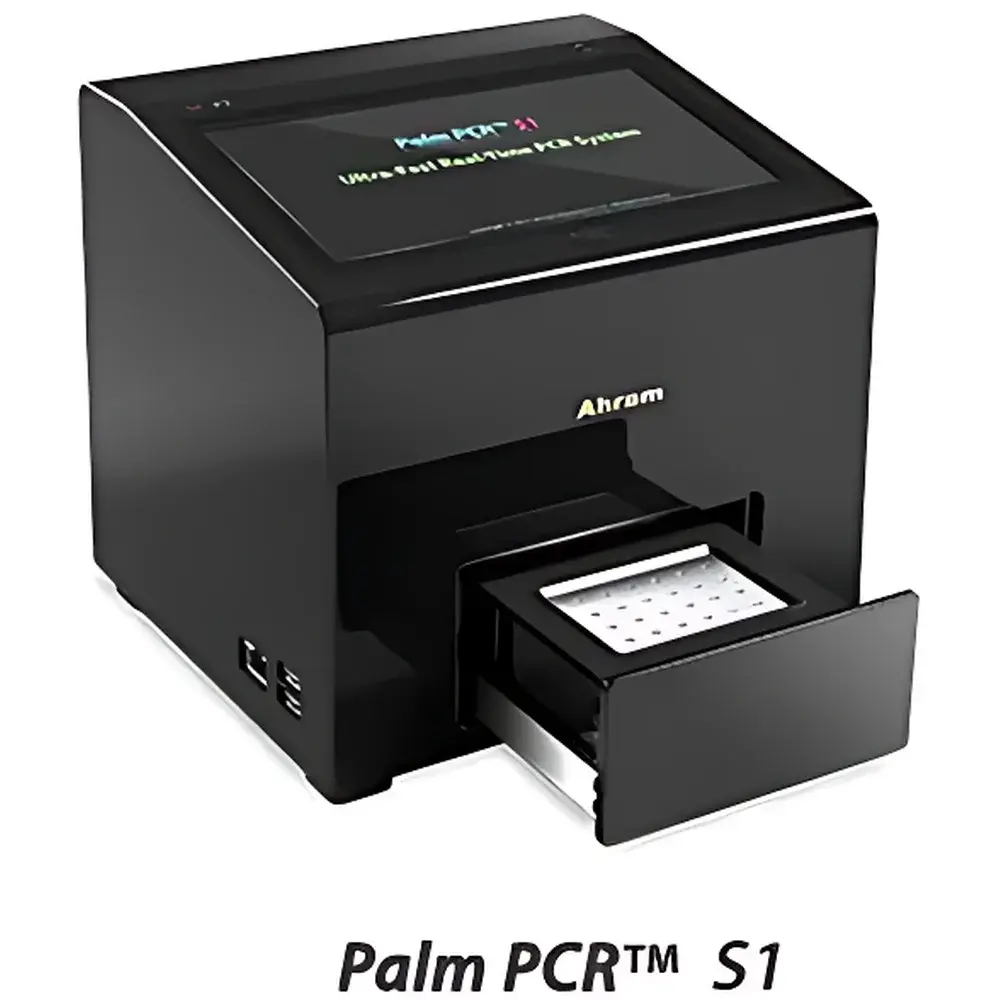
Ahram Palm q-PCR S1 / S1e Portable Real-Time Fluorescent Quantitative PCR System
| Brand | Ahram |
|---|---|
| Origin | South Korea |
| Model | S1 / S1e |
| Instrument Type | Real-Time Fluorescent Quantitative PCR System |
| Sample Throughput | 24-well |
| Heating Mechanism | Tri-zone semiconductor thermal blocks with micro-tube angular oscillation |
| Cycle Time | ≤10 min for 30 cycles |
| Power Options | Rechargeable Li-ion battery (≥4 h continuous operation) or AC adapter |
| Dimensions (W×D×H) | 19.5 × 17.7 × 17.9 cm |
| Weight | 3.0 kg (3.8 kg with battery) |
| Detection Channels | 3 / 5 / 6 multiplex fluorescent channels |
| Connectivity | LAN, Wi-Fi, Bluetooth, USB, optional GPS |
| Control Interface | Integrated capacitive touchscreen OS |
| Compliance | Designed to support GLP/GMP-aligned workflows |
Overview
The Ahram Palm q-PCR S1 and S1e are compact, field-deployable real-time fluorescent quantitative PCR systems engineered for rapid nucleic acid amplification and detection under resource-limited or mobile laboratory conditions. Unlike conventional qPCR instruments relying on single-block thermal cycling with sequential heating and cooling phases, the Palm q-PCR employs a proprietary tri-zone semiconductor thermal architecture—comprising three independently controlled heating elements corresponding precisely to denaturation, annealing, and extension temperatures. Coupled with dynamic angular oscillation of micro-reaction tubes, this design induces convective fluid circulation within each well, enabling highly efficient heat transfer and eliminating thermal inertia delays. As a result, full 30-cycle amplification—including fluorescence acquisition at each cycle—is completed in ≤10 minutes with high inter-run reproducibility (CV < 2.5% for Cq values across technical replicates). The system operates without external computing hardware, featuring an embedded Linux-based touchscreen interface optimized for intuitive assay setup, real-time amplification curve visualization, and endpoint quantification using standard curve or ΔΔCt methods.
Key Features
- Ultra-rapid thermal cycling: Achieves ≤10-minute 30-cycle protocols via synchronized tri-zone semiconductor control and microfluidic tube motion
- True portability: Weighing only 3.0 kg (3.8 kg with integrated Li-ion battery), fully operational on battery power for ≥4 hours—ideal for biosurveillance, border inspection, and emergency response
- Multiplex detection capability: Configurable 3-, 5-, or 6-channel optical modules supporting common dyes (FAM, HEX, ROX, Cy5, etc.) with spectral crosstalk compensation
- Self-contained operation: On-device touchscreen OS enables protocol programming, real-time monitoring, baseline adjustment, and melt-curve analysis without PC dependency
- Robust connectivity suite: Dual-band Wi-Fi, Bluetooth 5.0, Gigabit Ethernet, USB 3.0 host/device mode, and optional GPS module for geotagged assay metadata
- Modular consumables compatibility: Designed exclusively for 24-well microfluidic reaction cartridges with pre-aliquoted master mix options (sold separately)
Sample Compatibility & Compliance
The Palm q-PCR accepts standard 24-well PCR plates and proprietary microfluidic cartridges compatible with lyophilized or liquid-format master mixes. It supports DNA, cDNA, and RNA targets following appropriate reverse transcription steps. All thermal profiles adhere to ISO/IEC 17025–recommended temperature uniformity standards across the 24-well array (±0.3°C at setpoints). The instrument’s firmware architecture is designed to meet regulatory expectations for data integrity: timestamped run logs, user-authenticated access control, electronic signatures, and immutable audit trails align with FDA 21 CFR Part 11 requirements when deployed with validated software versions. Routine calibration verification follows ASTM E2853–22 guidelines for thermal performance validation in portable nucleic acid amplification devices.
Software & Data Management
The embedded operating system provides native support for MIQE-compliant experimental annotation, including sample ID, operator, extraction method, and inhibition controls. Raw fluorescence data (.rdml format) and processed results (.csv, .pdf) export directly via any enabled interface. Optional cloud synchronization (via secure TLS 1.3–encrypted Wi-Fi) enables centralized database ingestion for epidemiological tracking or multi-site surveillance networks. Local storage retains ≥1,000 complete run records with full amplification curves and melt profiles. Software updates are delivered over-the-air (OTA) with cryptographic signature verification to ensure firmware integrity.
Applications
- Point-of-need pathogen detection: Rapid identification of viral (e.g., SARS-CoV-2, influenza A/B), bacterial (e.g., Salmonella, Listeria), and fungal targets in clinical, veterinary, or environmental samples
- Food safety monitoring: On-site screening for GMO markers, allergen residues, and spoilage organisms at processing facilities or customs checkpoints
- Forensic genotyping: STR and SNP profiling from low-input biological evidence in mobile crime labs
- Biosecurity and defense: Field-deployable detection of select agents per CDC/USDA APHIS Tier 1 pathogen lists
- Agricultural diagnostics: High-throughput varietal authentication and transgenic trait verification in breeding programs
- Educational use: Hands-on molecular biology instruction in undergraduate and graduate laboratories where space and infrastructure are constrained
FAQ
What sample formats are supported by the Palm q-PCR?
The system is optimized for 24-well microfluidic cartridges and standard skirted 24-well PCR plates. Tube-based formats require compatible adapters (sold separately).
Is the instrument compatible with third-party master mixes?
Yes—provided they are validated for fast-cycling conditions and compatible with the specified excitation/emission spectra of the installed optical module.
How is temperature uniformity verified across the block?
Each unit undergoes factory calibration using NIST-traceable thermocouples at nine spatial points across the 24-well footprint, with reports available upon request.
Can the device be used in regulated GxP environments?
When operated with validated software version 2.4+, it supports 21 CFR Part 11 compliance features including role-based access, electronic signatures, and tamper-evident audit logs.
What maintenance is required?
No routine mechanical servicing is needed. Optical calibration is recommended annually using Ahram-certified reference dyes; thermal block cleaning is performed with isopropyl alcohol wipes between runs.