
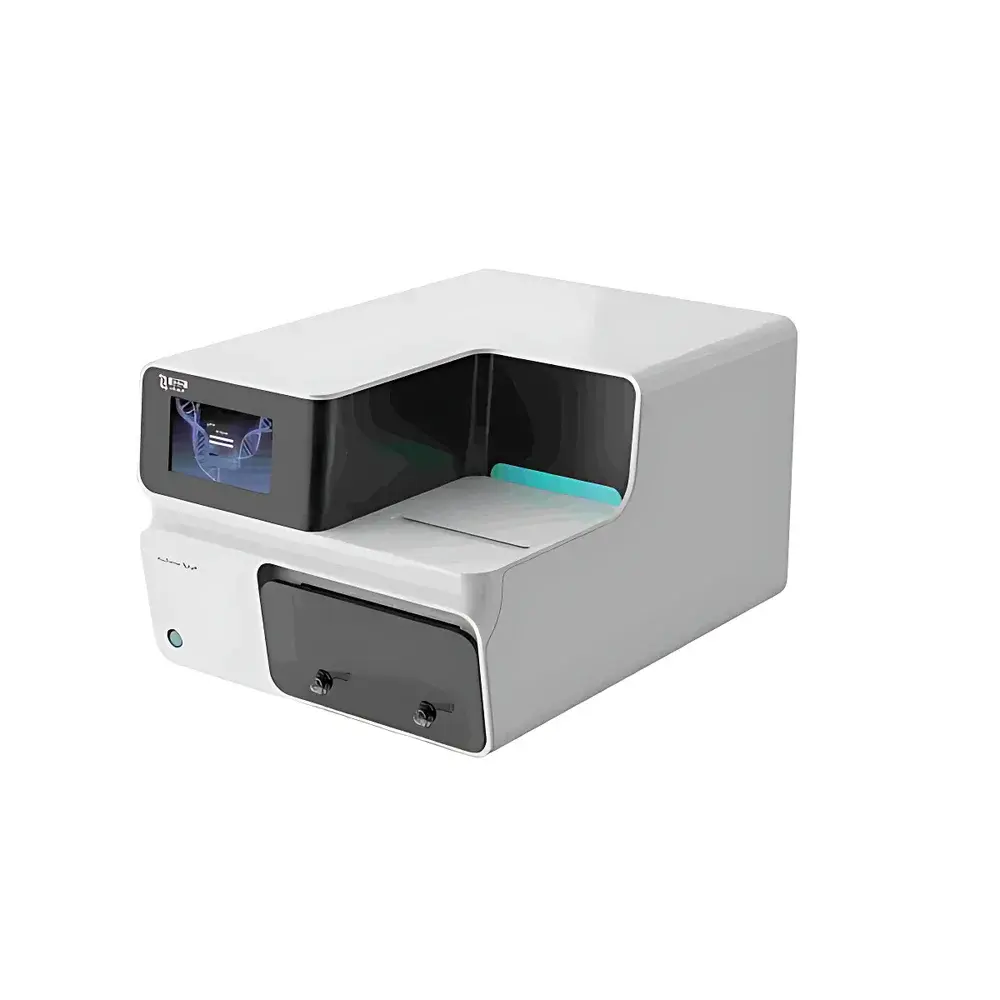
EoSonic FRAG96 Non-Contact Focused Ultrasonic Sonicator
| Brand | LIVOBOT |
|---|---|
| Model | EoSonic FRAG96 |
| Technology | Adaptive Cylindrical Ultrasonic (ACU) Focusing |
| Sample Format | 1–96 samples per run |
| Compatible Vessels | Standard 96-well PCR plates, 8-strip tubes, and other open-format consumables |
| Applications | DNA/RNA shearing, chromatin fragmentation, cell lysis, tissue homogenization, protein extraction, enzymatic digestion enhancement |
| Regulatory Context | Designed for GLP-compliant laboratories |
| Noise Level | <65 dB(A) at 1 m |
| Duty Cycle | Continuous operation with thermal management system |
| Origin | Beijing, China |
| Distribution Type | Authorized distributor |
Overview
The EoSonic FRAG96 is a non-contact, high-precision focused ultrasonic sonicator engineered for reproducible nucleic acid fragmentation and broad-spectrum sample preparation in life science laboratories. Unlike enzymatic or mechanical shearing methods, the FRAG96 employs Adaptive Cylindrical Ultrasonic (ACU) technology—a proprietary acoustic focusing architecture that delivers tightly controlled, spatially confined ultrasonic energy directly into sample wells without physical probe contact. This eliminates cross-contamination risk, probe wear, and thermal variability associated with immersion-based sonication. The system operates on the principle of cavitation-induced hydrodynamic shear: high-frequency acoustic waves (typically 400–700 kHz) generate transient microbubbles within the liquid phase; their asymmetric collapse produces localized fluid jets and shear stresses sufficient to fragment genomic DNA, chromatin, RNA, or disrupt cellular membranes—without sequence bias or chemical modification. As a result, the FRAG96 consistently yields narrow fragment size distributions (e.g., 200–600 bp for gDNA), making it suitable for next-generation sequencing (NGS), ChIP-seq, ATAC-seq, and RNA-seq library preparation workflows where fragment uniformity and reproducibility are critical.
Key Features
- Non-contact ACU focusing: Eliminates probe-to-sample contact, enabling true walk-away operation and eliminating contamination between runs.
- 96-well parallel processing: Supports full-plate, half-plate, or single-well configurations with identical acoustic coupling efficiency—no edge effect or well-to-well variability.
- Open-consumable compatibility: Works natively with standard polypropylene 96-well PCR plates and 8-strip tubes; no proprietary cartridges required.
- Acoustic parameter tuning: Independent control of amplitude (10–100%), duration (0.1–999 s), and cycle count enables precise targeting of fragment length distributions across diverse sample types.
- Low-noise, high-duty-cycle design: Engineered with active cooling and vibration-damped chassis; operates continuously at <65 dB(A) at 1 m distance.
- Integrated thermal monitoring: Real-time plate temperature feedback prevents sample denaturation during extended protocols.
Sample Compatibility & Compliance
The FRAG96 demonstrates robust performance across biologically challenging matrices—including primary neurons, FFPE tissue sections, macrophages, adipose tissue, and fibrous plant material—where conventional sonicators often underperform due to impedance mismatch or inefficient energy transfer. Its non-contact geometry ensures uniform energy delivery regardless of sample viscosity or particulate load. From a regulatory standpoint, the instrument supports Good Laboratory Practice (GLP) and Good Manufacturing Practice (GMP) environments: user authentication, protocol versioning, electronic signatures, and tamper-evident audit logs comply with FDA 21 CFR Part 11 requirements. All firmware and method files are digitally signed and timestamped. The system is compatible with ISO/IEC 17025-accredited validation frameworks and meets essential safety requirements per IEC 61010-1 for laboratory equipment.
Software & Data Management
The FRAG96 is operated via EoControl™ v3.x software—a Windows-based application supporting both local and networked deployment. The interface provides graphical protocol builder, real-time acoustic power monitoring, and automated calibration verification. All run parameters—including amplitude, duration, cycles, ambient temperature, and plate ID—are logged in structured CSV and XML formats compliant with LIMS integration standards (e.g., ASTM E1578, HL7). Raw acoustic waveform data (optional) can be exported for metrological traceability. Software updates are delivered through secure, authenticated channels and require dual-factor authorization for installation in regulated settings.
Applications
- Genomic DNA fragmentation for whole-genome sequencing, exome capture, and structural variant analysis.
- Chromatin shearing for ChIP-qPCR and ChIP-seq assays—preserving epitope integrity and histone modifications.
- RNA fragmentation prior to cDNA synthesis in stranded RNA-seq workflows.
- Cell lysis and nuclear extraction from suspension and adherent cultures without detergents.
- Tissue homogenization for proteomics, metabolomics, and multi-omics sample prep.
- Enhancement of protease digestion kinetics in bottom-up proteomics by increasing substrate accessibility.
FAQ
Does the FRAG96 require specialized consumables?
No—the system is designed for universal compatibility with commercially available 96-well PCR plates and strip tubes made from optical-grade polypropylene.
Can it process FFPE-derived DNA effectively?
Yes; optimized low-frequency acoustic modes and extended dwell times enable efficient fragmentation of crosslinked, fragmented DNA from deparaffinized FFPE sections.
Is method transfer between instruments supported?
Yes; all acoustic parameters are hardware-calibrated and traceable to NIST-traceable reference standards, ensuring inter-instrument reproducibility across labs.
How is thermal drift managed during long runs?
An integrated Peltier-cooled base plate maintains plate temperature within ±0.5°C of setpoint throughout multi-hour protocols.
What validation documentation is provided?
Each unit ships with Factory Acceptance Test (FAT) report, acoustic output calibration certificate, and IQ/OQ templates aligned with ISO 13485 and GAMP 5 guidelines.




