
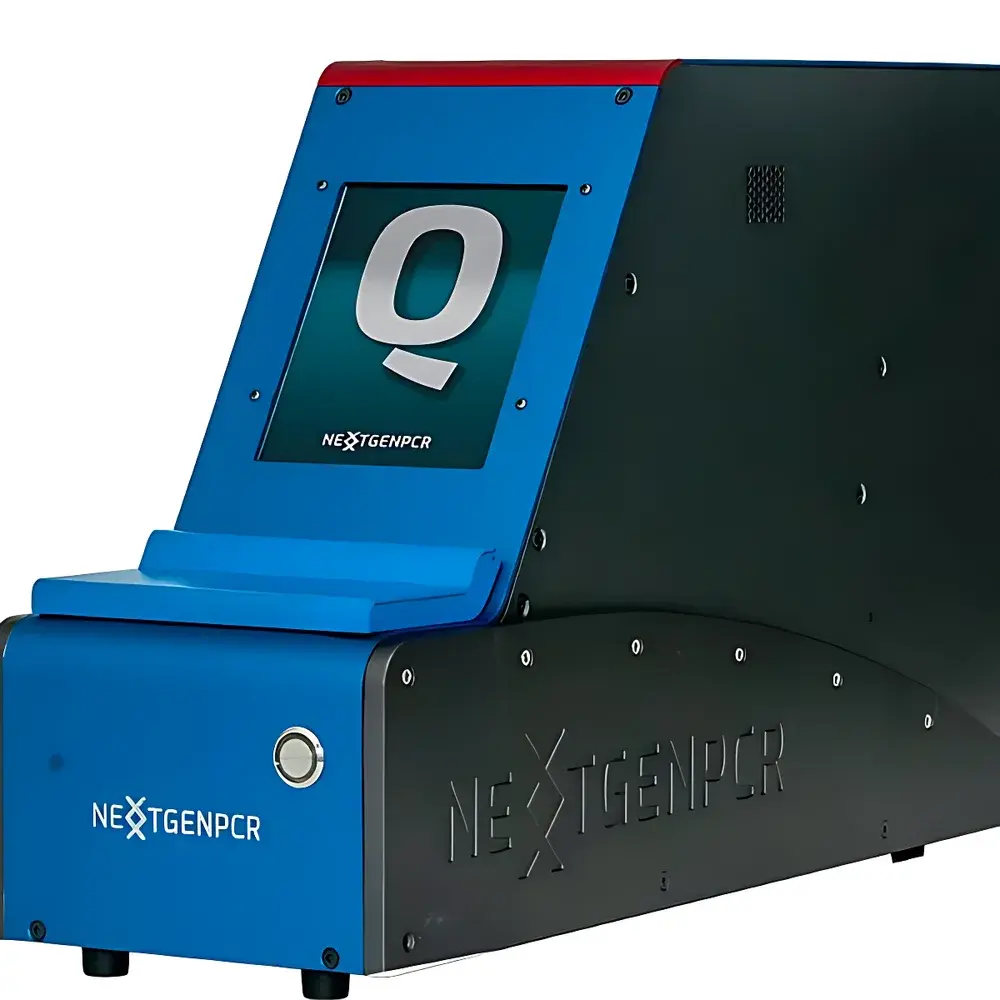
MBS cyQlone™ Ultra-Fast Real-Time qPCR System
| Brand | MBS |
|---|---|
| Origin | Netherlands |
| Model | cyQlone™ |
| Instrument Type | Ultra-Fast Real-Time PCR System |
| Sample Throughput | 6-Channel Detection |
| Power Supply | 80–240 V, 50/60 Hz |
| Max Power | 800 W |
| Avg Power | 150 W |
| Dimensions (W×L×H) | 197 × 580 × 375 mm |
| Weight | 22 kg |
| Display | LCD |
| Detection Method | Integrated Fiber-Optic Fluorescence Detection |
| Compatible Plate Format | NextGenPCR™ Polypropylene Microplates |
| Fluorophore Channels | FAM, ROX, Cy5, ATTO425, TET, Cy7 |
| Cycle Detection Time per Channel | ≤20 ms |
| Full 96-Well Run Time | ≤9 min |
Overview
The MBS cyQlone™ Ultra-Fast Real-Time qPCR System is a high-performance, fiber-optic–based quantitative polymerase chain reaction platform engineered for speed, precision, and reproducibility in nucleic acid quantification. Unlike conventional qPCR instruments relying on filter-based or LED-driven excitation with mechanical stage movement, the cyQlone™ employs a stationary, multi-channel fiber-optic detection architecture that eliminates thermal ramping delays and optical repositioning latency. This design enables true real-time acquisition at sub-second temporal resolution across all six fluorescence channels during every thermal cycle—supporting kinetic profiling of amplification without compromising data fidelity. As part of the NextGenPCR™ product family, the system is optimized for rapid thermal cycling (≤9 minutes for full 96-well SBS-format plates), making it suitable for time-sensitive applications including point-of-need diagnostics development, high-throughput assay validation, and dynamic gene expression studies requiring rapid turnaround.
Key Features
- Ultra-fast thermal cycling: Achieves complete 40-cycle qPCR runs on 96-well plates in ≤9 minutes, enabled by proprietary Peltier-based heating/cooling modules with adaptive thermal control algorithms.
- Six-channel parallel fluorescence detection: Simultaneous acquisition across FAM, ROX, Cy5, ATTO425, TET, and Cy7 emission bands using calibrated fiber-optic pathways—no moving parts, no filter wheels, no signal crosstalk calibration drift.
- Sub-millisecond per-cycle detection: Each channel captures fluorescence intensity in ≤20 ms per cycle, ensuring full kinetic resolution even during rapid early-cycle amplification phases.
- Compact benchtop footprint: Measures only 197 mm wide, minimizing spatial demand in regulated laboratory environments while maintaining full SBS-compliant plate handling.
- Thermally stable optical path: All optical components are housed within a temperature-controlled enclosure to eliminate ambient-induced photometric variance—critical for longitudinal inter-run comparability.
- Full chemistry compatibility: Supports hydrolysis probe (TaqMan®), hybridization probe, molecular beacon, and intercalating dye (e.g., SYBR® Green I) chemistries without hardware modification.
Sample Compatibility & Compliance
The cyQlone™ is validated for use with standard 96-well SBS-format polypropylene microplates conforming to ANSI/SLAS standards. Its thermal block geometry and optical alignment are specifically tuned for NextGenPCR™-branded plates, though third-party plates meeting dimensional and optical transmission specifications (350–750 nm, ≥85% transmittance) may be used under user-defined validation protocols. The system complies with IEC 61010-1 (Safety Requirements for Electrical Equipment for Measurement, Control, and Laboratory Use) and meets electromagnetic compatibility requirements per EN 61326-1. While not pre-certified for clinical diagnostics under FDA 21 CFR Part 820 or ISO 13485, the instrument supports GLP/GMP-aligned workflows through audit-trail–enabled software logging (see Software & Data Management section) and is routinely deployed in research-use-only (RUO) and IVD-development settings compliant with ISO 15189 and CLIA guidelines.
Software & Data Management
The cyQlone™ operates via the NextGenPCR™ Analysis Suite—a Windows-based application supporting method setup, real-time monitoring, endpoint analysis, and MIQE-compliant reporting. Raw fluorescence time-series data are stored in vendor-neutral HDF5 format with embedded metadata (thermal profile, optical gain settings, plate map, user annotations). The software enforces role-based access control, provides electronic signature support per FDA 21 CFR Part 11 (when deployed with validated IT infrastructure), and generates automated QC reports including inter-run CV%, baseline stability metrics, and amplification efficiency histograms. Data export options include CSV, Excel (.xlsx), and RDML v1.2 for cross-platform interoperability with third-party bioinformatics pipelines.
Applications
- Rapid pathogen detection assay development (e.g., viral load quantification in respiratory panels)
- High-frequency gene expression time-course experiments (e.g., circadian rhythm, drug response kinetics)
- Quality control of CRISPR editing efficiency via digital droplet–informed endpoint dilution assays
- Validation of NGS library quantification methods against orthogonal qPCR standards
- Teaching laboratories requiring robust, low-maintenance instrumentation with minimal training overhead
- Field-deployable R&D platforms where power efficiency (<150 W avg.) and thermal inertia reduction are operationally critical
FAQ
Does the cyQlone™ require proprietary consumables to achieve its published run times?
Yes—the ≤9-minute runtime specification assumes use of NextGenPCR™-formulated rapid-cycle master mixes, which feature engineered polymerases and optimized buffer kinetics. Standard commercial master mixes may extend run time by 15–30% depending on amplicon length and GC content.
Can the system perform melt curve analysis?
Yes—post-amplification high-resolution melt (HRM) profiling is supported across all six channels with 0.02°C temperature increment resolution and continuous fluorescence sampling at 10 Hz.
Is remote monitoring or network integration supported?
The instrument includes Ethernet and USB-C connectivity; remote status polling and file transfer are enabled via RESTful API endpoints documented in the Developer Integration Guide (provided under NDA).
What maintenance is required for long-term optical performance?
The fiber-optic detection module is sealed and requires no user-serviceable alignment; annual verification of LED output intensity and detector linearity is recommended using the included NIST-traceable calibration standard kit.
How is data integrity ensured during power interruption?
The system features non-volatile memory buffering: all active run data up to the last completed cycle is preserved and recoverable upon restart, provided the interruption duration is <120 seconds.
Related Products




